
How Does a HELOC Work? Draw Period & Repayment Guide
Last Checked and Updated on September, 2026
Being a term hard to understand, people often don't know how a HELOC actually works. If you're curious about home equity lines of credit, this guide walks you through the draw period, the repayment period, real payment examples, and a few things most articles skip over — like whether the interest is tax-deductible and what happens if you change your mind after closing. Grab a coffee and scroll down; by the end you'll know more about HELOCs than most people shopping for one.
Quick summary: A HELOC is a revolving line of credit secured by your home. You draw what you need during a set period (usually 10 years), pay interest only on what you've borrowed, then repay the balance over the following 10–20 years. National average rates sit around 7.1%–7.5% as of September 2026, well below where they were a year earlier.
What Is a HELOC Loan?
Before going further, it helps to understand what a HELOC is at its core. A Home Equity Line of Credit (HELOC) is a revolving line of credit secured by the equity you've built in your home.
Unlike a one-time home equity loan, a HELOC lets you draw, repay, and redraw funds up to an approved limit during the draw period, similar to how a credit card works — except your house backs it instead of your credit history alone. Interest is only charged on the balance you've actually pulled out, not on your full credit line.
HELOC rates are typically variable, usually expressed as prime plus a margin, though many lenders let you lock part or all of a balance into a fixed rate. The U.S. Prime Rate has held steady at 6.75% since December 2025, and the national average HELOC rate was 7.11% as of September 16, 2026, according to Bankrate — down roughly a full point from where rates stood a year earlier.
Also Read: HELOC vs Bridge Loan: What are the Differences? Full Guide
Key Features of a Home Equity Line of Credit
-
Revolving credit line: Repaid amounts can generally be borrowed again during the draw period, much like a credit card that refills itself.
-
Interest charged on outstanding balance only: Your monthly interest applies only to what you've actually drawn, not your entire approved limit.
-
Rate structure: Most HELOCs float with prime plus a margin (currently prime sits at 6.75%). Many lenders also offer a fixed-rate conversion option for part or all of the balance.
-
Access and use: You typically withdraw funds through checks, an online transfer, or a linked access card.
-
Typical limits: Limits vary widely by lender and borrower profile. Combined loan-to-value (CLTV) and your credit profile are the biggest drivers of how much you can borrow.
How Does a Home Equity Line of Credit Work?
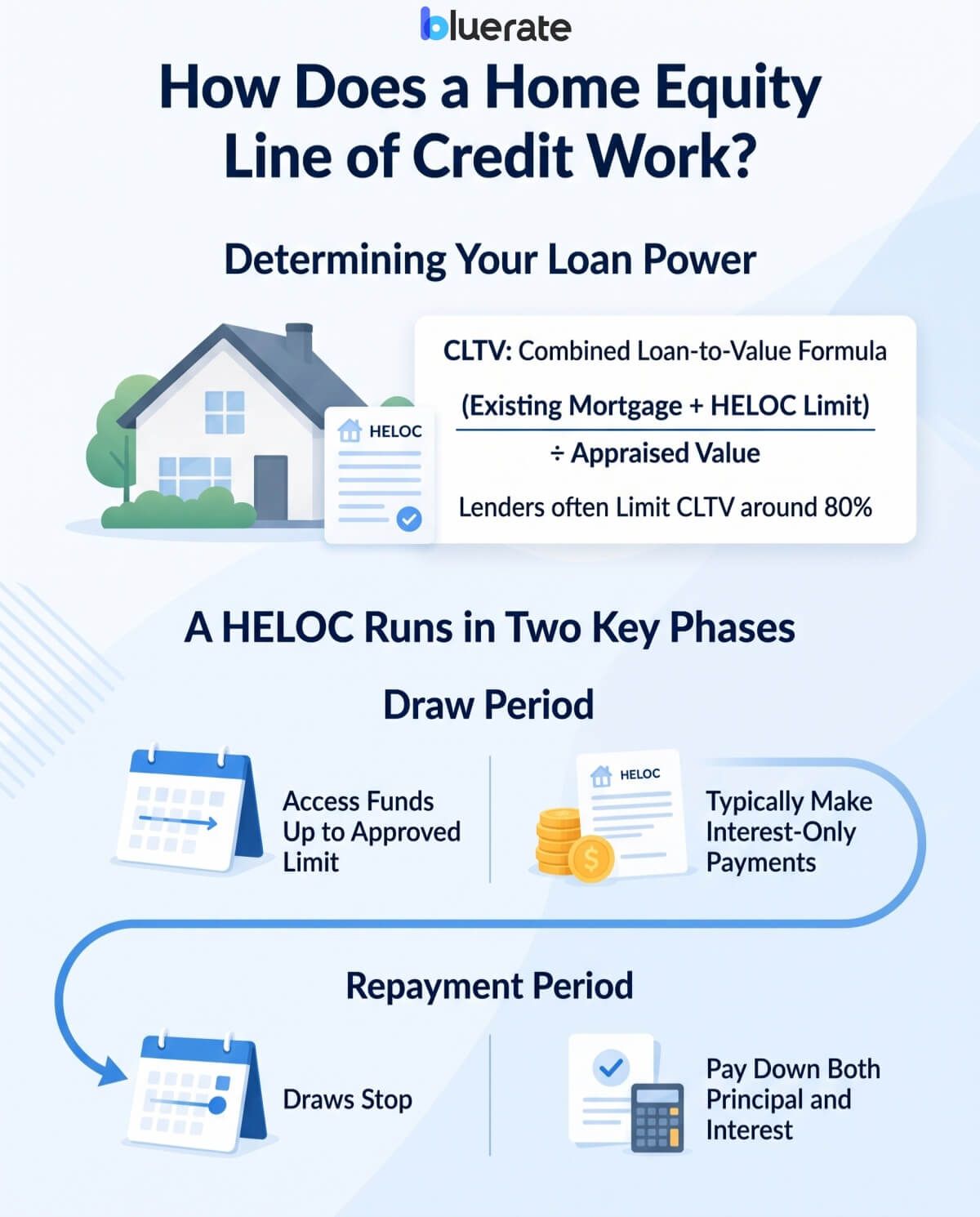
A HELOC runs in two phases. During the draw period, you can pull funds up to your approved limit and usually make interest-only payments. Once that ends, you enter the repayment period, where draws stop and you pay down both principal and interest.
Lenders underwrite HELOCs based on your property value, existing mortgage balance, credit history, income, and debt-to-income ratio (DTI). The math behind how much you can borrow comes down to combined loan-to-value, or CLTV:
CLTV = (existing mortgage balances + HELOC credit limit) ÷ appraised value
Most lenders cap CLTV around 80%, though some stretch to 85% for well-qualified borrowers. If your CLTV comes in higher than a lender's cap, you'll likely need to either borrow less or improve your equity position first.
How Does the HELOC Draw Period Work?
Ten years is the most common draw period length, though some lenders offer terms as short as 5 years or as long as 15. During this stretch, you can withdraw, repay, and re-borrow against your line as often as you need to.
Minimum monthly payments are often interest-only, but that varies by lender — some build in a small required principal payment, or a percentage-of-balance floor instead of pure interest.
One detail a lot of first-time borrowers miss: some lenders require an initial draw right at closing rather than letting you open the line and leave it untouched. Requirements swing widely — a handful of lenders don't require any initial draw at all, while others ask for a flat minimum (often somewhere between $10,000 and $50,000) or a percentage of your total line, which can run anywhere from 50% up to 85–90% depending on the product. This is exactly the kind of fine print that gets buried in a disclosure packet, so it's worth asking your loan officer directly before you sign.
How Does HELOC Repayment Work?
Once the draw period ends, the loan typically shifts into a repayment phase lasting 10 to 20 years, during which you owe both principal and interest every month. Put the two phases together and a HELOC's full lifespan usually runs 20 to 30 years from open to payoff.
Monthly payments often jump noticeably once repayment begins, since you're no longer paying interest-only. Lenders sometimes call this "payment shock," and it's the single biggest surprise borrowers report once the draw period closes. Some lenders soften the transition by allowing partial fixed-rate conversions or alternative amortization schedules.
Variable Interest Rate vs. Fixed Interest Rate
What's the real difference between a variable-rate HELOC and a fixed-rate one? Here's the short version.
-
Variable-rate HELOCs: Rates move with a benchmark like prime, so your payment can rise or fall over time. They usually start lower than fixed alternatives but come with more payment uncertainty.
-
Fixed-rate options: Many lenders let you convert some or all of your balance into a fixed-rate installment loan, trading a bit of rate flexibility for predictable payments. Availability, fees, and terms differ from lender to lender.
Fixed Interest Option
A fixed-rate conversion locks part of your outstanding balance into a set rate, either during the draw period or later on, depending on your lender's rules. Before converting, check your disclosures for conversion fees, minimum or maximum conversion amounts, and whether the switch triggers new underwriting.
Key HELOC Terms and Conditions at a Glance
HELOC paperwork is dense, and it's easy to lose track of what each term actually means once you're staring at a 40-page disclosure. Here's a quick reference for the terms that show up most often:
-
Draw Period: The window (commonly 10 years) when you can borrow, repay, and re-borrow against your line
-
Repayment Period: The following 10–20 years when draws stop and you pay principal plus interest
-
CLTV: Combined loan-to-value — all secured debt on the home divided by its appraised value
-
Margin: The percentage a lender adds on top of the index (usually prime) to set your rate
-
Index: The benchmark rate, most often the U.S. Prime Rate, that your margin gets added to
-
Rate Cap: The maximum interest rate your HELOC can reach, if your lender includes one
-
Minimum Draw: The smallest amount you're allowed to withdraw per transaction
-
Annual/Inactivity Fee: A fee some lenders charge if your line sits unused for a stretch, or simply for keeping it open
-
Early Closure Fee: A charge some lenders apply if you close the line within the first few years
HELOC Example for Dummies to Understand
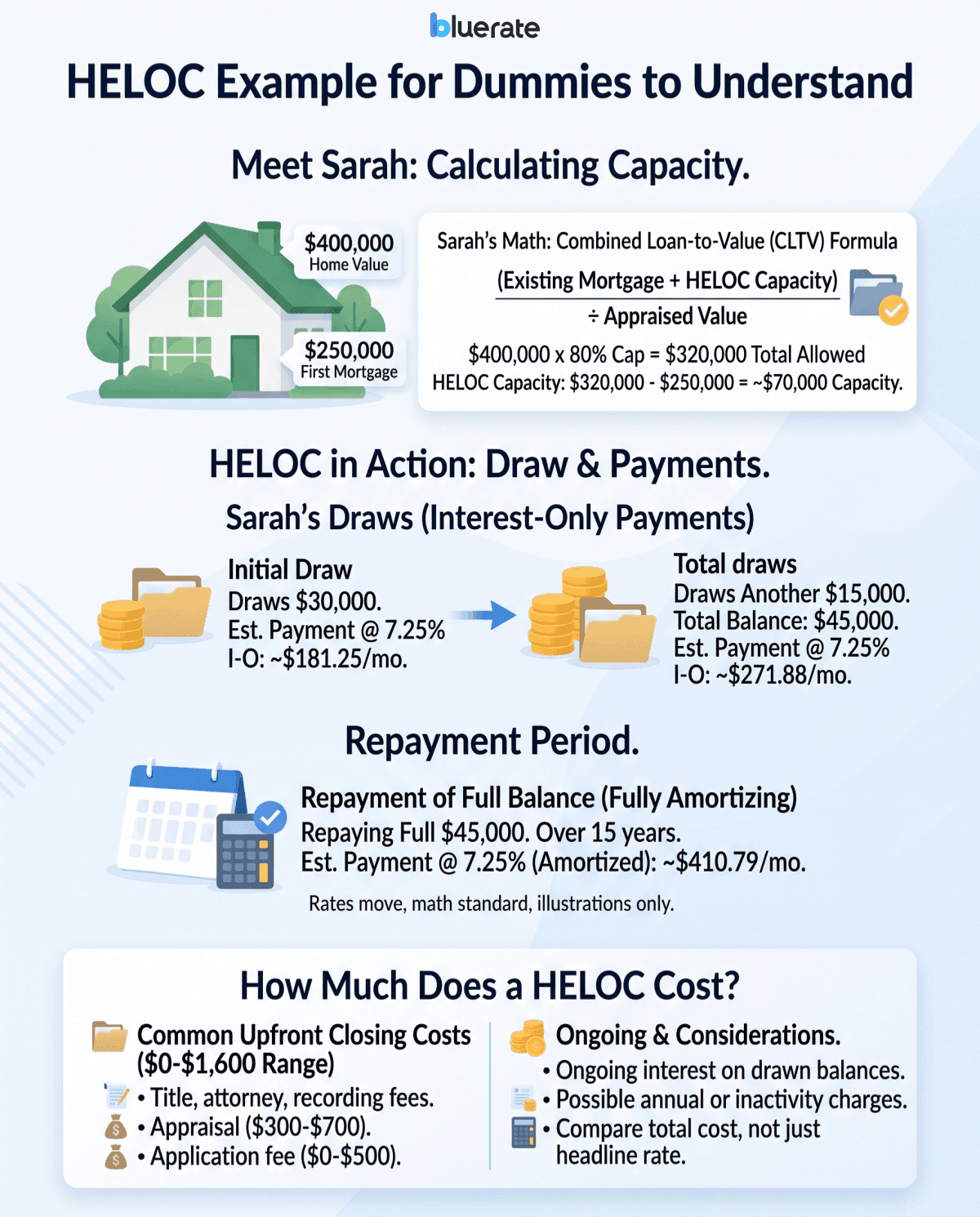
Sarah owns a home valued at $400,000 with a first mortgage balance of $250,000, leaving her with roughly $150,000 in equity. Her lender caps CLTV at 80%, so the total secured debt allowed is $400,000 × 80% = $320,000. Subtract her existing mortgage, and her theoretical HELOC capacity comes out to about $70,000, assuming she qualifies.
-
Sarah draws $30,000 at a rate of 7.25% and makes interest-only payments: $30,000 × 0.0725 ÷ 12 ≈ $181.25 a month.
-
A few months later, she draws another $15,000, bringing her outstanding balance to $45,000: $45,000 × 0.0725 ÷ 12 ≈ $271.88 a month.
-
Once the draw period ends and she starts repaying the full $45,000 over 15 years at 7.25%, her fully amortizing payment comes to roughly $410.79 a month.
Every lender rounds slightly differently and rates move, so treat these as illustrative rather than exact — but the math behind them is standard amortization, the same formula your lender's system runs behind the scenes.
How Much Does a HELOC Cost?
Costs break down into upfront fees and ongoing interest. Third-party closing costs typically range from $0 to roughly $1,600, depending on the lender and whether a promotional fee waiver applies. Common line items include an appraisal ($300–$700), an application fee ($0–$500), and title, attorney, or recording fees, plus possible annual or inactivity charges down the road.
"No closing cost" HELOCs exist, but the savings often get baked back in through a slightly higher rate or other fees. It's worth comparing total cost — fees plus expected interest over the time you plan to keep the line open — rather than just the headline rate.
Is HELOC Interest Tax-Deductible?
This is one of the most commonly misunderstood parts of a HELOC, and it's worth getting right before you assume the interest will shrink your tax bill. Under current federal rules, HELOC interest is deductible only when the funds go toward buying, building, or substantially improving the home that secures the loan, according to IRS Publication 936. The One Big Beautiful Bill Act made this use-of-proceeds requirement permanent starting in 2026, so it isn't going away anytime soon.
Practically speaking, that means a HELOC used to remodel a kitchen or add a bedroom can qualify for a deduction, subject to a combined mortgage debt limit of $750,000 for loans taken out after December 15, 2017. Use the same HELOC to consolidate credit card debt or cover a tuition bill, and the interest on that portion generally isn't deductible — regardless of how the loan itself is labeled.
You'll also need to itemize deductions on Schedule A to benefit at all, which fewer filers do now that the standard deduction is higher. If a big chunk of your reason for choosing a HELOC is the tax angle, it's worth running the numbers with a tax professional before you commit, since the rules hinge entirely on how the money gets spent.
Can You Cancel a HELOC After Closing?
Yes — and this is a protection a lot of borrowers don't realize they have. Federal law under the Truth in Lending Act gives you a three-business-day right of rescission on a HELOC secured by your primary residence, according to the Consumer Financial Protection Bureau. Saturdays count toward those three days; Sundays and federal holidays don't.
The clock doesn't start until you've signed your credit contract, received your Truth-in-Lending disclosure, and received two copies of the notice explaining your cancellation right. If you decide to back out, you have to notify your lender in writing — a phone call or a visit to the branch won't count — and the lender then has 20 calendar days to return any fees you've paid.
This detail matters for a question a lot of people ask without realizing it's connected: how long does it actually take before HELOC funds are usable? Even after your closing appointment, funds typically aren't released until the three-day rescission window has passed, so plan your project timeline around that extra buffer rather than the closing date alone.
How to Apply for a HELOC?
Here's the general process, start to finish. According to Bankrate, many HELOCs close within two to six weeks of application, though this varies by lender, property type, and how quickly you get documents in.
-
Shop lenders and compare APR, margin, fixed-rate conversion options, CLTV limits, and fees side by side.
-
Gather your documents — pay stubs, W-2s or tax returns, mortgage statements, property tax records, and proof of insurance.
-
Apply online or in person. Your lender will typically order an appraisal (or use an automated valuation model), pull credit, verify income, and underwrite the file.
-
Close, sign your disclosures, and — for owner-occupied homes — wait out the three-day rescission window before funds become available.
If you'd rather skip the guesswork of comparing lenders on your own, Bluerate's AI Agent can walk you through a few quick questions about your property, income, and goals, then match you with loan officers experienced in HELOCs near you — at no cost to you.
HELOC Eligibility Requirements
Before you apply, it's worth checking where you stand against typical lender requirements.
-
Credit score: Some lenders accept scores in the low-to-mid 600s, with 620 often treated as a common minimum. The best rates, though, are usually reserved for borrowers scoring well above 700.
-
DTI: Lenders generally prefer a debt-to-income ratio at or below roughly 43%, though acceptable limits shift by lender and loan program.
-
CLTV and equity: Common caps land around 80–85%, depending on the product and lender.
-
Property type: Primary residences and many second homes qualify without issue. Investment properties, certain condos, and manufactured homes may face restrictions or different pricing.
How to Calculate Your HELOC Payment
You can estimate a monthly HELOC payment by hand, or just plug your numbers into an online HELOC payment calculator for an instant answer — our full step-by-step guide walks through both methods.
-
Interest-only (draw period): Monthly payment ≈ (outstanding balance × annual rate) ÷ 12. Example: $50,000 at 7.25% → $50,000 × 0.0725 ÷ 12 ≈ $302.08 a month.
-
Amortizing (repayment period): Uses the standard loan amortization formula based on your monthly rate and remaining term. Example: $50,000 at 7.25% over 15 years ≈ $456.49 a month.
Keep in mind these numbers shift with your rate. A variable-rate HELOC means your payment today isn't guaranteed to be your payment next year.
What Is the Monthly Payment on a $50,000 Home Equity Line of Credit?
Using this exact question as an example: at a 7.25% rate, an interest-only payment during the draw period runs about $302.08 a month. Once you move into repayment and amortize that same $50,000 over 15 years, expect roughly $456.49 a month. These figures are illustrative — your actual payment depends on your lender's specific terms and how the rate moves over time.
FAQs About HELOC
Q1. What are the disadvantages of a HELOC?
Variable rates mean payment uncertainty, and the shift from interest-only to full principal-and-interest payments can catch borrowers off guard. Because your home secures the loan, missed payments put you at risk of foreclosure. Lenders can also freeze or reduce your credit limit if home values drop or your credit profile weakens.
Q2. What is a better option than a HELOC?
It depends on what you need the money for.
-
Home equity loan (fixed-rate, lump sum): Works well for a one-time, known expense where you want predictable payments.
-
Cash-out refinance: Replaces your first mortgage while pulling out equity — can make sense if today's first-mortgage rates beat what you currently have.
-
Personal loans or credit cards: No home collateral required, but rates run higher. Better suited to smaller amounts you can pay off quickly.
Q3. Can I get a HELOC for any type of property?
Primary residences typically qualify without much friction, and second homes often do too, depending on lender policy. Investment properties, some condos or co-ops, and manufactured or mobile homes may come with added restrictions or different pricing — always confirm eligibility with your specific lender.
Q4. How much HELOC can I get?
Your credit limit comes down to CLTV, credit profile, income, and lender policy. Most lenders underwrite up to roughly 80–85% CLTV, so your available HELOC generally equals (allowed CLTV × appraised value) minus your existing mortgage balance. Limits commonly start around $10,000–$15,000 and climb much higher for well-qualified borrowers.
Q5. Can you sell your house if you have a HELOC?
Yes. A HELOC is a lien against your property, so it has to be paid off — or handled through subordination or assumption if agreed to at closing — before or at the time you sell. Title and closing agents coordinate the payoff so the buyer receives clear title.
Q6. Are there closing costs on a HELOC?
Usually, yes — appraisal, title, attorney, and recording fees are common. Some lenders waive these or advertise "no-closing-cost" HELOCs, which are often offset by a slightly higher rate. Compare the full cost of the loan, not just the closing fees, before deciding.
Q7. Does a HELOC have a balloon payment?
Not in the way most people picture a balloon payment. A standard HELOC fully amortizes during the repayment period — typically 10 to 20 years of regular principal-and-interest payments rather than one large lump sum due at the end. The "payment shock" borrowers describe when repayment begins is really the jump from interest-only to full payments, not a balloon. That said, loan structures vary, so it's worth confirming with your lender exactly how your specific HELOC repays before you sign.
Q8. Is HELOC interest simple or compound?
Most HELOC lenders calculate interest using simple interest on your outstanding daily balance — your daily rate multiplied by whatever you currently owe, added up over the billing cycle — rather than compounding interest on top of interest. That's good news if you're making extra payments, since paying down principal early reduces the balance interest accrues on right away. Some lenders do use compounding methods, though, so it's one more line worth checking in your disclosures.
Q9. How long does a HELOC actually last, start to finish?
Add the draw period and the repayment period together and you're typically looking at 20 to 30 years total — commonly a 10-year draw period followed by 10 to 20 years of repayment. Shorter and longer structures exist depending on the lender, so this is a good question to ask upfront rather than assume.
Looking for a loan officer who actually specializes in HELOCs? Chat with Bluerate's AI Agent to get matched with vetted, local loan officers based on your property and goals — it takes a few minutes and there's no obligation.
