

What Is a HELOC? Complete 2026 Guide for Homeowners
Last Checked and Updated on September, 2026
If you've ever searched Reddit at midnight trying to figure out how a HELOC actually works, you're not alone — it's one of the most common questions homeowners ask once they realize how much equity they're sitting on. A home equity line of credit (HELOC) can be a smart way to cover renovations, consolidate debt, or handle a big expense without touching your low first-mortgage rate. But it's not free money, and the terms trip up more people than you'd expect. This guide walks through what a HELOC is, how it works, what lenders look for, and the numbers you should know before applying.
Key takeaways:
-
A HELOC is a revolving credit line secured by your home, with a draw period (commonly 10 years) followed by a repayment period (commonly 10–20 years).
-
National average HELOC rates were running roughly 7.1%–7.5% as of September 2026, down from near 9% at the start of 2025.
-
Most draw-period payments are interest-only and don't reduce your balance — repayment-period payments are fully amortizing.
-
Under the 2025 tax law (OBBBA), the $750,000 mortgage-interest deduction cap is now permanent, and HELOC interest only qualifies if the funds go toward home improvements.
What Is a HELOC?
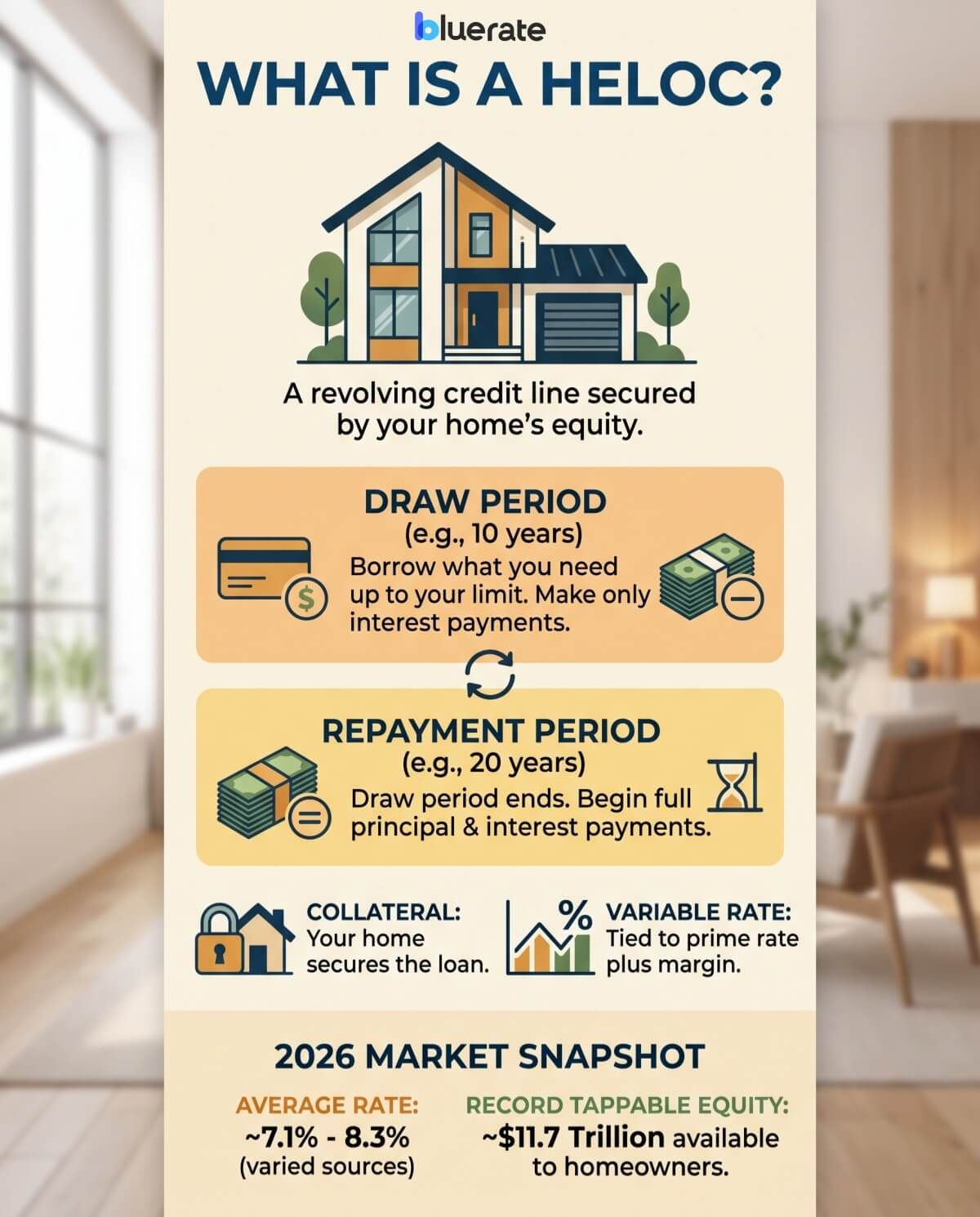
A home equity line of credit is a revolving credit line secured by the equity in your home. Unlike a traditional loan that hands you a lump sum upfront, a HELOC works more like a credit card: you're approved for a limit, you draw against it as needed, and you repay (or re-borrow) during a set draw period. Once that period ends, you move into a repayment phase where you pay down both principal and interest.
The Consumer Financial Protection Bureau, which requires lenders to hand borrowers a HELOC disclosure booklet before closing, describes it simply: it's a loan that lets you borrow, spend, and repay as you go, using your home as collateral. That's really the core of it.
Most HELOCs carry a variable rate tied to the prime rate plus a lender margin, so your payment can shift over time. As of mid-September 2026, Bankrate's weekly survey of major lenders put the national average around 7.1%–7.3%, while Curinos data (also cited by Experian and Yahoo Finance) showed a slightly different average closer to 7.2%–7.5%. LendingTree's borrower-offer data ran a bit higher, near 8.3% in August 2026. Those gaps come down to methodology — some track only large banks, others track actual borrower offers — so treat any single figure as a benchmark, not a quote, and pull live rates before comparing lenders.
Worth noting: homeowners are sitting on a record amount of equity right now. Tappable equity across U.S. mortgage holders hit roughly $11.7 trillion in the second quarter of 2026, according to ICE Mortgage Monitor data, which works out to about $212,000 per borrower on average. That's a big part of why HELOC interest has picked up this year.
What Can You Use a HELOC For?
Curious how a HELOC works in practice? Here's where borrowers typically put the money:
-
Home renovations and repairs — usually the most tax-advantaged use, since improvement-related interest may qualify for a deduction.
-
Debt consolidation, swapping high-rate credit card balances for a lower-rate line.
-
Major expenses like tuition, weddings, or unexpected medical bills.
-
Bridge funding to cover a down payment before selling your current home.
-
Business or investment purposes — though lenders sometimes restrict this, and it can affect how the interest is taxed, so confirm with your lender first.
How Does a HELOC Work?
Once approved, you access funds through checks, an online transfer, or sometimes a dedicated card — the exact method depends on your lender. Here's what shapes the line itself:
Credit limit. Lenders calculate your available line based on your home's appraised value minus what you still owe on your mortgage. Most allow a combined loan-to-value (CLTV) up to roughly 80%–90%, though this varies by lender and property type.
HELOC Draw Period
The draw period is the stretch of time you can actually pull money from the line — 10 years is the industry standard, though some lenders offer shorter (5-year) or longer terms. During this window, you can borrow, repay, and borrow again as needed. Most lenders only require interest-only payments here, which keeps monthly costs low but means your balance doesn't shrink unless you choose to pay down principal voluntarily.
HELOC Repayment Period
Once the draw period closes, you enter repayment — typically 10 to 20 years, depending on the lender. This is where the HELOC becomes fully amortizing: each payment now covers both principal and interest, so monthly costs can jump noticeably compared to the interest-only draw phase. A handful of lenders let you convert some or all of your balance to a fixed rate at this point, which can be worth asking about if you're worried about rate swings.
Add the two phases together and a HELOC can realistically run 20 to 30 years from open to payoff — longer than most people expect going in.
HELOC Terms at a Glance
-
Draw period: 5–10 years (10 is most common)
-
Repayment period: 10–20 years
-
CLTV limit: 80%–90%
-
Minimum credit score: 620–700+ (640+ for the best pricing)
-
Rate type: Variable, tied to prime + margin
-
Average rate (Sept. 2026): ~7.1%–7.5%
-
Typical minimum line: $10,000–$25,000
HELOC Requirements You Should Know
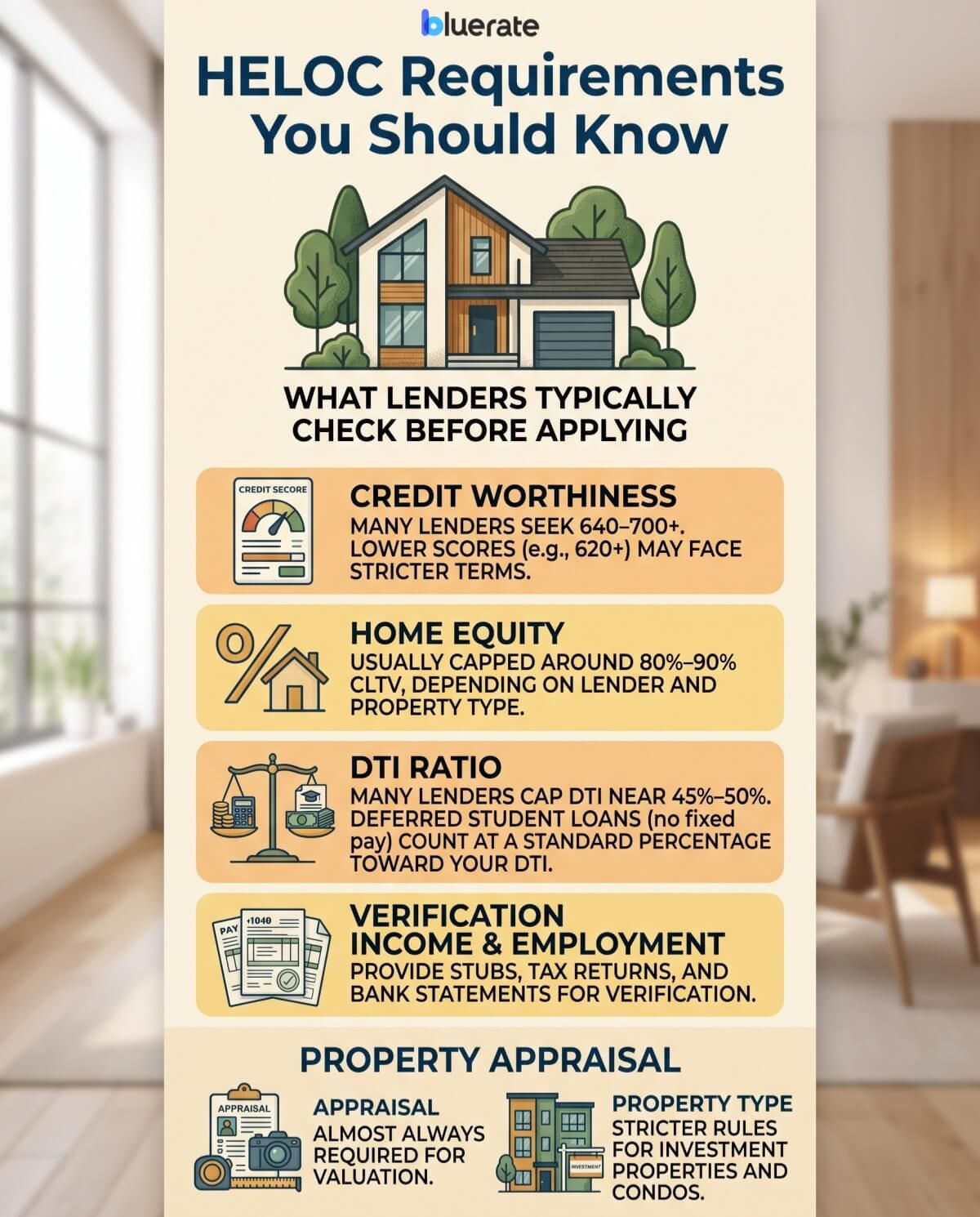
Before applying, here's what lenders typically check:
-
Credit score. Many lenders want 640–700+ for competitive pricing, though some approve down to around 620 with higher rates or stricter terms.
-
Equity and CLTV. Usually capped around 80%–90%, depending on the lender and property type.
-
Debt-to-income ratio (DTI). Guidelines vary, but many lenders cap DTI around 45%–50% under automated underwriting. If you have deferred student loans, agency guidance allows lenders to count 1% of the outstanding balance toward your DTI when no fixed payment is specified.
-
Income and employment verification. Expect to provide pay stubs, tax returns, and bank statements.
-
Appraisal. Almost always required. Investment properties and certain condo types often face stricter limits or lower CLTVs.
Pros and Cons of a HELOC
Pros
-
Flexible access — draw only what you need, when you need it.
-
Interest-only payments during the draw period keep initial costs manageable.
-
Generally cheaper than credit cards or unsecured personal loans.
-
Interest may be tax-deductible when funds go toward qualifying home improvements.
Cons
-
Variable rates mean your payment can rise if the index moves up.
-
Your home secures the debt — missed payments put it at risk.
-
Payments jump once you hit the repayment period and amortization kicks in.
-
Extra costs are possible: appraisal fees, closing costs, or inactivity fees, depending on the lender.
How to Get a HELOC?
-
Estimate your equity — current market value minus what you owe on your mortgage(s).
-
Shop multiple lenders. Rates, margins, fees, and draw/repayment lengths vary more than most borrowers realize. This is exactly the kind of comparison Bluerate was built for — it pulls personalized rate quotes from over 100 lenders and connects you directly with loan officers who specialize in HELOCs, rather than sending your information to a call center.
-
Gather your documents: pay stubs, tax returns, bank statements.
-
Apply and schedule an appraisal, which typically runs $300–$500.
-
Underwriting and closing. Bankrate's reporting puts the typical timeline at 30–45 days, though some online lenders close faster and complex files can take longer.
Is It Hard to Get a HELOC?
It depends heavily on your profile. Borrowers with solid credit (roughly 700+), steady income, and meaningful equity usually move through underwriting without much friction. Self-employed applicants or anyone with a recent credit event may face extra documentation requests. Condos, manufactured homes, and investment properties tend to draw closer scrutiny too, so budget extra time if any of those apply to you.
How HELOC Payments Actually Work?
A lot of borrowers assume every HELOC payment chips away at the balance the way a mortgage payment does — it doesn't, at least not at first. Here's the breakdown:
During the draw period, payments are usually interest-only, which means they're non-amortizing: you're not required to reduce principal. Formula: monthly interest ≈ (outstanding balance × APR) ÷ 12. So a $50,000 balance at 8% runs roughly $333/month.
Once repayment begins, the loan fully amortizes over the remaining term, and every payment includes both principal and interest.
Here's how that plays out in practice: say a homeowner opens a $100,000 line. In year two, they draw $30,000 for a kitchen remodel and pay interest-only on that balance — call it around $200/month at current rates. By year five, they've drawn another $20,000 to cover a medical bill, so their interest-only payment climbs accordingly. When the draw period ends in year ten, whatever balance remains converts into a fully amortizing repayment schedule — often stretched over 15 years — and the monthly payment increases to include principal. That jump is the part people are least prepared for, so it's worth running the HELOC payment calculator or reading through how to calculate a HELOC payment before you commit to a draw schedule.
HELOC vs. Home Equity Loan
Not sure which fits your situation better? Here's the short version — for the full comparison, see HELOC vs. Home Equity Loan.
-
HELOC: Revolving line, usually variable rate, draw-then-repay structure, flexible for ongoing or uncertain expenses.
-
Home equity loan: Lump sum, fixed rate, predictable payments from day one.
Also read: HELOC vs. Bridge Loan: What's the Difference?
If your expenses are spread out or uncertain — a multi-phase renovation, for example — a HELOC usually makes more sense. If you need one lump sum and want payment certainty, a home equity loan is often the simpler choice.
FAQs About Home Equity Lines of Credit
Q1. Is a HELOC a good idea?
It can be, particularly for value-adding home improvements or replacing higher-rate debt. Just remember your home is the collateral, so it's worth thinking through your repayment plan — and talking to a financial advisor if you're unsure — before signing.
Q2. Are HELOC payments amortized?
Not during the draw period — most lenders only require interest, so your balance stays flat unless you pay extra. Once repayment starts, the loan fully amortizes, meaning each payment includes both principal and interest until it's paid off.
Q3. Can you refinance a HELOC?
Yes. Common options include opening a new HELOC, converting the balance to a fixed-rate home equity loan, or doing a cash-out refinance on your first mortgage. Weigh the closing costs against how much the new rate or term actually saves you.
Q4. How long does getting a HELOC take?
Usually 30–45 days from application to closing, based on recent lender surveys. Some online lenders move faster; more complex financial profiles can take longer.
Q5. Is HELOC interest tax-deductible?
Only if the funds go toward buying, building, or substantially improving the home securing the loan — using it for tuition, debt consolidation, or a vacation doesn't qualify. Under the One Big Beautiful Bill Act (OBBBA), signed in 2025, the $750,000 combined mortgage-debt cap on this deduction (previously expected to expire after 2025) is now permanent. Talk to a tax professional for your specific situation, since IRS rules here have real edge cases.
Q6. Can you get a HELOC with bad credit?
It's harder but not impossible. Some lenders will work with scores in the 580–620 range if you have strong compensating factors, like significant equity or a low DTI — though expect a higher rate and stricter terms.
Q7. Can you use a HELOC for a down payment?
Often, yes — but most mortgage lenders want the HELOC to be seasoned (open for several months) and will factor the payment into your DTI. Carrying two mortgages at once makes qualifying harder, so run the numbers carefully first.
Q8. What is a HELOC statement?
It's your monthly account summary — it shows your credit limit, current balance, available credit, interest rate, and the minimum payment due, similar to a credit card statement.
Q9. Who offers HELOCs on investment property?
Fewer lenders than on primary residences, and those that do usually require higher credit scores, lower CLTVs (often 70%–75%), and stronger cash reserves. It pays to shop around here more than usual.
Q10. Are student loans counted as debt when applying for a HELOC?
Yes. If your student loans are deferred, agency guidelines may let lenders use 1% of the outstanding balance as your qualifying payment instead of your future contractual amount — but this varies by lender, so confirm during underwriting.
Ready to see real numbers? Compare personalized HELOC rates from over 100 lenders on Bluerate, or connect directly with a trusted local loan officer who can walk you through your options.
People Also Read
