
How Much Does a Mortgage Underwriter Make? Salary Here
If you are thinking about stepping into the mortgage industry, you have probably wondered if the financial reward matches the high responsibility. When I first considered becoming a mortgage underwriter, my biggest question was simple: how much does this job actually pay?
Many people assume you need to be a loan officer chasing commissions to make a great living in real estate. But underwriting offers a surprisingly lucrative, stable alternative that we should look at closely.
Key Takeaways
-
The overall average salary for a US mortgage underwriter typically sits between $65,000 and $85,000.
-
Your compensation package is highly flexible, often combining a stable base salary with per-file production bonuses.
-
Industry credentials such as FHA Direct Endorsement (DE) authority or VA SAR approval can improve employability and may support higher pay in some roles
-
Pay varies across major platforms based on whether they track base pay or self-reported total compensation packages.
Mortgage Underwriter Salary Breakdown
In my years in the industry, I have learned that a mortgage underwriter's salary is never a flat, one-size-fits-all number. Several critical factors shape your earning potential, and understanding them helps you negotiate better offers.
-
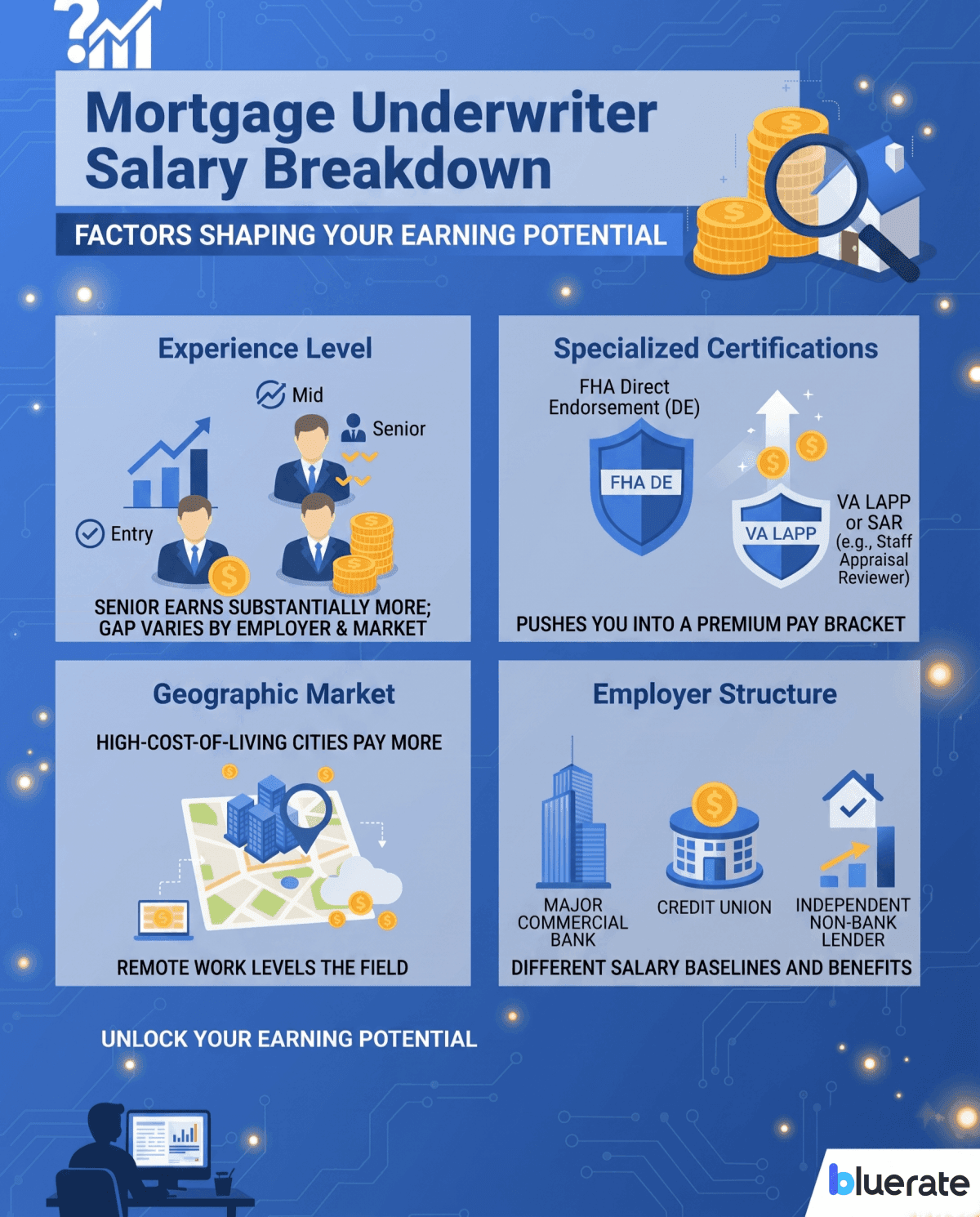
Experience Level: Senior underwriters can earn substantially more than entry-level underwriters, though the exact gap depends on employer and market.
-
Specialized Certifications: Having your FHA Direct Endorsement (DE) or VA LAPP/SAR credentials instantly pushes you into a premium pay bracket.
-
Geographic Market: High-cost-of-living metropolitan areas pay more, though remote work has started leveling this playing field.
-
Employer Structure: Working for a major commercial bank, a credit union, or an independent non-bank lender will yield different salary baselines and benefits.
Average Mortgage Underwriter Salary
When you look up salary figures online, you will quickly notice that different job portals show vastly different averages. This can be incredibly confusing. The trick is understanding how each platform collects its data. While the broad national average hovers around** $65,000 to $85,000**, let's look at what the four major career websites report for the US market.
Indeed
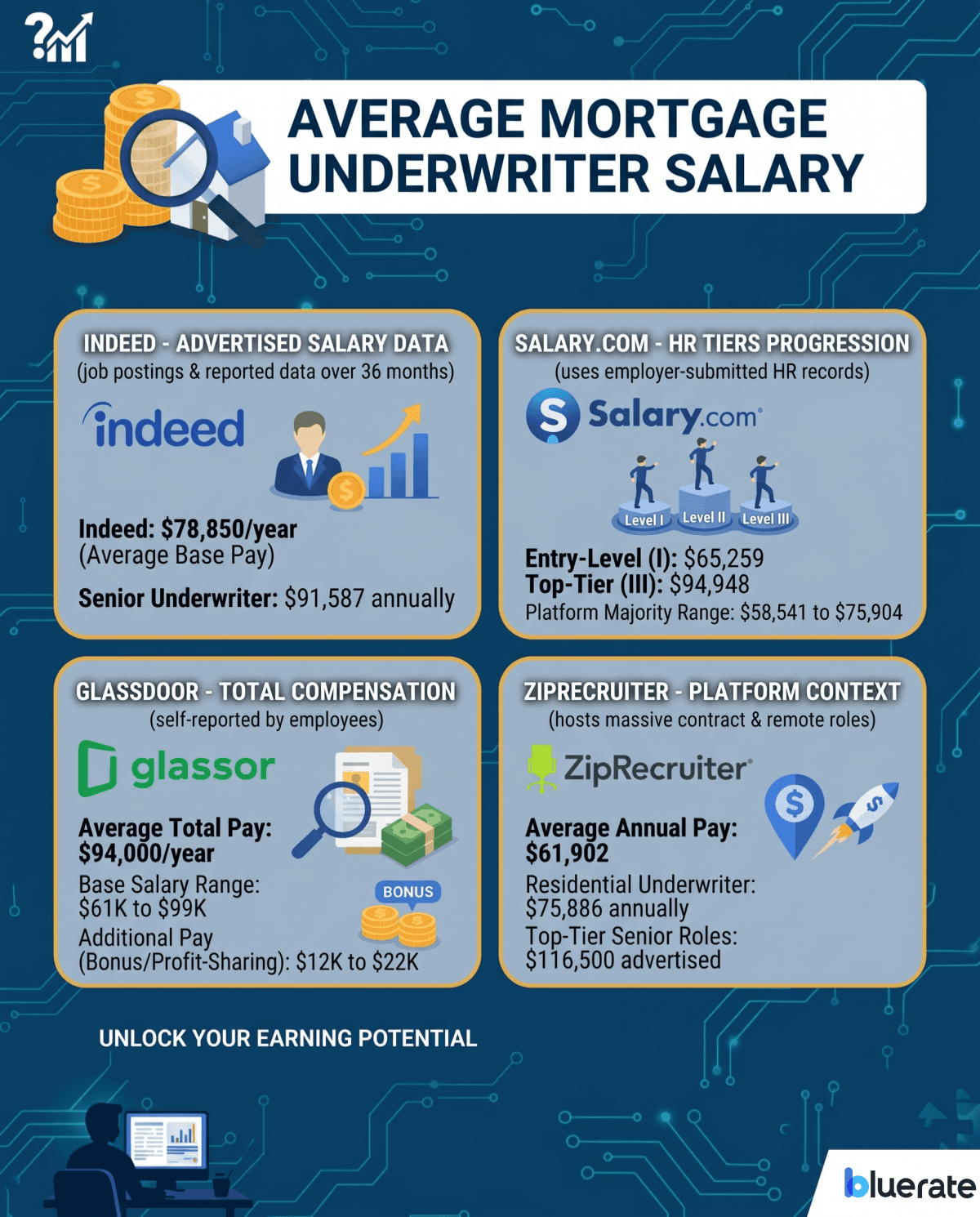
According to Indeed, the average base salary for a mortgage underwriter in the US is** $78,850 per year**. I find this data highly reliable because Indeed bases its estimates on salary information derived from job postings and reported data over the past 36 months. It represents what companies are actually advertising to attract talent right now.
For professionals with a solid track record, Indeed notes that a senior mortgage underwriter's average base salary steps up significantly to $91,587 annually. This highlights the clear payoff that comes with gaining a few years of solid industry experience.
Salary.com
Salary.com shows a majority range from**$58,541 to $75,904** per year for US mortgage underwriters. What makes this data unique is that it relies on employer-submitted HR records rather than job seeker estimates. It also breaks down salaries beautifully by professional tiers.
For instance, an entry-level Mortgage Underwriter I can expect an average starting pay of** $65,259**. However, as you climb the ranks to a Mortgage Underwriter III, the average salary climbs to** $94,948**. This tier structure is incredibly helpful for planning your long-term career progression.
Glassdoor
Glassdoor offers a slightly different perspective, reporting an average total pay of $94K per year. If that number seems high, there is a very good reason for it. Glassdoor gathers self-reported compensation directly from employees, which captures the "total package."
While the base salary ranges from $61K to $99K, employees report taking home an additional** $12K to $22K** in bonuses or profit-sharing. Having worked through hectic underwriting seasons myself, I can tell you those production bonuses are very real and can completely transform your annual W-2.
ZipRecruiter
ZipRecruiter lists the average annual pay for a mortgage loan underwriter at $61,902, which is about $29.76 an hour. Because ZipRecruiter hosts a massive volume of contract-based, entry-level, and remote-first roles, its average skews slightly lower. However, specific sub-categories on the platform tell a much brighter story.
For instance, a Residential Mortgage Underwriter averages $75,886 annually, and top-tier senior roles frequently advertise salaries of $116,500. This shows that while entry-level pay might start lower, the ceiling for skilled underwriters remains incredibly high.
How Does a Mortgage Underwriter Get Paid?
Understanding the payroll structure is vital if you want to maximize your income in this field. Unlike loan officers who often live or die by commission, underwriters enjoy a highly secure blend of fixed and performance-based pay.
-
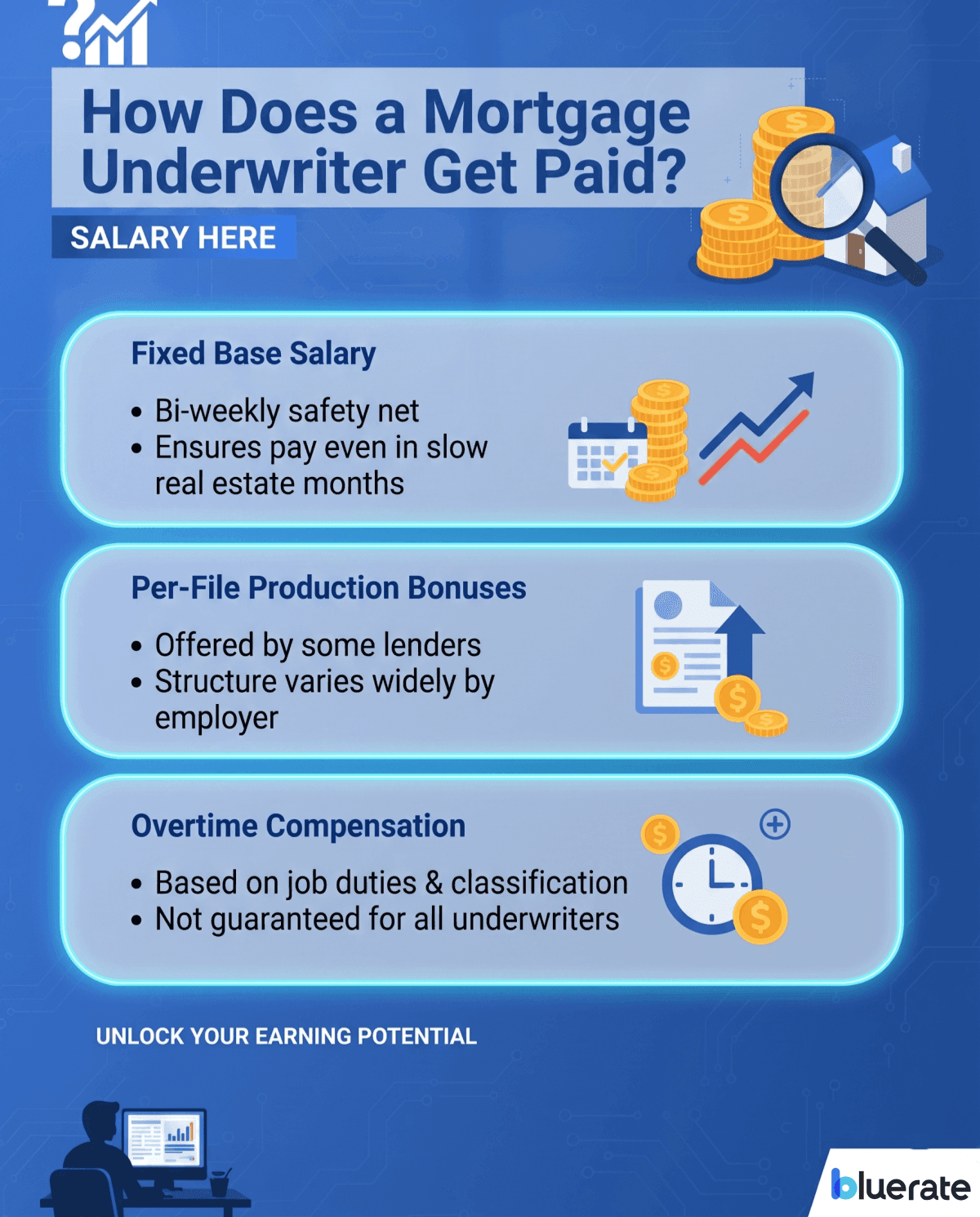
Fixed Base Salary: This is your bi-weekly safety net, ensuring you get paid even during slow real estate months.
-
Per-File Production Bonuses: Some lenders offer production bonuses or incentives, but the structure varies widely by employer.
-
Overtime Compensation: Because underwriters often handle tight deadlines, overtime eligibility depends on job duties and employer classification, so it is not guaranteed for all mortgage underwriters.
This balanced combination of a safe base salary and high-performance incentives is why many real estate professionals transition into underwriting.
FAQs About Home Loan Underwriter Salary
Q1. Do remote mortgage underwriters make the same as in-office ones?
Yes, they absolutely can. In fact, many national lenders recruit remote underwriters at highly competitive rates to save on office overhead. Because remote work allows you to live in a low-cost area while earning a salary based on a high-cost metropolitan market, it is often a fantastic strategy for boosting your real net income.
Q2. How can I increase my salary as a mortgage underwriter?
The fastest path to a higher salary is specialized credentials. Earning your FHA Direct Endorsement (DE) designation or VA LAPP/SAR approval instantly elevates your status. These government-backed programs require meticulous risk assessment, and lenders are highly eager to pay a premium to underwriters who can sign off on them.
Q3. Who makes more: a Mortgage Underwriter or a Loan Officer?
It depends on your risk tolerance. Loan officers can earn significantly more because their income is commission-only. A strong market can yield massive paydays. However, in a slower market, loan officers might struggle. Underwriters enjoy a steady, high-paying base salary coupled with production bonuses, offering far superior financial stability.
Q4. What is the starting salary for an entry-level mortgage underwriter?
Entry-level underwriters typically start out making between $52,000 and $65,000 per year. To secure these roles, many beginners gain valuable experience first as loan processors or assistant underwriters. Doing so allows you to learn the systems and guidelines before stepping into a full decision-making underwriting seat.
Q5. Does the choice of niche affect the salary?
Yes. Commercial and residential underwriting pay differently by employer and market, and either can be higher depending on the role. While residential underwriting is highly volume-driven and tied to the housing market, commercial underwriting is based on detailed business financials, commands higher compensation, and experiences fewer seasonal layoffs.
Final Word
Ultimately, a career as a mortgage underwriter offers a fantastic balance of strong earning power and stability. While different online portals show some variations in averages, the underlying truth remains: this is a highly skilled job with a healthy financial reward. My best advice for anyone wanting to maximize their salary is to focus heavily on continuous learning.
Don't just settle for standard conventional files. Seek out training for specialized niches like FHA, VA, or even commercial loans. By protecting financial institutions from unnecessary risks with your sharp expertise, you will always be in high demand, and your salary will naturally reflect that.
People Also Read
