
1099 Income Loan Explained: Meaning, Requirements, FAQs
As someone who works closely with self-employed borrowers, I constantly see talented freelancers get turned away by traditional banks simply because business tax write-offs lower their reported net income.
A 1099 income loan can often qualify you without using your tax returns to calculate income, though lenders may still request a 4506‑C or tax transcripts for verification and fraud checks. If you want to explore this route, you can easily use Bluerate to find qualified, licensed loan officers nearby for free and compare options.
Key Takeaways
-
Alternative Documentation: Qualify using IRS Form 1099-NEC or 1099-MISC instead of standard W-2s or full Form 1040 tax filings.
-
Standard Expense Adjustment: Available for primary residences, second homes, and many investment properties. Maximum loan amounts commonly reach $3 million, with some programs going up to $3.5–4 million depending on credit, LTV, and occupancy.
-
Flexible Financing: Available for primary residences, second homes, and investment properties with loan limits reaching $3 million or higher.
-
Core Requirements: You generally need a one‑ to two‑year contractor track record, ongoing bank deposit proof, and a credit score that typically starts around 620–660, though many programs prefer 660–700+ for better terms or lower down payments.
What is a 1099 Mortgage Loan?
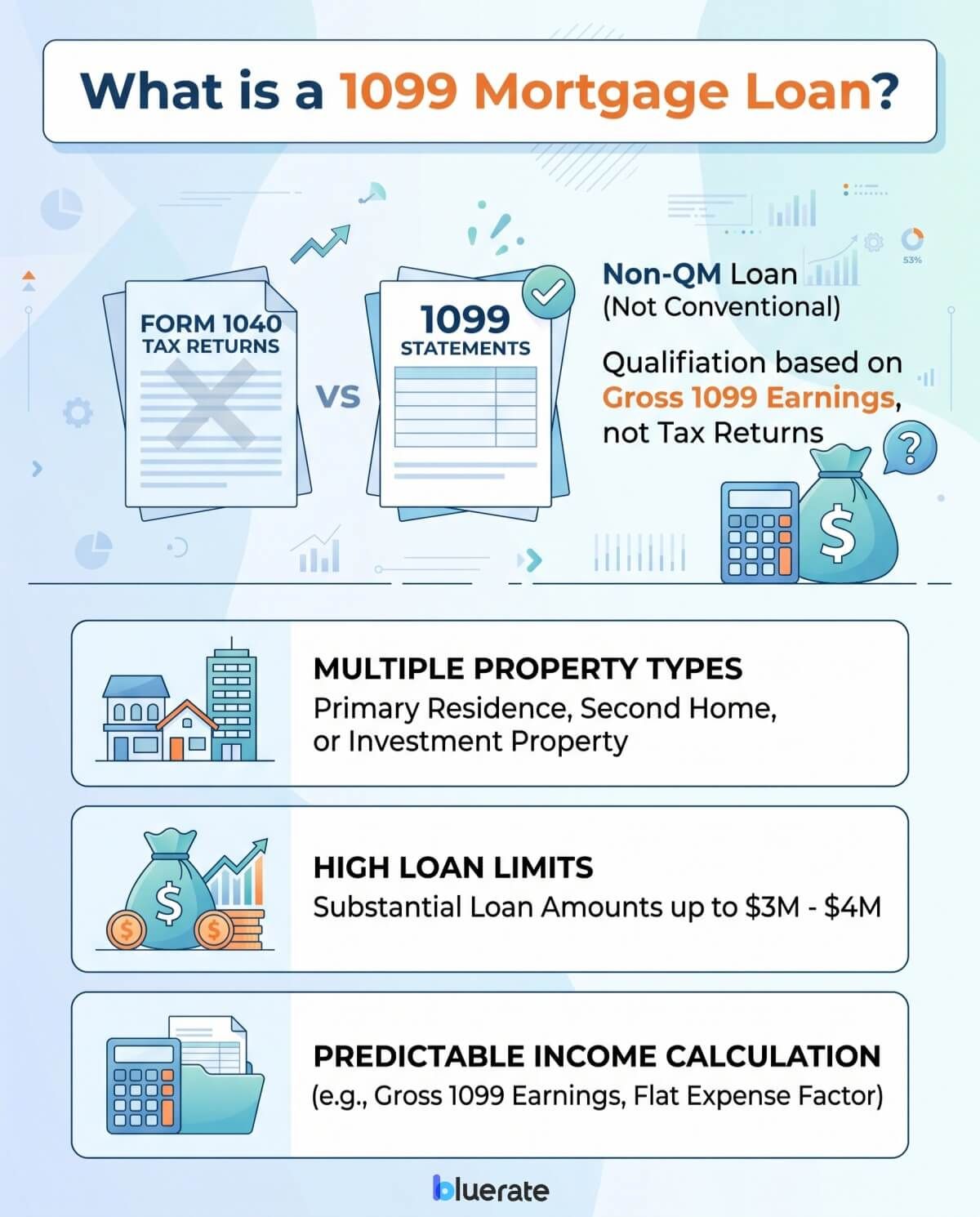
Whenever I break down this program for clients, I clarify that a 1099 mortgage is a Non-QM (non-qualified mortgage) product rather than a conventional agency loan backed by Fannie Mae or Freddie Mac. Conventional programs scrutinize two years of complete tax returns, penalizing contractors who take legitimate deductions.
A 1099 loan allows many borrowers to qualify without using personal or business tax returns to calculate income, with underwriting based primarily on gross 1099 earnings (though lenders may still request tax transcripts or a 4506‑C for verification).
-
**Tax Returns Often Not Required for Income Calculation: **Underwriters can often use your 1099 statements instead of your Form 1040 to calculate income, which may preserve more of your purchasing power after business write‑offs. Lenders may still request tax transcripts or a 4506‑C for verification.
-
Substantial Loan Amounts: Many programs cap loans around $3 million, with some wholesale or high‑balance programs reaching $3.5–4 million subject to stricter credit, LTV, and occupancy requirements (investment properties often have lower caps).
-
Multiple Property Types: Many programs allow you to purchase or refinance a primary residence, second home, or investment property, subject to specific program guidelines and often with different down payment and loan‑amount limits by occupancy type.
-
Predictable Income Calculation: Many lenders apply a flat expense factor (commonly 10%, but it varies). Some programs allow a CPA‑prepared profit‑and‑loss letter to override the default factor. Others use a fixed 10% with no exceptions.
Who is a 1099 Income Loan for?
In my experience, this loan is ideal for sole proprietors and independent professionals who do not receive a standard bi-weekly W-2 paycheck. If your tax deductions make your net taxable income look artificially low on paper despite steady cash flow, this financing route works best for:
-
Freelancers and Gig Workers: Creative freelancers, developers, digital consultants, and some rideshare or platform‑based workers may qualify, though lenders place extra emphasis on income stability and documentation quality.
-
Commission Earners: Real estate agents, mortgage brokers, and direct sales professionals paid largely or entirely on commission often find 1099 programs useful, especially when tax write‑offs reduce their taxable net income.
-
Independent Contract Specialists: Travel healthcare workers, locum tenens physicians, and IT specialists billing via 1099-NEC.
-
Arm's-Length Contractors: Ideally, the 1099 should come from an unrelated company. Many lenders will not accept 1099s issued by a company you own or by a family‑owned entity, or they will underwrite such income much more conservatively.
1099 Income Loan Requirements
While you do not need federal tax returns, Non-QM lenders still enforce responsible underwriting guidelines to verify your ability to repay. Here are the core benchmarks I tell applicants to prepare for:
-
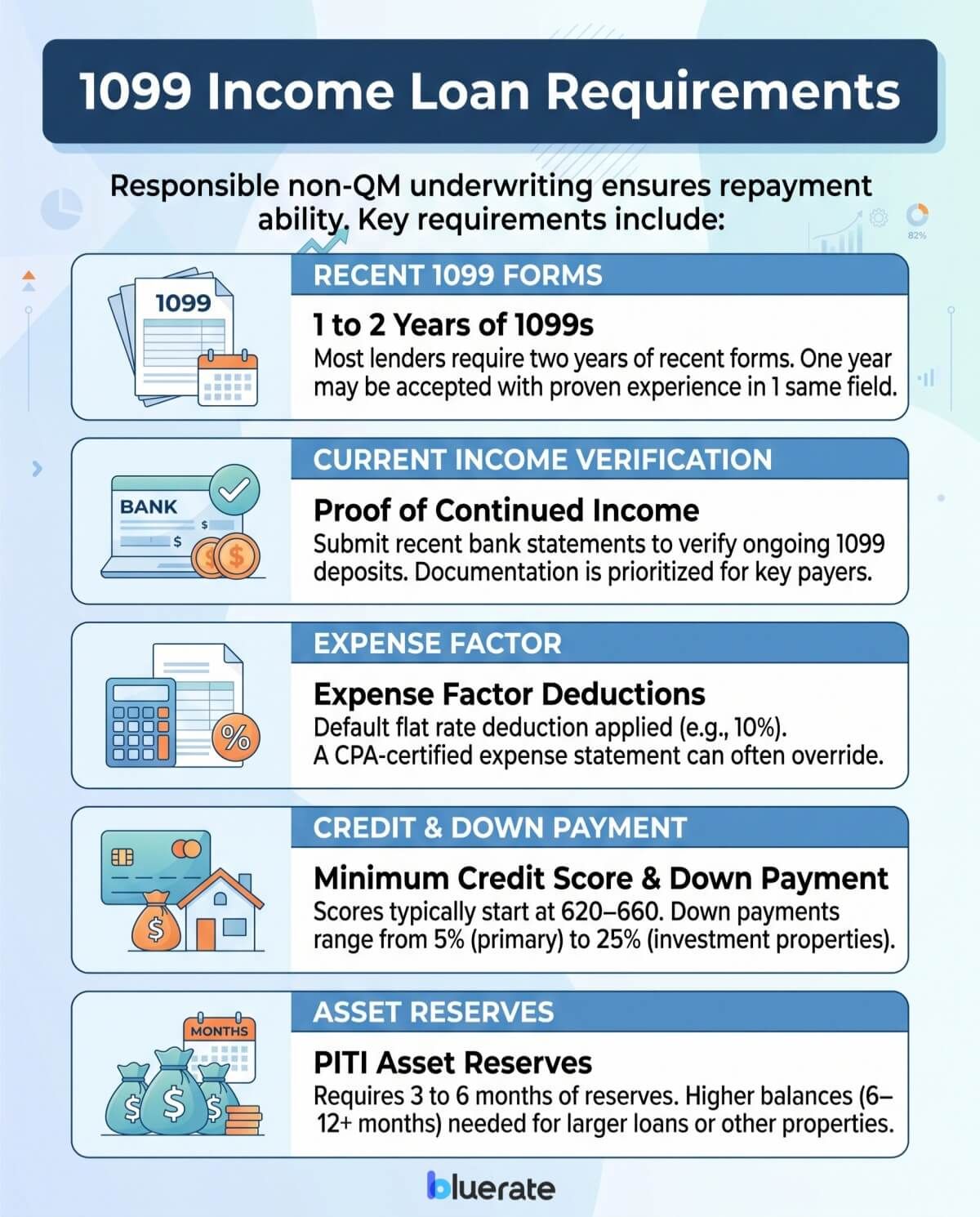
1 to 2 Years of 1099 Forms: Most lenders look for your two most recent years of 1099 slips. Some accept a single year if you have verified prior experience in the exact same field.
-
Proof of Current Receipt: You must supply recent bank statements showing ongoing deposits that corroborate your 1099 income. Lenders may ask for additional documentation for major payers, but they typically do not require proof for every single 1099 issuer.
-
Expense Factor Deductions: Many programs deduct a flat expense factor (often 10%, but it varies). Some allow a CPA‑prepared expense statement to override the default. Others use a fixed factor with no exceptions.
-
Credit Score & Down Payment: Minimum credit scores typically start between 620 and 660. Down payments often start around 10% for primary residences on stronger profiles, but can range from 5% to 25% depending on the program, credit score, and property type (investment properties usually require 20–25%).
-
Asset Reserves: Many programs require 3 to 6 months of PITI reserves, with higher balances (6–12+ months) often required for larger loans, second homes, or investment properties.
How to Get a 1099 Loan?
Because mainstream commercial banks rarely handle Non-QM products, securing a 1099 mortgage requires working with wholesale specialists. Here is the step-by-step roadmap I recommend:
-
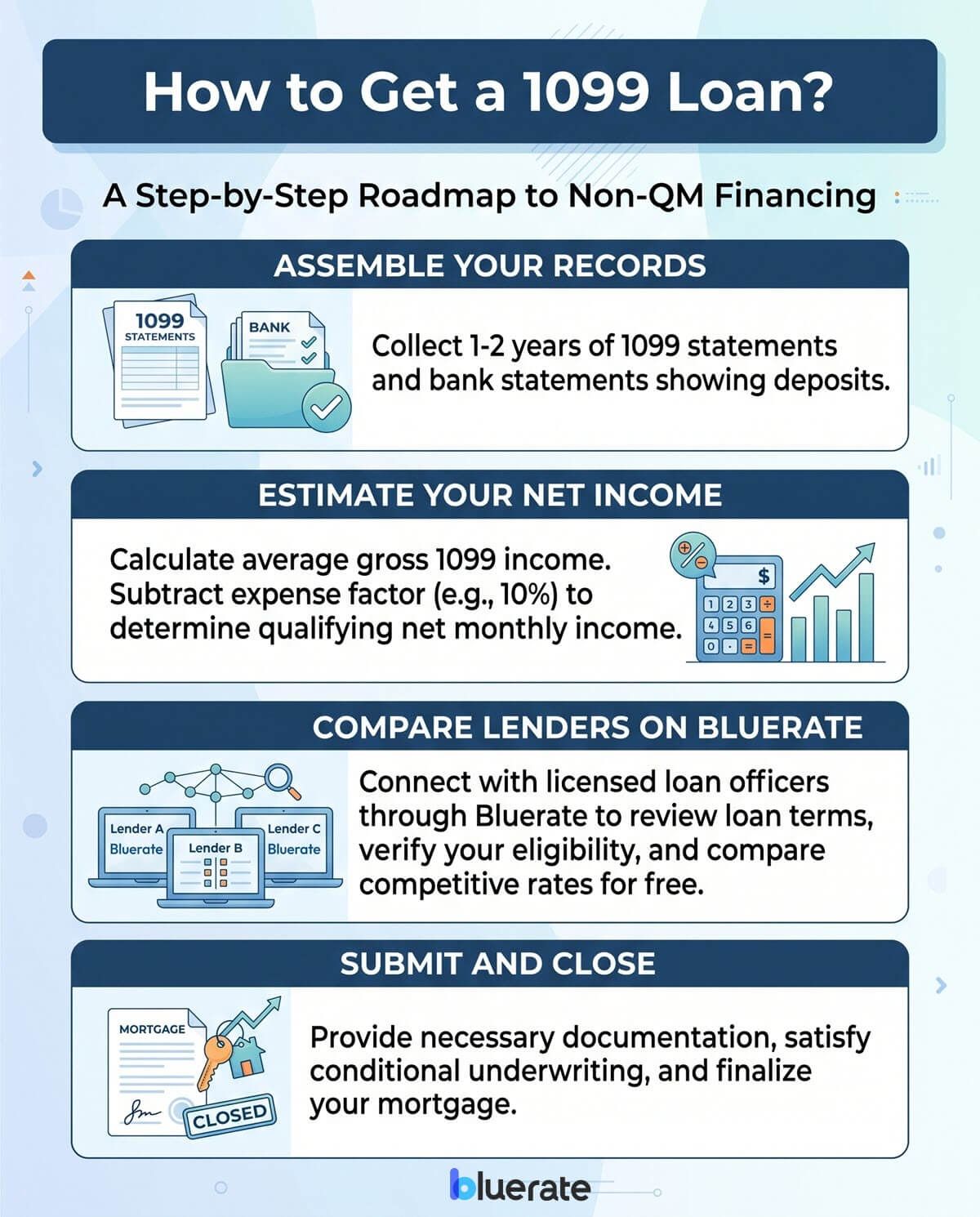
Assemble Your Records: Collect your last one to two years of 1099 statements along with supporting bank statements showing continuous deposits from each client.
-
Estimate Your Net Income: Add up your 1099 earnings over the last 12 or 24 months, subtract the program's expense factor (often 10%), then divide by the same number of months to estimate your qualifying monthly income.
-
Compare Lenders on Bluerate: Connect with licensed loan officers through Bluerate to review loan terms, verify your eligibility, and compare competitive rates for free.
-
Submit and Close: Provide any necessary supporting documentation, satisfy conditional underwriting requirements, and finalize your mortgage.
More 1099 Mortgage Loan FAQs
Q1. Can you use a 1099 to get a loan?
Yes, you can use your 1099 forms to qualify through specialized Non-QM mortgage programs. However, conventional agency loans (Fannie Mae and Freddie Mac) do not allow self‑employed borrowers to qualify using only 1099 forms. They typically require two years of tax returns with Schedule C (and related statements) to verify net self‑employment income.
Q2. What is a 1099 form for a mortgage?
In mortgage underwriting, IRS Form 1099 (typically 1099-NEC or 1099-MISC) serves as third-party proof of non-employee compensation. Non-QM lenders use the total earnings on these slips as your baseline gross revenue rather than reviewing tax schedules.
Q3. Can I qualify for a 1099 loan with bad credit?
It is possible, but options are limited. Many Non‑QM 1099 programs set their minimum around 620–640, though some accept scores near 600 (often with higher down payments, higher rates, and lower loan amounts). If your score is near 600, expect to put down 20–25%+ and show substantial reserves.
Q4. Can I apply for 1099 loans with no credit check?
No. Under federal Ability‑to‑Repay rules, legitimate residential lenders must thoroughly document your ability to repay, which in practice almost always includes a formal credit check. Be wary of any "no credit check" mortgage offers. Avoid any program marketing a mortgage with "no credit check," as these are almost always predatory lending scams.
Q5. Where to find a 1099 loan officer near me?
Because many retail bank loan officers focus primarily on conventional W‑2 files, borrowers often benefit from working with a mortgage broker or marketplace that regularly places 1099 and other Non‑QM loans. Platforms such as Bluerate can help you locate NMLS‑licensed officers, but always verify licensing and compare multiple options.
Final Word
Writing off legitimate business expenses should never keep you from owning a home. A 1099 income loan bridges this gap for independent workers, evaluating your real earning power without tax return penalties.
When you are ready to take the next step, turn to Bluerate. You can connect with licensed, experienced loan officers nearby for free, compare competitive rates, and secure home financing tailored to your career.
People Also Read
