
What is a 1099 Form in Mortgage? Common Types to Learn
When I first transitioned from corporate payroll to independent consulting, I had no idea how complicated getting a mortgage would feel. A 1099 form proves you earn non-employee income, but mortgage underwriters view it quite differently than a routine W-2 paycheck. If you want to buy a home with freelance or contractor earnings, here is how these tax documents directly shape your loan approval.
Key Takeaways
-
Lenders primarily verify self-employed income through your federal tax returns (Form 1040 with Schedule C), not the 1099 forms themselves. 1099s can support your file, but qualifying income is usually based on your reported net profit after business expenses.
-
Underwriters typically require a two-year history of self-employment income documented on your tax returns (Form 1040 with Schedule C) to verify stability. Some programs may consider one year with strong compensating factors.
-
Aggressive tax write-offs reduce your net taxable income, which directly lowers your borrowing power on conventional loans.
-
For contractor and freelancer compensation, Forms 1099-NEC and, in some cases, 1099-MISC are among the variants lenders may review, though qualifying income is primarily verified through tax returns.
-
Specialized Non-QM programs (e.g., 1099 or bank statement loans) can qualify borrowers using gross deposit history, but lenders typically apply an expense ratio or percentage factor to estimate qualifying income. These programs still generally require at least two years of self-employment history.
What is a 1099 Form?
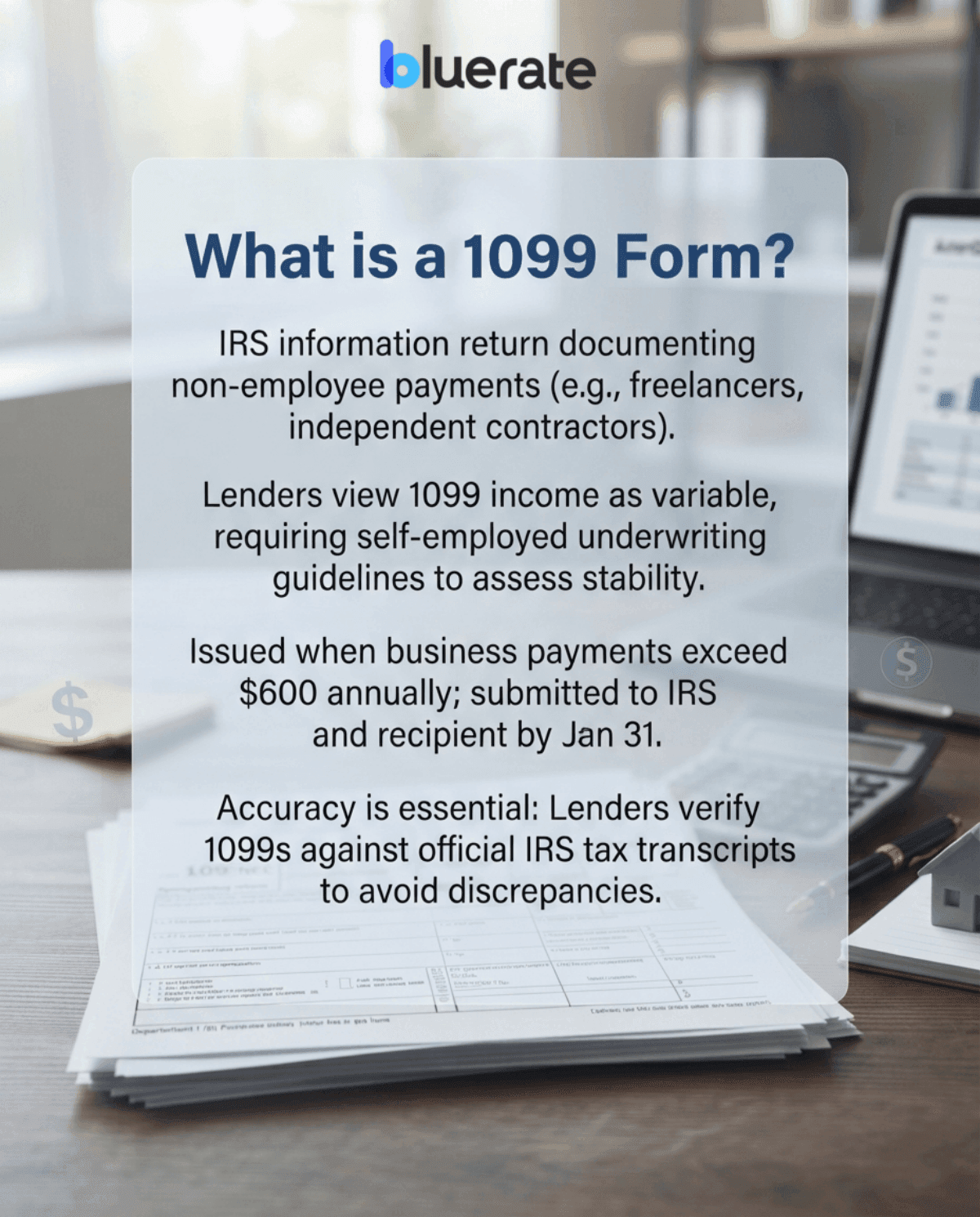
A 1099 form is an IRS information return used to document payments made to individuals who are not regular company employees. Businesses, clients, or financial institutions issue this document whenever they pay you money outside of standard payroll systems.
In my years reviewing mortgage files, seeing a 1099 immediately tells an underwriter that your income is variable rather than guaranteed by an hourly wage or salary. Unlike traditional employees who submit recent paystubs, 1099 recipients follow self-employed underwriting guidelines.
Lenders scrutinize these records to confirm that your revenue stream is consistent, ongoing, and durable enough to support monthly housing payments. It serves as primary evidence of your true earning power, determining the overall mortgage amount you can safely borrow.
What are the IRS 1099 Rules?
The IRS establishes strict standards governing how non-employee compensation must be disclosed. Payers are legally required to issue a 1099 form whenever business-related payments to an independent worker reach or exceed $600 within a single tax year. These filings must be submitted to both you and the IRS by January 31 following the calendar year of payment.
From a mortgage approval perspective, accuracy here is paramount. When you apply for a loan, I ask you to sign IRS Form 4506-C, which allows us to pull your official tax transcripts straight from federal databases. Underwriters match your submitted 1099 documents against these government records. Any mismatch or unreported client payment triggers underwriting red flags, halting your loan progress until amended returns or formal explanations clear up the discrepancy.
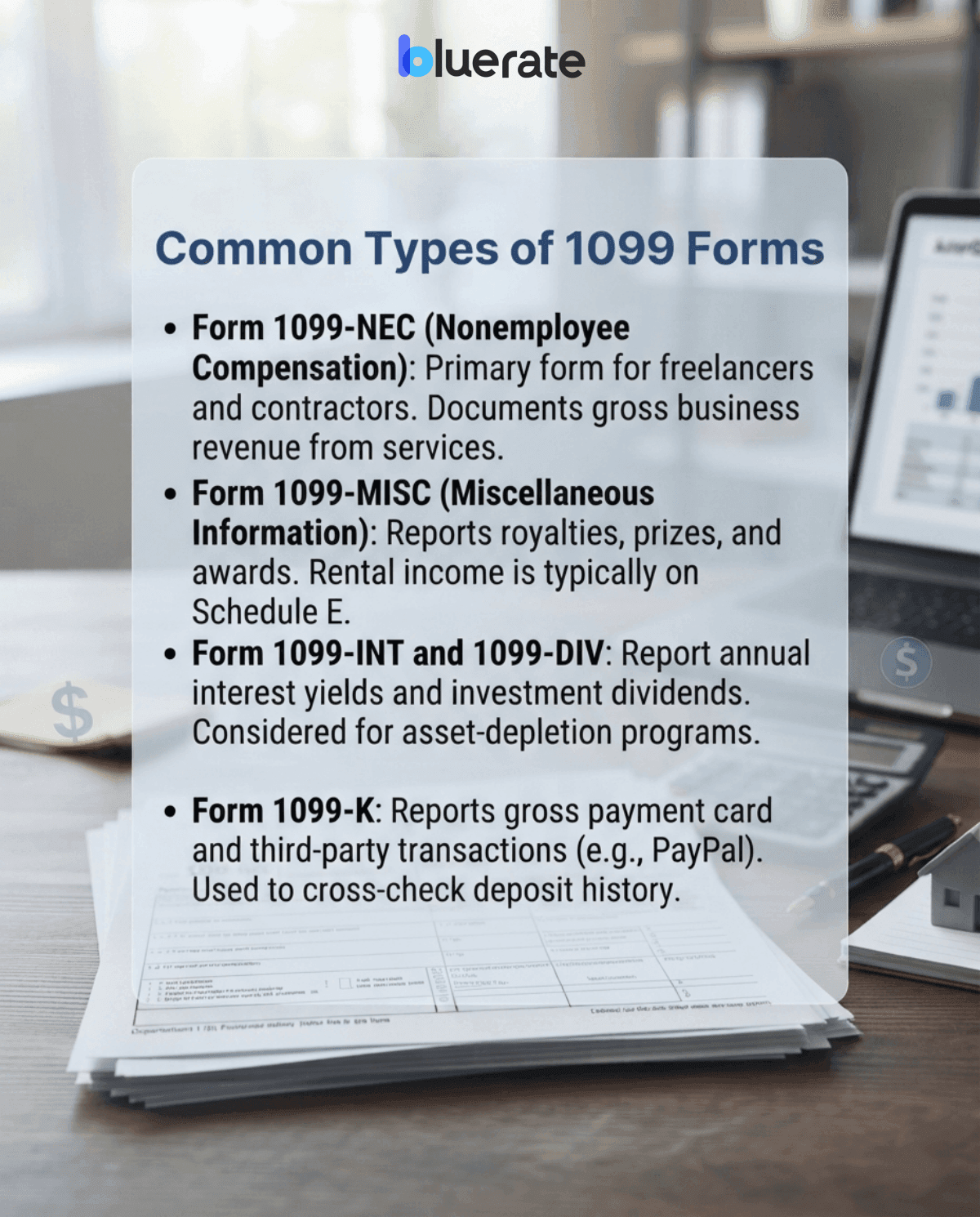
Common Types of 1099 Forms
While the IRS maintains nearly twenty different versions of Form 1099, mortgage underwriters focus on the specific variants that substantiate your qualifying cash flow:
-
Form 1099-NEC (Nonemployee Compensation): This is the primary form for freelancers, gig economy workers, and independent contractors. If you earn fees from project work or service contracts, this document establishes your primary gross business revenue.
-
Form 1099-MISC (Miscellaneous Information): Reports items such as royalties (Box 2), prizes/awards (Box 3), and certain other payments. Rental income from real estate is generally reported on your tax return (Schedule E), not via 1099-MISC in most consumer mortgage contexts.
-
Form 1099-INT and 1099-DIV: Report annual interest yields and investment dividend payments. Lenders factor these in if you qualify through asset-depletion formulas or portfolio-based wealth programs.
-
Form 1099-K: Reports gross payment card and third-party network transactions (e.g., Stripe, PayPal). Underwriters may use it to cross-check deposit history, but they focus on taxable income and consistent business deposits after excluding personal transfers and non-income items.
1099 Form Requirements for Mortgage Approval
Qualifying for a home purchase with 1099 earnings involves stricter scrutiny than a standard employee file. To approve your mortgage, loan underwriters look for concrete signs of long-term financial viability:
-
Two-Year Continuity: Lenders generally insist on at least two consecutive years of consistent 1099 income within the same field to verify stability.
-
Schedule C Reconciliation: Lenders expect your 1099 totals to be reasonably consistent with the gross receipts on Schedule C, but differences can occur. What matters most is that your tax-return income is well-documented and any variances can be explained.
-
Focus on Net Profit: Underwriters calculate your debt-to-income ratio using your net profit after expense deductions, rather than the gross sum listed on the 1099.
-
Current-Year Verification: You frequently must supply a year-to-date profit and loss statement, backed by two to three months of business bank statements.
How to Obtain and Prepare 1099 Forms for a Mortgage
Organizing your tax paperwork before starting house hunting prevents stressful underwriting hold-ups. I recommend setting up your documentation using these three simple steps:
-
Collect Client Copies: Reach out to clients and digital service platforms every February to compile every 1099 issued under your Social Security number or business tax ID.
-
Download Federal Transcripts: If a payer neglected to send your paperwork, sign into your IRS online account and pull an official Wage and Income Transcript.
-
Assemble Supporting Schedules: Group your 1099 forms alongside their corresponding 1040 tax returns, business balance sheets, and bank statements so your loan officer receives a complete, transparent financial picture.
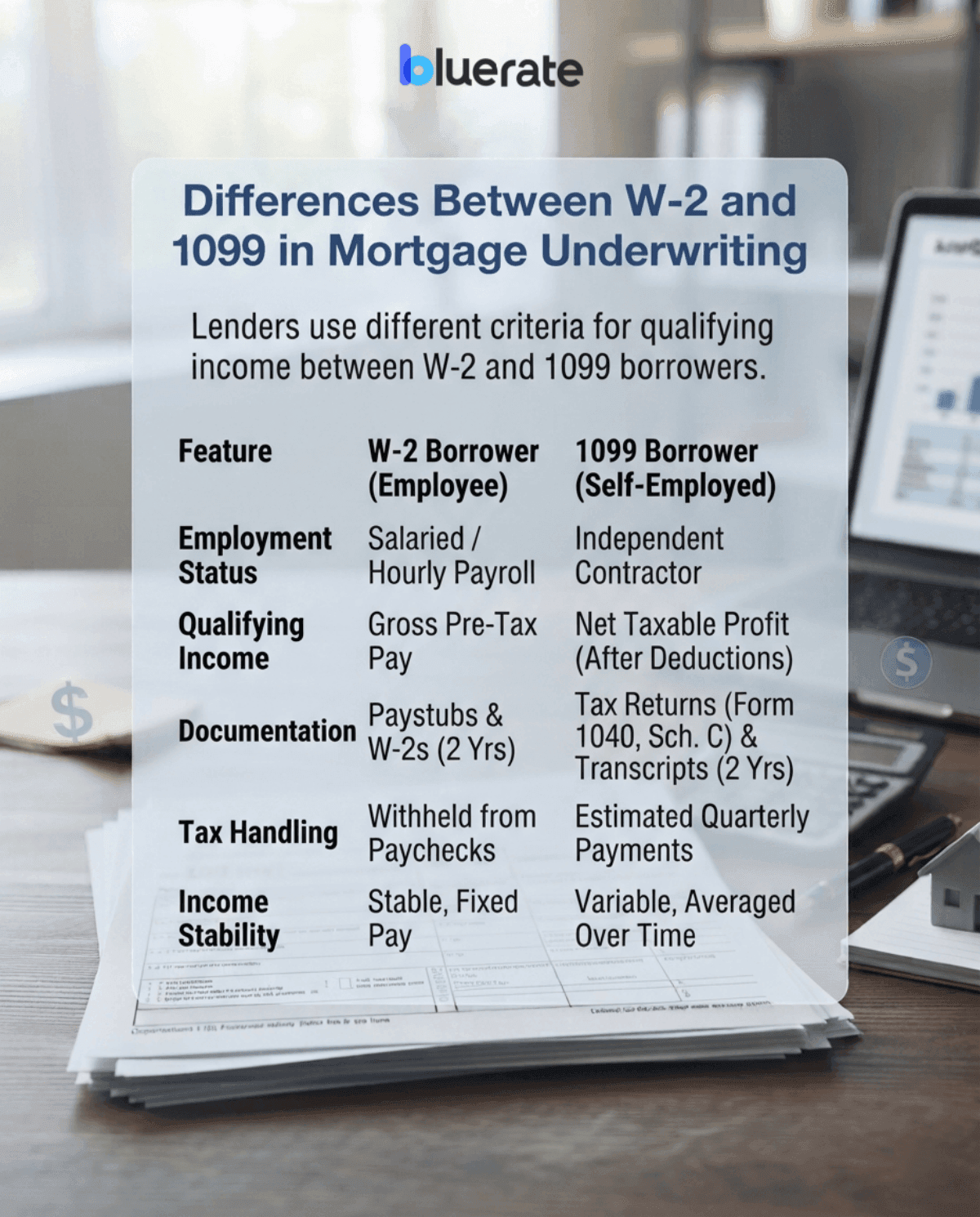
Differences Between W-2 and 1099 in Mortgage Underwriting
Transitioning from regular payroll to contract work fundamentally alters how lenders assess your borrowing capacity. While W-2 employees qualify based on gross base wages, 1099 contractors face an income averaging system that deducts business write-offs.
FAQs About 1099 Forms in Mortgage
Q1. What does it mean if you get a 1099 form?
Receiving a 1099 means an organization paid you as an independent contractor without withholding federal or state taxes. In mortgage lending, it classifies you as self-employed. Underwriters will scrutinize your operating expenses and net profitability instead of relying on an established payroll salary.
Q2. Does receiving a 1099 mean you have to pay taxes?
Yes. You must pay personal income taxes alongside self-employment taxes, which cover Medicare and Social Security obligations. Staying current on quarterly tax payments is vital because unpaid IRS liabilities or tax liens will immediately prevent a mortgage lender from approving your file.
Q3. Who needs to file a 1099?
Businesses must issue 1099 forms whenever they disburse $600 or more to an independent vendor during the year. Businesses must issue 1099 forms when they pay an independent contractor $600 or more in a year. As the recipient, you must report the income on your tax return if you meet the IRS filing requirements. If your net self-employment earnings are $400 or more, you generally must also pay self-employment tax.
Q4. Who is exempt from getting a 1099?
W-2 employees do not receive 1099s for normal payroll earnings. Furthermore, payers generally do not issue Form 1099-NEC to corporations (C-Corps or S-Corps), with notable exceptions such as payments for legal services and certain other categories.
Q5. Can I get a mortgage if write-offs reduce my 1099 income?
It is difficult through traditional Fannie Mae or Freddie Mac loans because heavy deductions lower your net income and spike your debt-to-income ratio. However, you can consider Non-QM 1099 or bank statement loans, which qualify you using gross client deposits rather than net tax profit.
Final Words
Holding 1099 income will not stop you from achieving homeownership, provided you map out your mortgage strategy ahead of time. Striking the right balance between claiming tax deductions and preserving borrowing capacity requires careful coordination. I suggest consulting a loan officer on Bluerate and a certified tax specialist at least twelve months before buying to align your records.
Disclaimer: This article is for general educational information only and does not constitute tax, legal, or mortgage advice. Guidelines vary by lender and change over time. Consult a qualified tax professional and a licensed loan officer for advice specific to your situation.
People Also Read
