
![[How-to Guide] Can You Refinance a Second Mortgage?](/_next/image?url=https%3A%2F%2Fdynamic-light-ab6e2536d6.media.strapiapp.com%2Frefinance_a_second_mortgage_banner_bf0c926c48.png&w=3840&q=75)
[How-to Guide] Can You Refinance a Second Mortgage?
Yes, you can refinance a second mortgage, and I frequently help homeowners navigate this exact process. Whether you hold a home equity loan or a HELOC, you can replace it with a new second lien or roll it into your primary mortgage. In this guide, I will break down how refinancing works, key qualification standards, and critical underwriting rules to help you secure better terms.
Key Takeaways
- Multiple Refinance Paths: You can execute a standalone refinance to replace just your second lien or consolidate both mortgages into one primary loan.
- Strict Seasoning Rules: Many conventional cash-out refinances require at least** six months** of ownership seasoning, but the exact rule depends on the loan program and lender. HELOC availability and draw restrictions vary by lender and state, so there is no universal 90-day lockout rule.
- First Lien Health Matters: Your primary mortgage must be in good standing, meaning no active forbearance, balloon payments due soon, or negative amortization.
- Key Financial Criteria: Approval requires sufficient home equity (typically under 80% to 85% CLTV), a credit score of 620+, and manageable DTI ratios.
Can You Refinance a Second Mortgage?
Yes, refinancing a second mortgage is possible, but eligibility depends on the loan type, lender guidelines, and the status of your first mortgage. In my practice, I guide clients through two main avenues:
- Replace the second lien with a standalone loan offering a lower rate
- Execute a combined refinance to merge both mortgages.
Choosing the right method depends on your current interest rates, existing equity, and whether you want to alter your primary mortgage terms.

Is It Hard to Refinance a Second Mortgage?
Refinancing a second mortgage can be somewhat more challenging than a primary loan. Because second-lien lenders take a subordinate position, they assume higher risk if you default. From my experience with underwriting guidelines, approvals hinge heavily on strict equity thresholds, clean credit histories, and ensuring your primary mortgage carries no high-risk features like active forbearance, private financing, or approaching balloon payments.
Qualification Requirements to Refinance a Second Mortgage
When evaluating applications, lenders scrutinize several strict financial parameters to offset their second-lien risk exposure. In my practice, I always advise borrowers to verify these core requirements before applying:
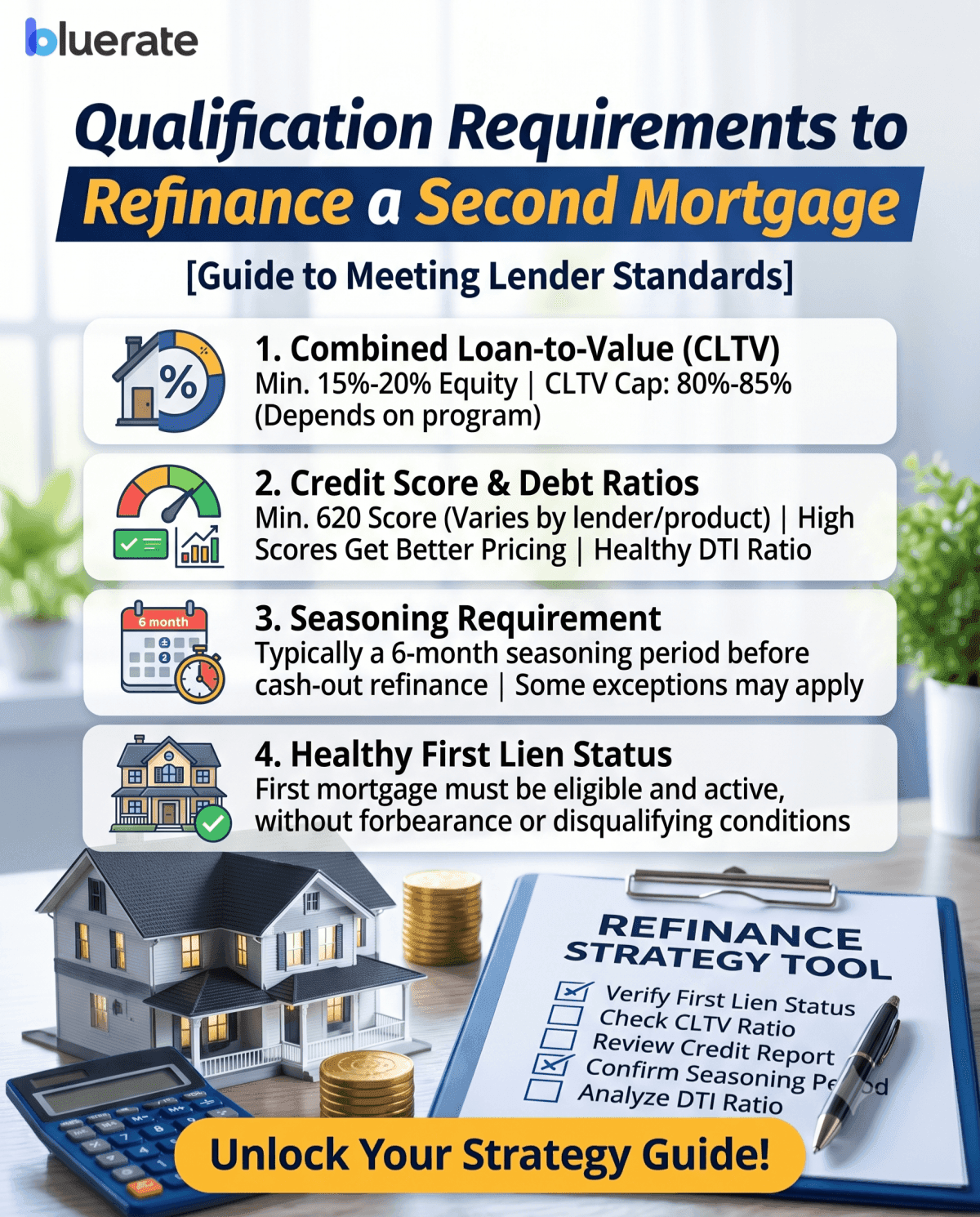
- Combined Loan-to-Value (CLTV): Many lenders look for at least **15% to 20% **equity remaining after the refinance, which often translates to a CLTV cap around 80% to 85%, depending on the program.
- Credit Score & Debt Ratios: A 620 credit score is a common minimum for many programs, but actual requirements vary by lender, product type, and occupancy. Borrowers with higher scores usually qualify for better pricing.
- Seasoning & Draw Lockouts: Many conventional cash-out refinances are subject to** a six-month** seasoning requirement, although exceptions may apply, such as delayed financing scenarios.
- Healthy First Lien Status: Your first mortgage must be eligible for the refinance program, and active forbearance or other disqualifying loan conditions may prevent approval. Lender requirements for subordinate financing vary by program.
Full Guide: How to Refinance a Second Mortgage?
If you are ready to proceed, I recommend following this structured step-by-step framework to navigate the underwriting process smoothly:
- Select Your Strategy: Decide whether a standalone second refinance or a single consolidated mortgage better suits your financial goals and current rate environment.
- Audit Equity & First Mortgage Status: Estimate your home equity and verify that your primary loan carries no disqualifying conditions, such as forbearance or balloon payments.
- Compare Lender Guidelines: Shop across traditional and non-QM lenders. Pay close attention to specific restrictions like 90-day draw lockouts or strict cash-out seasoning limits.
- Gather Required Documentation: Collect tax forms, bank statements, income proof, and prepare a detailed letter of explanation regarding the use of funds if taking cash out.
- Complete Appraisal & Closing: Schedule a professional home appraisal to confirm market value. At closing, ensure the closing agent satisfies and removes your previous subordinate lien, ensuring clean title recording.
FAQs About Refinancing a Second Mortgage
Q1. Can I combine my first and second mortgage into one loan?
Yes, you can merge both mortgages through a single consolidated refinance. In my experience, this option works best when primary mortgage rates are favorable, allowing you to streamline your monthly payments into one single loan.
Q2. What is the 6-month seasoning rule for second mortgage refinances?
Most lender matrices mandate that you must own the home or maintain your existing cash-out lien for at least six months before refinancing for cash-out proceeds. Attempting a cash-out refinance earlier usually results in strict CLTV caps or outright denial.
Q3. Can I refinance if my first mortgage is in forbearance?
No. Underwriting standards strictly exclude properties where the primary mortgage is in active forbearance, deferment, or negative amortization. You must resolve any forbearance status and establish a clean payment track record before refinancing your second mortgage.
Q4. What happens if I want to refinance only my first mortgage and keep my second?
If you want to refinance only the first mortgage and keep the second lien in place, you generally need a subordination agreement from the second-lien holder. If they do not agree, you may need to pay off the second lien or use a different refinance structure.
Q5. Are there state-specific restrictions on refinancing second mortgages?
Yes. Texas has its own home equity lending rules, including special requirements for refinancing, subordinate financing, and the 80% loan-to-value cap. Some existing second liens may be subordinated, but treatment depends on whether the loan is a Texas Section 50(a)(6) loan. Certain national second-mortgage products are prohibited or restricted in Texas as a result.
The Bottom Line
Refinancing a second mortgage offers a powerful opportunity to reduce your interest rates, lock in fixed payments, or consolidate debt. However, success requires meeting strict CLTV thresholds, verifying seasoning guidelines, and ensuring your first mortgage is in good standing.
I always recommend consulting a licensed mortgage professional to review lender matrices and identify the best refinance strategy for your financial situation.
