
Blanket Loan vs Portfolio Loan: What's the Difference in 2026
Investors frequently conflate 'blanket' and 'portfolio' loans when seeking capital for multiple acquisitions. Although lenders sometimes use these terms interchangeably, they refer to fundamentally different aspects of mortgage financing.
A blanket loan ties multiple properties into one mortgage. A portfolio loan simply describes who keeps your note after closing. Knowing how they interact saves you tens of thousands in closing fees.
Key Takeaways
-
Core Distinction: A blanket loan secures multiple properties with a single lien, whereas a portfolio loan refers to any mortgage the lender keeps on its own balance sheet rather than selling to Fannie Mae or Freddie Mac.
-
Structural Overlap: Most blanket mortgages are originated as portfolio loans because institutional secondary markets rarely purchase bundled liens.
-
Exit Mechanics: Blanket loans rely on a partial release clause to sell individual homes without triggering full payoff, whereas single-asset portfolio loans sell like standard mortgages.
-
The Bottom Line: Choose a blanket mortgage to simplify multi-door admin. Turn to portfolio lenders when you need flexible qualification rules for non-conforming deals.
What is a Blanket Loan?
A blanket loan is a single financing agreement collateralized by two or more separate real estate parcels. Whenever I set these up for investors buying turnkey packages or small rental portfolios, the linchpin is always the partial release clause. This clause allows you to sell off a single home from the bundle by paying down an agreed portion of the debt, typically 110% to 125% of its allocated loan value, though this premium varies by lender and property risk profile.
Underwriters primarily assess the aggregate or blended Debt-Service Coverage Ratio (DSCR) across the whole basket. While personal tax forms are often secondary to property cash flow, lenders may still review personal financial statements to gauge overall liquidity.
Pros:
-
Operational Efficiency: Consolidating closings, title work, and monthly payments into a single package significantly cuts administrative overhead and legal costs.
-
Aggregated Cash Flow: Strong rental properties can offset a temporarily vacant unit during underwriting.
-
Scalability: Enables bulk acquisitions that conventional lenders turn down.
Cons:
-
Cross-Collateral Risk: Defaulting on payment puts every pledged property at risk of foreclosure.
-
Prepayment & Release Hurdles: Releasing one door costs more than its exact balance due to paydown premiums.
-
Higher Down Payments: Expect to put down 20% to 30% across the asset pool.
What is a Portfolio Loan?
A portfolio loan is any debt an originating bank or private lender holds on its balance sheet until maturity rather than packaging it for sale to secondary market buyers like Fannie Mae. Because the lender absorbs the entire default risk, their internal credit committee sets the qualification rules.
Over the years, I have turned to portfolio lenders whenever a client hit conventional roadblocks, such as exceeding the Fannie Mae limit of ten financed properties per borrower, needing bank-statement income verification, or purchasing unique properties like mixed-use buildings and unpermitted additions.
Pros:
-
Flexible Guidelines: Accommodates self-employed borrowers, foreign nationals, and unconventional credit scores.
-
No Property Limits: Bypasses standard secondary market caps on financed residential units.
-
Direct Relationship: Underwriting happens in-house, making loan restructuring and approvals faster.
Cons:
-
Slightly Steeper Rates: Rates and origination points often sit 1.0% to 2.5% higher than prime conforming mortgages, depending on the borrower's credit profile and property cash flow.
-
Shorter Terms: Many portfolio programs feature 5- or 10-year balloon payments or adjustable-rate adjustments rather than 30-year fixed locks.
-
Heavier Reserve Demands: Lenders typically want six to twelve months of liquid reserves on deposit.
What are the Differences Between Portfolio Loan vs Blanket Loan?
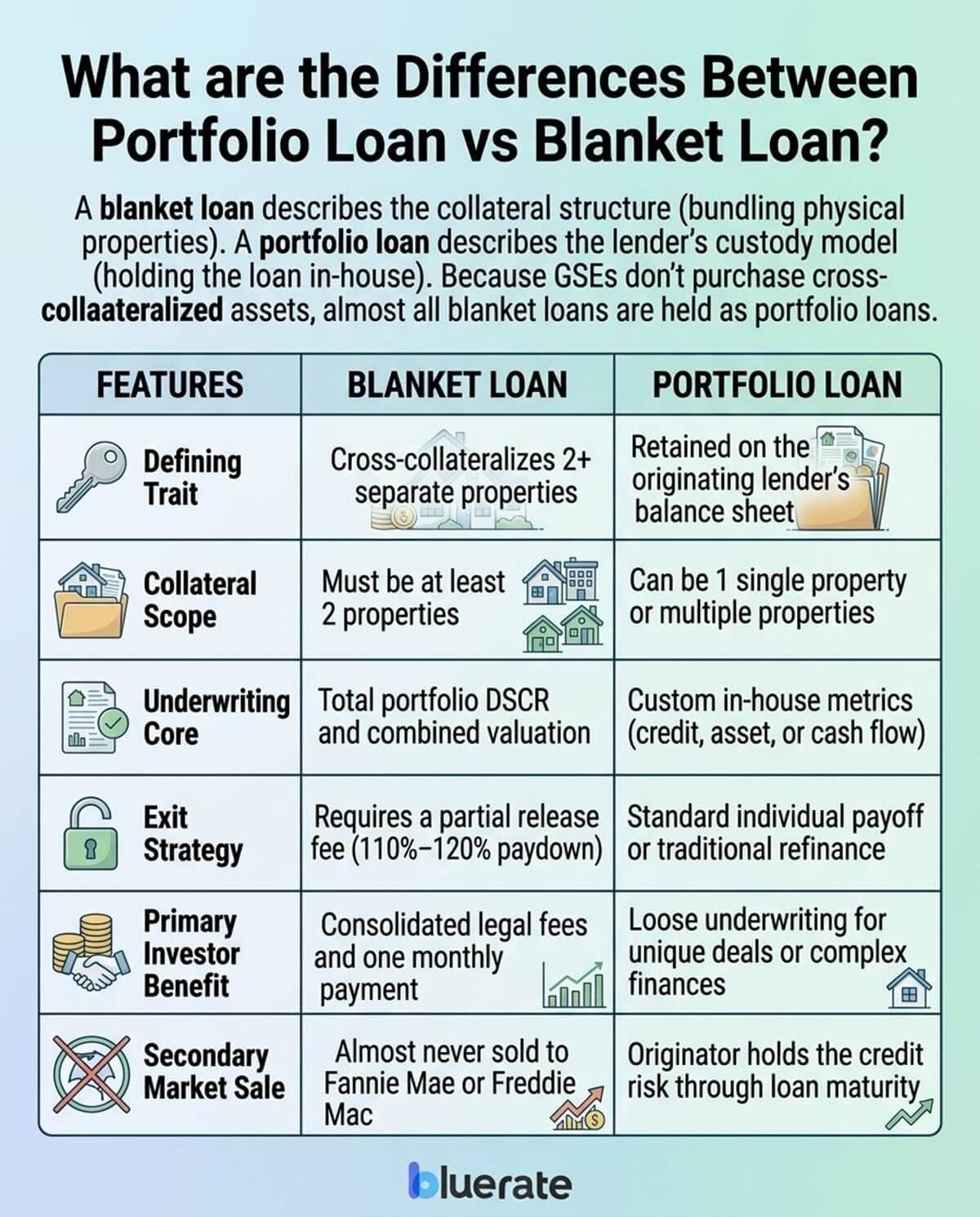
Borrowers often compare these options as if they were competing products, but they actually define two completely different lending dimensions. "Blanket" describes the collateral structure, bundling several physical properties into one contract. "Portfolio" describes the lender's custody model, holding the loan in-house rather than selling the paper. Because government-sponsored enterprises do not purchase cross-collateralized assets, virtually every blanket loan is held as a portfolio loan.
Blanket Loan vs Portfolio Loan: Which to Choose?
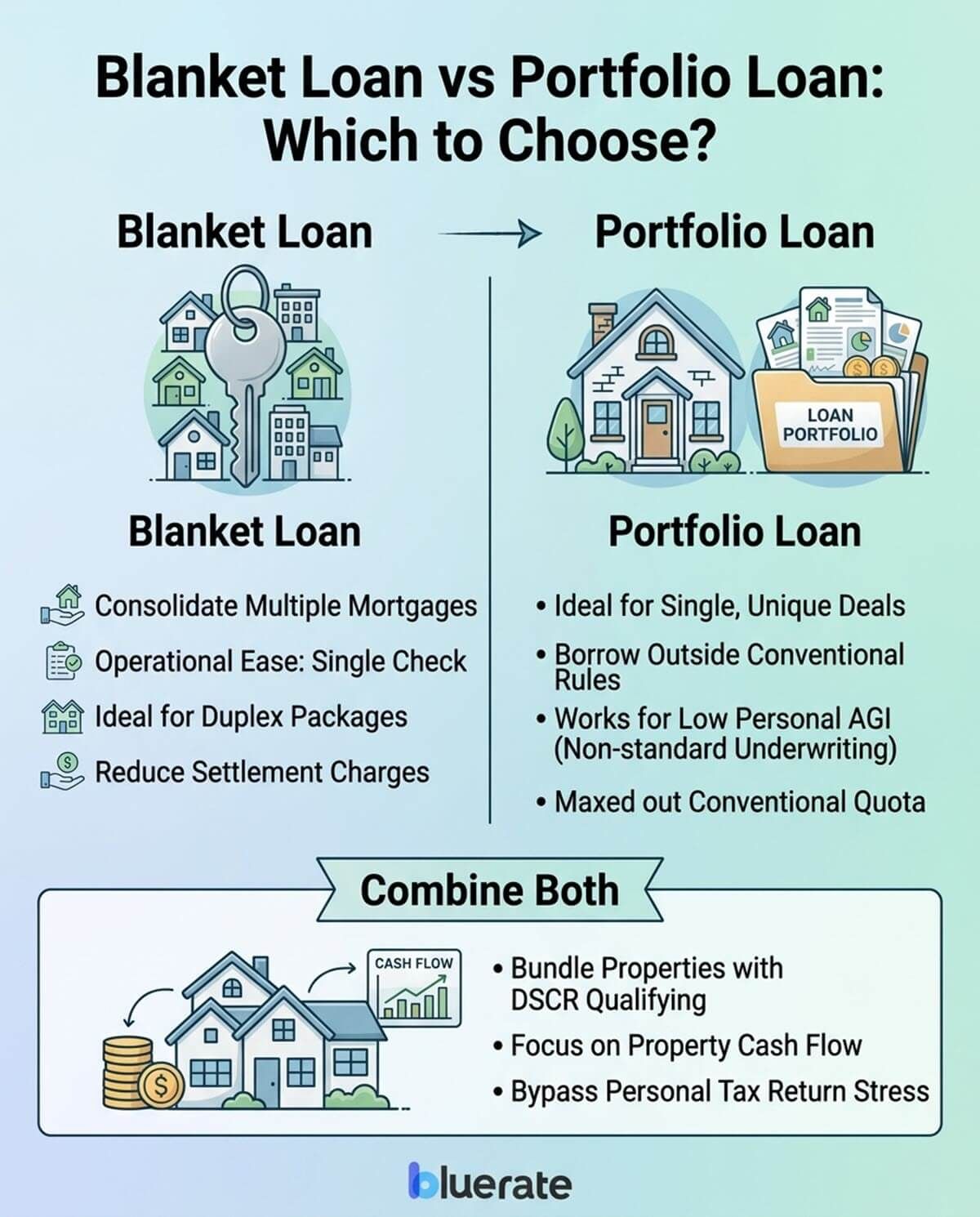
Your choice boils down to whether your primary barrier is logistical complexity across multiple assets or restrictive underwriting on specific deals. Here is how I steer clients toward the best path:
-
Choose a Blanket Loan if: You are acquiring a turnkey duplex package, consolidating six separate rental mortgages to slash recurring settlement charges, and want the operational ease of writing a single monthly check.
-
Choose a Portfolio Loan if: You are buying a single home with non-standard conditions, have tax write-offs that deflate your adjusted gross income, or have maxed out your conventional borrowing quota.
-
Combine Both if: You want to bundle multiple properties while qualifying purely through property cash flows (DSCR) rather than your personal tax returns.
FAQs About Portfolio Loan vs Blanket Loan
Q1. Can a blanket loan also be a portfolio loan?
Yes. In practice, almost all blanket loans are portfolio loans. Conventional secondary agencies do not buy multi-property cross-collateralized debts, meaning local banks, balance-sheet credit unions, or specialized private debt funds must hold them in their own portfolios.
Q2. What is a release clause, and why do I need one?
A partial release clause permits you to sell or refinance one parcel out of your blanket pool without clearing the full loan. The lender calculates a payoff premium, often 110% to 125% of that specific property's allotted value, releasing the title while maintaining security on the rest.
Q3. Do blanket loans require personal W-2 tax forms?
Rarely. Commercial and investor blanket mortgages evaluate performance through the Debt-Service Coverage Ratio (DSCR) of the combined real estate package. Underwriters care about gross rents servicing the pooled debt rather than your personal W-2 wages.
Q4. Are interest rates higher on blanket and portfolio mortgages?
Yes, you should expect interest rates to run roughly 50 to 150 basis points higher than conforming fixed rates. However, the savings realized from executing one unified title closing and appraisal set frequently outweigh that minor rate spread.
Q5. What happens if one property in a blanket loan suffers an extended vacancy?
Because the loan is cross-collateralized, a single underperforming door will not trigger default as long as the other rentals generate enough revenue to meet the total monthly installment. The portfolio's aggregated cash flow protects you during localized tenant turnover.
Conclusion
Navigating blanket and portfolio financing comes down to matching your property volume and cash flow model with the right credit structure. Whether you are seeking to consolidate existing scattered rentals into a single lien or need flexible balance-sheet capital for an unconventional deal, proper structuring matters.
Contact the loan officers at Bluerate today to evaluate your real estate portfolio and lock in a lending solution tailored to your growth goals.
People Also Read
