

Portfolio Loan Explained 2026: Every Detail to Know
When I first started advising real estate clients, I constantly saw creditworthy buyers hit dead ends with traditional lenders simply because their income did not fit standard W-2 guidelines. That is where a portfolio loan steps in.
It is an in-house mortgage that a lender funds and keeps on its own balance sheet. If you need a flexible financing solution, finding seasoned loan officers through Bluerate makes securing these custom programs straightforward.
Key Takeaways
-
Held In-House: Lenders keep these mortgages on their own balance sheets instead of selling them to Fannie Mae or Freddie Mac.
-
Flexible Underwriting: Terms, debt limits, and income verification adapt to unique borrower circumstances.
-
Higher Upfront Costs: Expect down payments between 15% and 30% alongside slightly higher interest rates.
-
Best Candidates: Perfect for self-employed professionals, multi-property real estate investors, and non-standard home purchases.
What is a Portfolio Loan Mortgage?
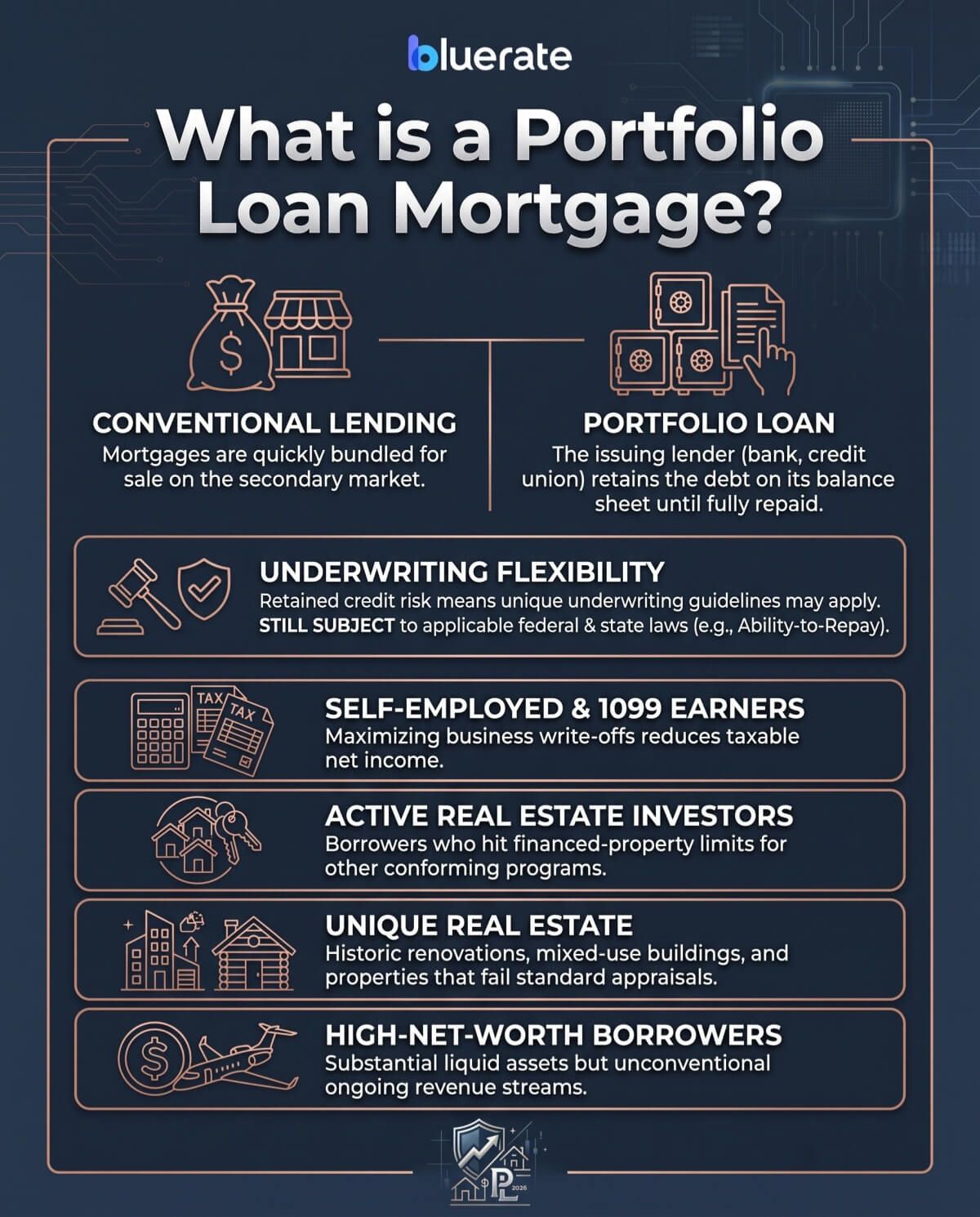
In conventional lending, institutions originate mortgages and quickly bundle them for sale on the secondary market. A portfolio loan works differently: the issuing lender, typically a regional bank, credit union, or private institution, retains the debt on its balance sheet until it is fully repaid.
Because they retain more of the credit risk, portfolio lenders may use underwriting standards that differ from conforming-loan guidelines. However, most closed-end consumer mortgages remain subject to applicable federal and state laws, including Ability-to-Repay requirements.
In my practice, I frequently recommend portfolio financing for:
-
Self-Employed & 1099 Earners: Business owners who minimize taxable net income through legal write-offs.
-
Active Real Estate Investors: Buyers who have reached the financed-property limits that may apply to second-home or investment-property loans under certain conforming programs.
-
Non-Warrantable** & Unique Real Estate:** Properties like mixed-use buildings, historic renovations, or log cabins that fail standard appraisals.
-
High-Net-Worth Borrowers: Buyers holding substantial liquid assets but unconventional ongoing revenue streams.
Pros and Cons of a Portfolio Loan
Over the years, I have seen portfolio financing rescue deals that seemed impossible, but the added flexibility comes with distinct trade-offs you must evaluate.
Pros:
-
Custom Underwriting: Lenders evaluate your complete financial picture, including bank statements and asset reserves, rather than strict tax filings.
-
Property Versatility: You can finance fixer-uppers, non-warrantable condominiums, or commercial-residential parcels without bureaucratic roadblocks.
-
Streamlined In-House Approvals: Internal credit committees review files locally, often speeding up final loan approval.
Cons:
-
Higher Upfront Capital: Down payment minimums generally sit between 15% and 30%, which ties up more liquid cash.
-
Elevated Interest Rates: Rates often run 0.50% to 1.50% higher than conventional options to compensate for balance sheet risk.
-
Specific Loan Clauses: Certain contracts feature early prepayment penalties or adjustable interest rate structures.
How Do Portfolio Loans Work?
Understanding how portfolio mortgages operate behind the scenes explains why financial institutions handle them with unique care:
-
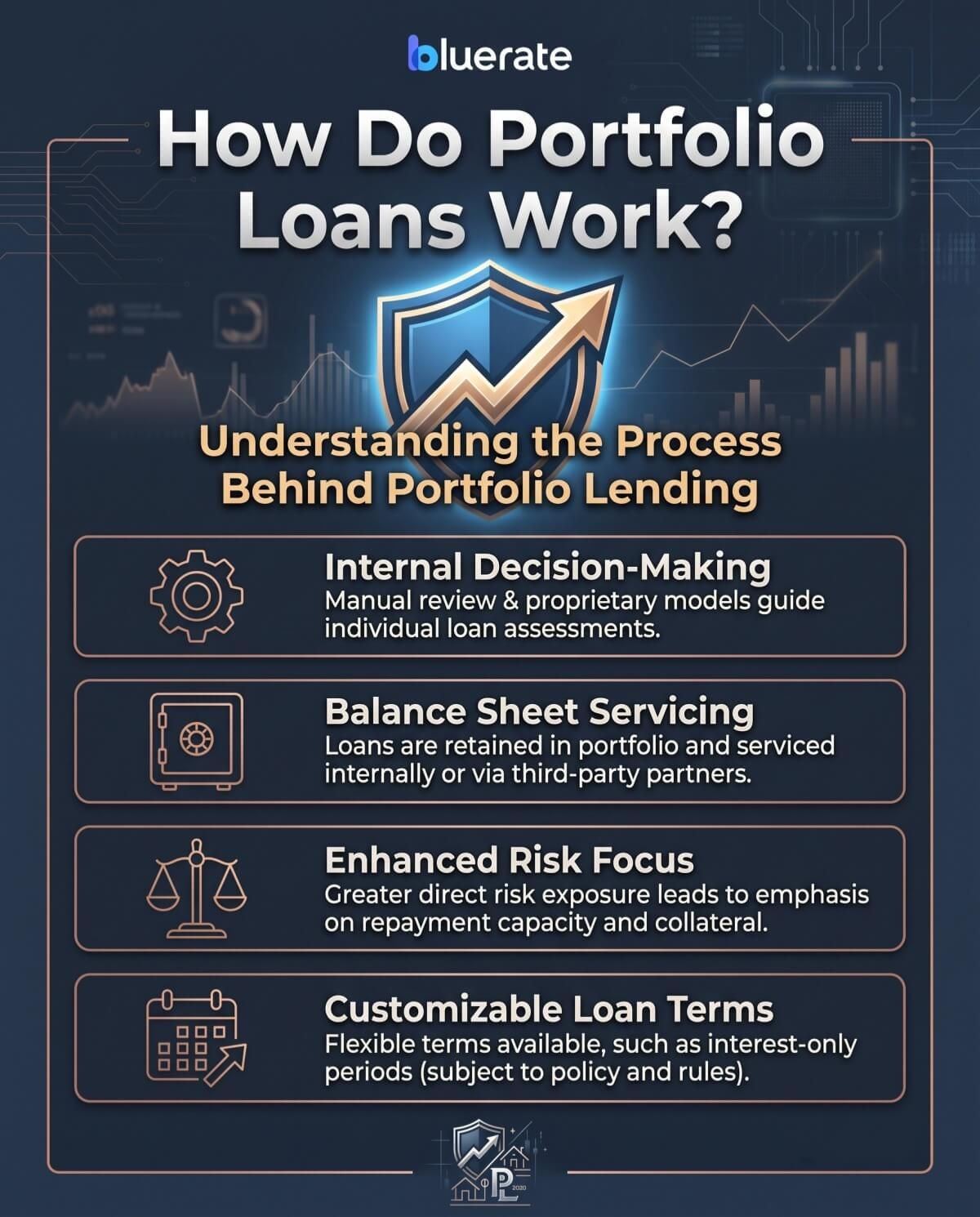
Internal Decision-Making: Rather than relying solely on the automated underwriting systems and eligibility rules used for conforming loans, a portfolio lender may use manual review, proprietary models, or a combination of both.
-
Balance Sheet Servicing: A portfolio lender may service the loan itself or use a third-party servicer. Retaining a loan in portfolio does not necessarily prevent future servicing transfers, although borrowers generally must receive required transfer notices.
-
Direct Risk Absorption: Because a lender that retains a loan generally has more direct exposure to its credit performance, it may place added emphasis on repayment capacity, collateral, and the overall borrower relationship.
-
Customizable Loan Structures: Some portfolio programs may offer interest-only periods, balloon structures, or other customized repayment terms, but availability depends on lender policy and applicable lending rules. Borrowers should evaluate payment-reset risk, refinancing risk, and any prepayment terms carefully.
Portfolio Loan Requirements
While underwriting guidelines vary across individual institutions, most portfolio lenders in the United States operate within these baseline benchmarks:
-
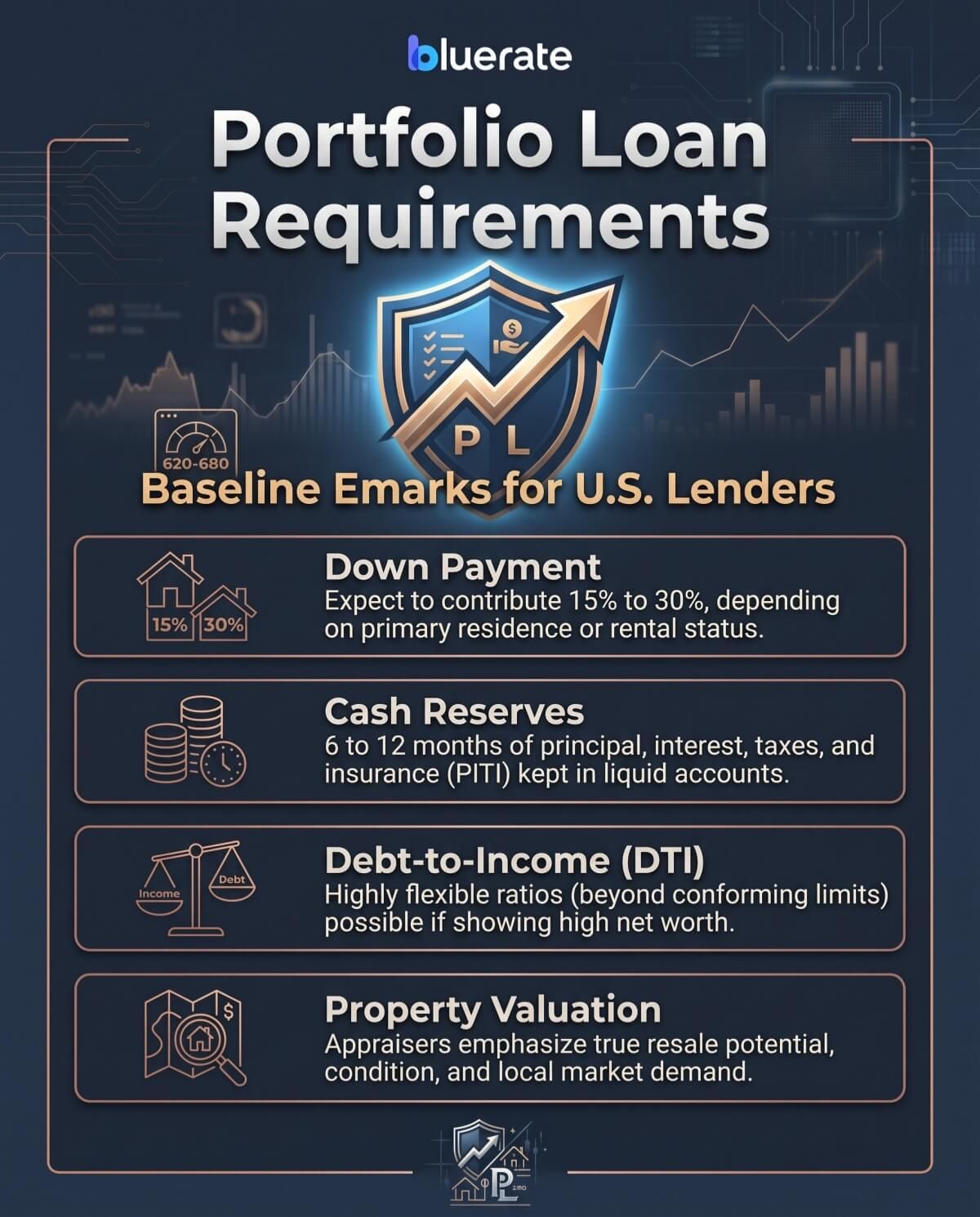
Credit Profile: Minimum credit scores usually range from 620 to 680, though substantial liquid reserves can sometimes offset lower scores.
-
Down Payment: Expect to contribute** 15% to 30%**, depending on whether the home is a primary residence or rental property.
-
Cash Reserves: Lenders typically require** 6 to 12 **months of principal, interest, taxes, and insurance (PITI) kept in liquid accounts.
-
Debt-to-Income (DTI): Although conforming loans cap DTI near** 45% to 50%**, portfolio lenders can approve higher ratios if you show significant net worth.
-
Property Valuation: Appraisers focus heavily on true resale potential, condition, and local market demand.
How to Qualify for a Portfolio Loan?
Qualifying for a portfolio mortgage requires strategic preparation rather than just filling out a generic application. Here is how I advise my clients to prepare:
-
Target Community-Focused Lenders: Focus on regional banks, local credit unions, or specialized mortgage brokers with active balance sheet programs.
-
Assemble a Robust Financial Package: Prepare 12 to 24 months of business bank statements, profit-and-loss sheets, and proof of brokerage assets.
-
Leverage Relationship Banking: Offering to transfer operating accounts or savings deposits to the lending institution can unlock better terms.
-
Provide a Clear Financial Narrative: If you had past credit blips or seasonal income drops, submit a concise letter explaining the situation alongside proof of your current financial stability.
Portfolio Loan vs Conventional Loan
Choosing between these paths depends on whether your financial profile fits standard federal parameters or requires specialized underwriting.
-
Secondary Market Sales: Many conforming conventional mortgages are sold or securitized through Fannie Mae, Freddie Mac, or other investors, while a portfolio loan is retained by the originating institution or its affiliate rather than sold through that channel.
-
Underwriting Guidelines: Conventional loans can accommodate W-2, self-employment, 1099, and certain asset-based income sources when they are documented under applicable agency guidelines. Portfolio loans may offer additional flexibility when a borrower or property falls outside those guidelines.
-
Down Payment Demands: Conventional options allow down payments as low as 3%, while portfolio financing generally starts at 15% to 30%.
-
Property Standards: Conforming loans must meet agency property and project-eligibility standards, which can limit financing for certain properties in poor condition or some non-warrantable condominium projects. Portfolio lenders may consider some of these properties, subject to their own appraisal and risk requirements.
Blanket Loan vs Portfolio Loan
Borrowers frequently confuse these two terms, but they address entirely different aspects of mortgage financing.
-
Structural Scope: A blanket loan consolidates multiple properties under a single mortgage lien, featuring a release clause that lets you sell individual parcels without paying off the full loan.
-
Holding Strategy: A portfolio loan describes how a financial institution funds and keeps a loan in-house, regardless of whether it covers one parcel or five.
-
The Key Connection: Blanket loans are commonly offered by banks, credit unions, and commercial or specialty lenders, and they are often structured outside standard agency-conforming programs because they secure multiple properties under one loan.
FAQs About Portfolio Loan
Q1. Can you refinance a portfolio loan?
Yes. Once you build enough home equity, improve your credit profile, or normalize your taxable income, you can refinance into a lower-rate conventional mortgage. You can also refinance existing conventional loans into a single portfolio mortgage.
Q2. How hard is it to get a portfolio loan?
It depends on your balance sheet. If you lack cash reserves or down payment funds, qualifying is difficult. However, for self-employed buyers with solid revenue and complex deductions, it is often far easier than passing rigid conventional underwriting.
Q3. Who qualifies for a portfolio loan?
Borrowers with dependable income, verifiable assets, and clear repayment capacity who do not meet conventional lending rules qualify. This includes 1099 contractors, investors exceeding loan limits, and buyers financing unique real estate assets.
Final Word
Portfolio loans offer an essential funding path when rigid conventional rules threaten to derail your property purchase. While they carry higher down payments and rates, their customized flexibility is unmatched for unique financial scenarios.
To review tailored options and compare in-house products, visit Bluerate to connect directly with experienced loan officers who can guide your mortgage strategy effectively.
People Also Read
