
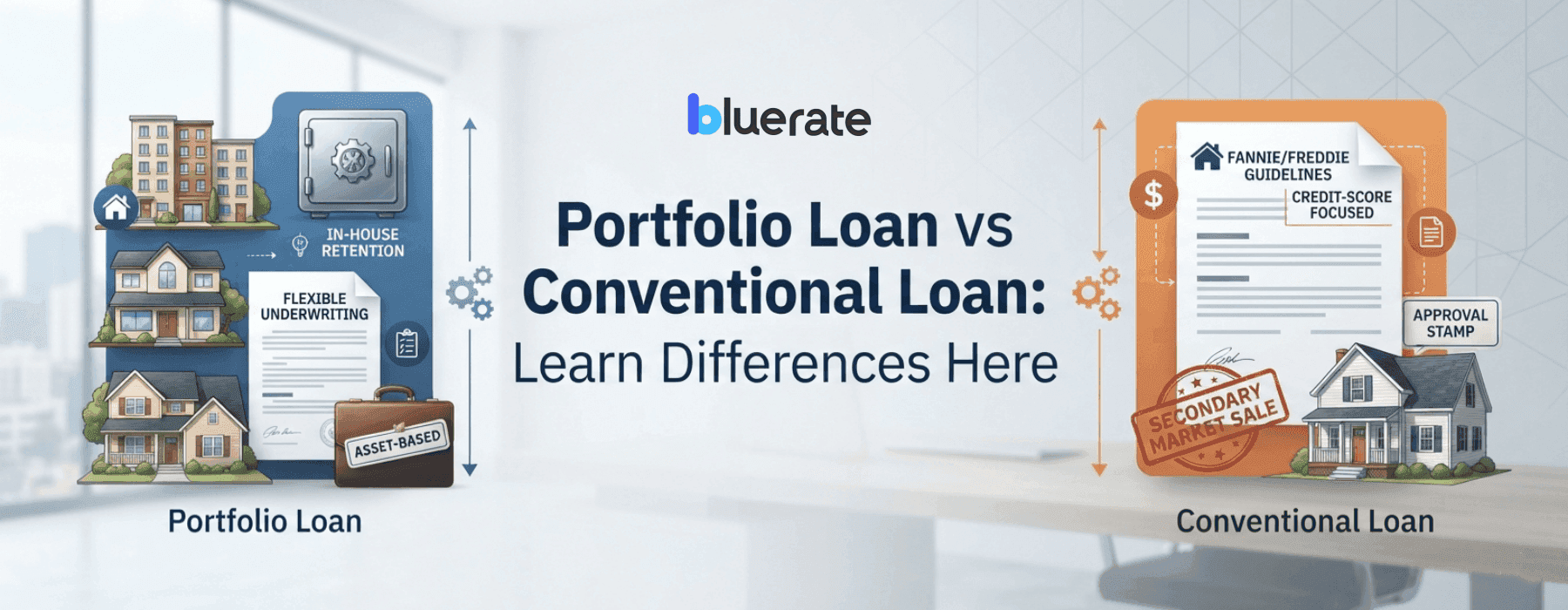
Portfolio Loan vs Conventional Loan: Learn Differences Here
Whenever homebuyers reach out to me confused about their loan options, it usually boils down to how lenders handle risk. Conventional mortgages stick to strict government-backed guidelines and get packaged off to outside investors, while portfolio loans stay right on the lender's books. Knowing how these two paths handle approvals, rates, and paperwork will save you both money and serious closing headaches.
Key Takeaways
-
Where the debt lives: Conventional loans are sold to Fannie Mae or Freddie Mac. Portfolio loans stay in-house.
-
Approval style: Conventional relies on rigid automated algorithms (DU/LPA), while portfolio lenders use hands-on manual underwriting.
-
Income flexibility: Self-employed buyers can use bank statements or 1099s for portfolio mortgages instead of strict tax returns.
-
Price vs. access: Conventional mortgages give you lower rates, but portfolio loans approve non-standard properties and jumbo loan sizes subject to lender guidelines.
What is a Portfolio Loan?
A portfolio loan is simply a mortgage that the lender originates and keeps on its own balance sheet for the entire loan term. Since they aren't offloading the debt to secondary market buyers like Fannie or Freddie, they can write their own rulebook. In my day-to-day work, I turn to these non-conforming and Non-QM programs whenever a borrower has great cash flow but doesn't fit standard agency guidelines.
Pros:
-
Qualify using 12 to 24 months of bank deposits, P&L statements, or liquid assets instead of tax returns.
-
Real human underwriters evaluate your full financial story and compensating strengths.
-
Covers high loan amounts well past conforming caps alongside non-warrantable condos.
Cons:
-
Interest rates run a bit higher to cover the lender's direct financial exposure.
-
You'll usually need more cash down, and investment properties might carry prepayment penalties.
What is a Conventional Loan?
A conventional loan is the traditional mortgage most people think of when buying a home. These are agency-conforming loans backed by standardized criteria set by Fannie Mae and Freddie Mac. To get approved, your file runs through automated software like Desktop Underwriter (DU) or Loan Product Advisor (LPA). Because these mortgages get bundled and sold on Wall Street, lenders cannot bend the rules for you.
Pros:
-
Provides the lowest interest rates and standard closing costs on the market.
-
Down payment options can go as low as 3% for eligible first-time homebuyers through programs like HomeReady or Home Possible. Standard conventional loans typically require at least 5% down.
-
Straightforward terms with no unexpected borrower fees.
Cons:
-
Demands two full years of clean W-2s, standard paystubs, and steady tax history.
-
Automated systems strictly enforce debt-to-income (DTI) ceilings.
-
Private mortgage insurance (PMI) is typically required if your down payment is under 20%, though some lenders offer lender-paid PMI or single-premium options instead of monthly PMI.
Differences Between Conventional Loan and Portfolio Loan
Both options put keys in your hand, but they operate under completely different underwriting mindsets:
-
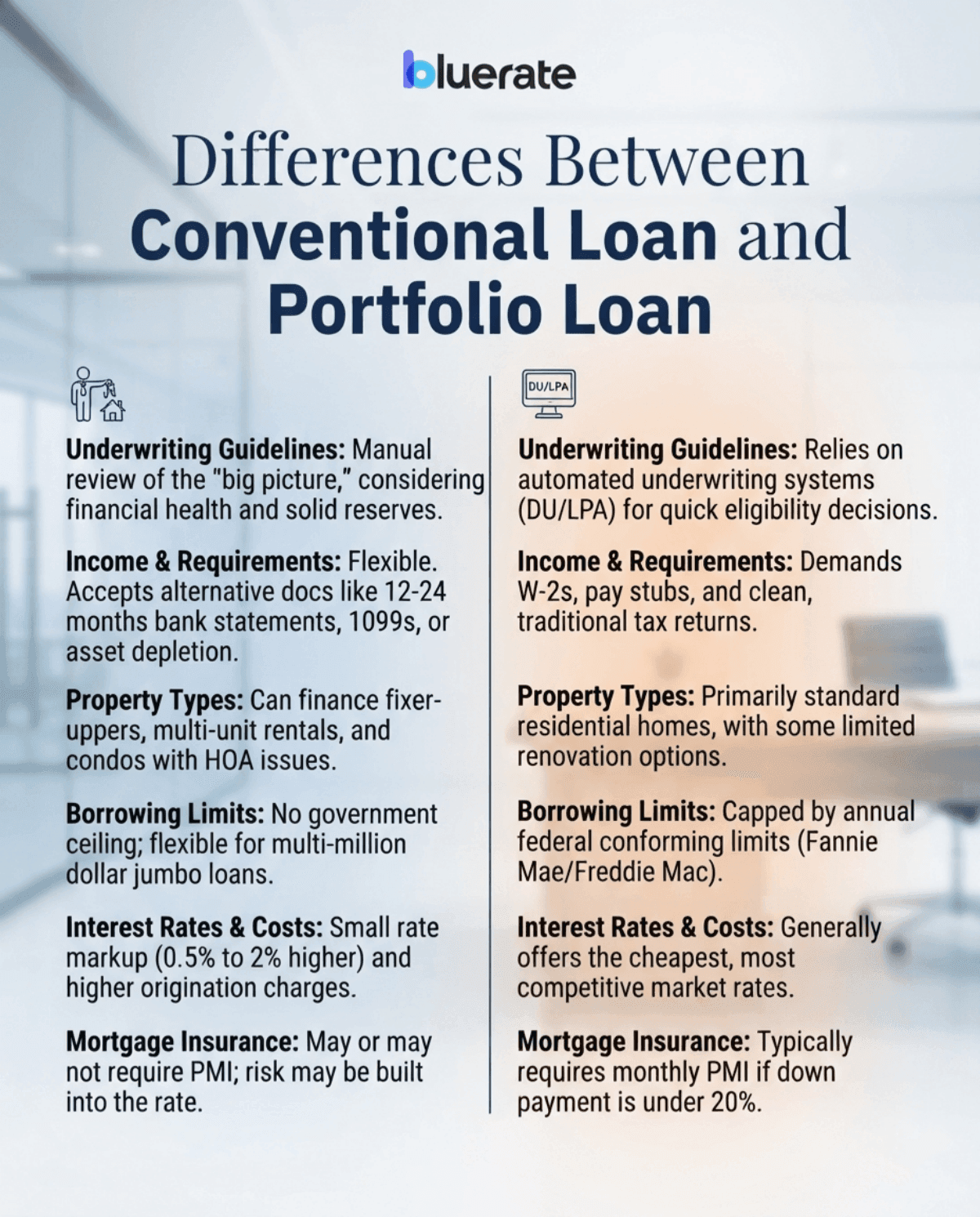
Underwriting Guidelines: Conventional approvals rely on automated underwriting systems (DU/LPA) that issue eligibility findings such as "Approve/Eligible" or "Refer/Eligible," with manual underwriting possible in certain cases. Portfolio lenders rely on manual reviews, letting underwriters look at the big picture if you have solid reserves.
-
Income & Requirements: Conventional loans demand W-2s and clean tax returns. Portfolio loans accept alternative documents like 12 to 24 months of bank statements, 1099s, or asset depletion.
-
Property Types: Conventional financing primarily covers standard residential homes, but renovation loans like HomeStyle or CHOICERenovation allow purchases of properties needing repairs. Portfolio loans can finance fixer-uppers in rough shape, multi-unit rentals, and condos with active HOA issues.
-
Borrowing Limits: Conventional mortgages are capped by annual federal conforming limits. Portfolio loans have no government ceiling and can easily stretch into multi-million-dollar jumbo territory.
-
Interest Rates & Costs: Conventional loans offer the cheapest rates because lenders offload the risk. Portfolio loans come with a small rate markup, usually 0.5% to 2% higher, along with slightly higher origination charges.
-
Mortgage Insurance: Conventional loans typically require monthly PMI if you put down under 20%. Portfolio lenders may or may not require separate PMI. Some build the risk into the interest rate, while others require private mortgage insurance depending on LTV and program.
Which One is Suitable for You?
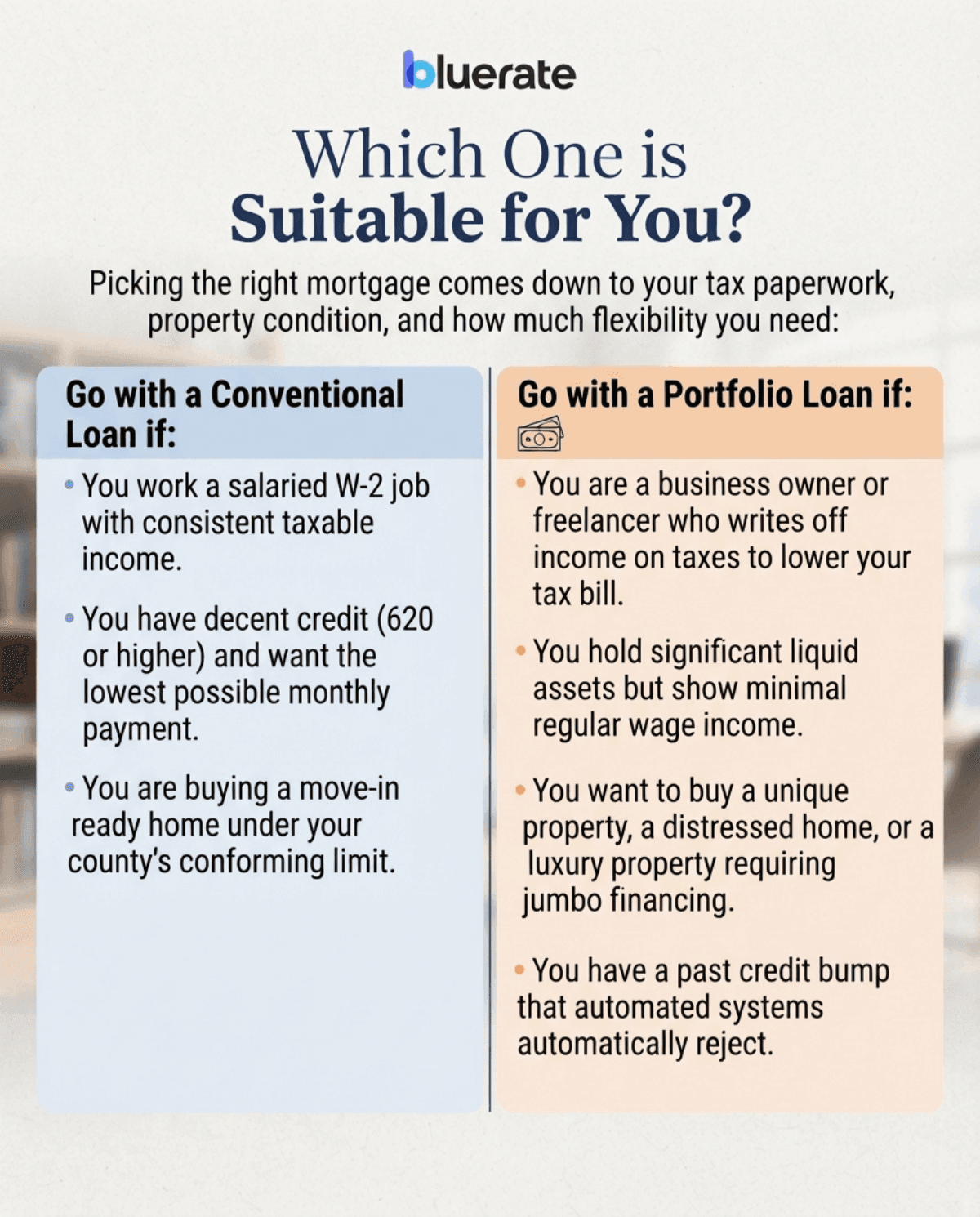
Picking the right mortgage comes down to your tax paperwork, property condition, and how much flexibility you need:
Go with a Conventional Loan if:
-
You work a salaried W-2 job with consistent taxable income.
-
You have decent credit (620 or higher) and want the lowest possible monthly payment.
-
You are buying a move-in ready home under your county's conforming limit.
Go with a Portfolio Loan if:
-
You are a business owner or freelancer who writes off income on taxes to lower your tax bill.
-
You hold significant liquid assets but show minimal regular wage income.
-
You want to buy a unique property, a distressed home, or a luxury property requiring jumbo financing.
-
You have a past credit bump that automated systems automatically reject.
FAQs About Conventional Loan vs Portfolio Loan
Q1. Can I get a portfolio loan with bank statements instead of tax returns?
Yes, absolutely. That is one of the biggest reasons borrowers choose them. Portfolio lenders can look at 12 to 24 months of business or personal bank deposits to calculate your true monthly cash flow, completely bypassing the write-offs on your tax returns.
Q2. Do portfolio loans require private mortgage insurance (PMI)?
Usually, no. While conventional loans slap on monthly PMI if you put down less than 20%, portfolio lenders typically skip traditional insurance policies. Instead, they absorb the down payment risk by adjusting the interest rate or asking for extra cash reserves.
Q3. Why are interest rates generally higher on portfolio loans?
It all comes down to risk. Since portfolio lenders hold the mortgage on their own books rather than selling it to investors, they take on the entire loss if you default. The slightly higher rate helps balance that financial exposure and manual paperwork.
Q4. Can I refinance a portfolio loan into a conventional loan later?
Yes, and it is a smart strategy. Many buyers use a portfolio loan to close quickly on an unusual property or while organizing their finances, then refinance into a lower-rate conventional mortgage once their tax returns or property condition line up.
Q5. What makes a property ineligible for a conventional loan but fine for a portfolio loan?
Conventional loans require homes to meet strict livability standards and reject condos with legal disputes or high commercial usage. Portfolio lenders can finance distressed properties needing heavy repairs, unpermitted additions, and non-warrantable condo projects without issue.
Final Word
There is no one-size-fits-all answer here. It is about finding a loan that matches your actual financial profile. If you are not sure which route makes sense for your budget, hop over to Bluerate. You can connect with an experienced local loan officer, check current rates, and get a clear picture of what you qualify for before you start shopping.
People Also Read
