

Refinance vs Second Mortgage: Full Comparison of Differences
If you need cash or want to change your monthly housing expenses, tapping into your home equity is a proven strategy. Over my years advising homeowners, I often see people get confused between refinancing and getting a second mortgage. Both options unlock capital, but they work quite differently. To make the best financial choice, feel free to connect with a local loan officer on Bluerate for free rate estimates.
Key Takeaways
Here are the core takeaways I share with my clients:
-
Current Loan: A refinance replaces your original mortgage, whereas a second mortgage leaves your primary loan completely intact.
-
Monthly Bills: Refinancing maintains one single monthly payment, while a second mortgage adds an extra monthly bill.
-
Upfront Costs: Refinances carry 2%–6% closing costs. Second mortgages generally feature much lower or zero upfront fees.
Is a Refinance a First or Second Mortgage?
When clients ask me this question, I give them a straightforward answer: a refinance creates a new first mortgage, while a second mortgage sits behind it. When you refinance, your lender pays off your existing first loan entirely. A second mortgage, however, is a standalone secondary lien. Let us look closer at how both options function so you can see which setup fits your wallet.
What is a Refinance?
A refinance is when you replace your current home loan with a brand-new mortgage under updated terms, rates, or loan balances. In my practice, I usually see borrowers choose between a rate-and-term refinance to lower their interest rate or a cash-out refinance to pull out equity.
Key features include:
-
Loan Replacement: Your old mortgage is completely paid off and closed out.
-
Single Interest Rate: You deal with only one loan, one rate, and one lender.
-
New Terms: You can reset your repayment timeline, commonly to a new 15-year or 30-year fixed term (other terms like 10, 20, or ARM options may also be available).
-
Closing Expenses: Expect standard closing fees, which typically run between 2% and 6% of the total new loan balance.
What is a Second Mortgage?
A second mortgage allows you to borrow against your accumulated home equity while generally leaving your original primary loan's terms and interest rate unchanged. You end up with two active loans secured by the same property. These usually come as a fixed-rate Home Equity Loan or a Home Equity Line of Credit (HELOC).
Key features include:
-
Subordinate Lien: Your primary mortgage maintains first priority, and this new loan sits in second place.
-
Preserved Primary Rate: You keep your original loan terms and interest rate exactly as they are.
-
Separate Monthly Payment: You make a second, distinct payment every month.
-
Lower Upfront Costs: Closing costs are minimal, and many lenders even waive fees entirely to earn your business.

Comparison: Differences Between Second Mortgage vs Refinance
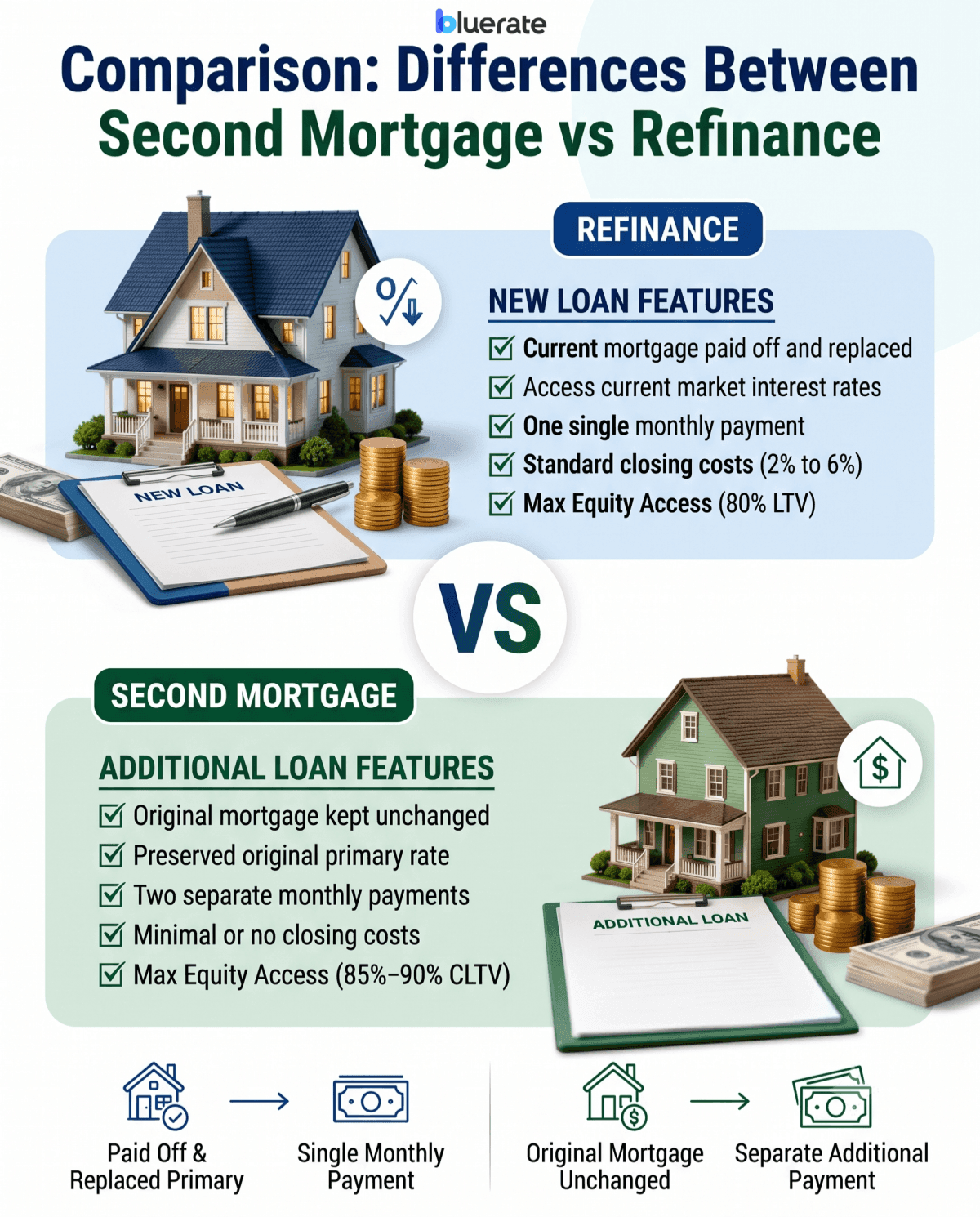
To help you evaluate your choices quickly, I have mapped out the primary differences in the table below. After reviewing these side-by-side specs, we can break down each category in detail.
Current Loan Status
The most fundamental difference comes down to what happens to your primary mortgage. When I write a refinance for a homeowner, we generate a brand-new promissory note that completely liquidates the old debt. Your previous mortgage ceases to exist. On the flip side, taking out a second mortgage keeps your original agreement completely intact. You simply add a secondary lien on top of your existing mortgage without altering its schedule, balance, or terms.
Interest Rate Structures
Interest rates work very differently across these two loan types. A refinance secures current primary market mortgage rates, which are usually fixed. Second mortgages carry higher interest rates, typically 0.5% to 1.5%** **above primary mortgage rates, because lenders take on more risk in second lien position. Additionally, while Home Equity Loans offer fixed interest rates, HELOCs often use variable rates linked to the Prime Rate, meaning your payments can fluctuate over time.
Monthly Payments & Cash Flow
From a day-to-day cash flow perspective, managing these loans feels quite different. Refinancing keeps your life simple because you continue paying just one monthly mortgage bill to a single loan servicer. A second mortgage requires you to manage two separate payments each month, one for your main mortgage and another for your second loan. For my clients who prefer streamlined budgeting, having a single bill is often a major selling point for refinancing.
Closing Costs and Upfront Fees
Closing costs are a major decider when I run calculations for borrowers. Refinancing requires full underwriting, appraisals, and title work, which drives upfront fees to between** 2% and 6% **of the new total loan amount. If you refinance a $300,000 balance, that means $6,000 to $18,000 in costs. Second mortgages cost much less upfront. Lenders frequently cover valuation fees or offer zero-closing-cost promotions, making second mortgages significantly cheaper out-of-pocket initially.
Maximum Borrowing Capacity (LTV vs. CLTV)
How much cash you can access depends on lender limits. For a conventional cash-out refinance, lenders limit your Loan-to-Value (LTV) ratio to 80%, meaning you must keep at least 20% equity in the home. Second mortgages evaluate your Combined Loan-to-Value (CLTV) ratio—the total of both loans relative to your property value. Lenders often allow a higher CLTV cap of 85% to 90%, letting you borrow more total capital without touching your main mortgage.
Impact on Your Existing Low Interest Rate
This factor is crucial in today's housing market. Millions of homeowners locked in historically low mortgage rates around 3% a few years back. If you refinance now, you must replace that ultra-low rate across your entire home balance with today's higher market rates. Taking out a second mortgage protects your 3% primary rate on the bulk of your debt, applying higher current rates only to the new funds you actually borrow.
Is It Better to Refinance or Take out a Second Mortgage?
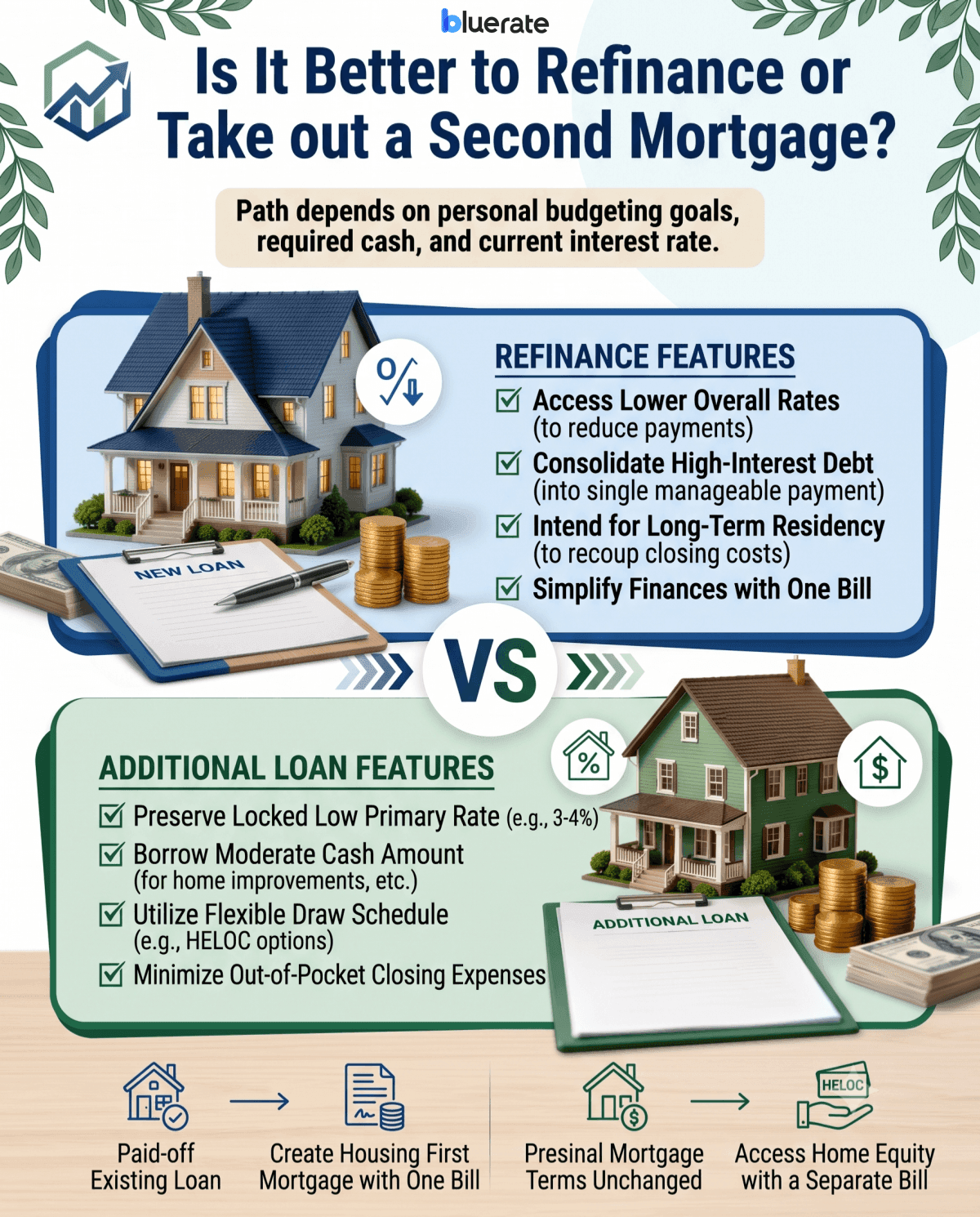
Neither loan is inherently better. The right path depends entirely on your current interest rate, required cash, and personal budgeting goals.
When to Choose a Refinance?
Refinancing makes the most sense when market conditions allow you to improve your financial foundation. I generally advise my clients to consider when to refinance in the following situations:
-
Lower Overall Rates: Current market rates are noticeably lower than your existing mortgage rate, helping you reduce your monthly payment.
-
Debt Consolidation: You want to pull out cash to pay off high-interest credit card debt into one manageable payment.
-
Long-Term Plan: You intend to stay in your home long enough to recoup the 2% to 6% closing costs.
-
Simplified Finances: You prefer tracking a single monthly housing bill rather than managing multiple lenders.
When to Choose a Second Mortgage?
A second mortgage is usually the smarter route when preserving your existing loan terms saves you money. I typically recommend this path under these conditions:
-
Locked Low Primary Rate: You hold a 3% or 4% rate on your main mortgage and want to keep it untouched.
-
Smaller Cash Needs: You only need a modest amount of cash for home improvements or medical expenses and want to avoid heavy closing fees.
-
Flexible Draw Requirements: You want a HELOC so you can borrow and pay interest only on what you use over time.
-
Upfront Savings: You prefer minimizing out-of-pocket closing expenses.
FAQs About Refinance vs Second Mortgage
Q1. Can I get a second mortgage without refinancing?
Yes, absolutely. A second mortgage is an independent financial product designed to sit behind your main mortgage. You can apply for a Home Equity Loan or HELOC with a new lender without altering or refinancing your original mortgage. However, depending on your original loan type and lender policies, you may need to disclose the new lien or obtain consent.
Q2. Is a second mortgage safer than a cash-out refinance?
Both loans use your home as collateral, so defaulting on either carries foreclosure risk. However, second mortgages, particularly HELOCs, often carry variable interest rates, which can increase your monthly payments if market rates rise. Fixed-rate refinances offer more predictable payments, which may be preferable for long-term budgeting.
Q3. Which option has lower upfront fees?
Second mortgages almost always win on upfront costs. Refinancing requires full underwriting fees that range from 2% to 6% of the new total loan balance. Second mortgages require far less paperwork, and many credit unions and banks offer zero-closing-cost options to borrowers.
Q4. Can I consolidate both loans back into one later?
Yes, you can. If interest rates drop down the road, you can execute a single cash-out or rate-and-term refinance that combines your primary mortgage and your second mortgage into one unified loan with a single monthly payment.
Q5. How does each option impact my credit score?
Both options trigger a minor, temporary credit score dip due to the lender's hard credit inquiry and the addition of new debt. Over time, making punctual monthly payments on either loan will strengthen your credit profile and demonstrate responsible debt management.
Final Word
Choosing between a refinance and a second mortgage boils down to your current rate, how much cash you need, and your comfort with managing multiple payments. Protecting a low rate often favors a second mortgage, while single-bill convenience favors refinancing.
To compare live rates and see which strategy saves you the most money, speak with a licensed loan officer today on Bluerate for a free consultation.
People Also Read
HELOC vs Second Mortgage: Is a HELOC a Second Mortgage?
Second Mortgage vs Home Equity Loan: What's the Difference?
How to Stop a Second Mortgage Foreclosure? Learn Here
