
Second Mortgage vs Home Equity Loan: What's the Difference?
Years ago, when I wanted to tap my home equity for a remodel, I got completely stuck trying to tell a 'second mortgage' apart from a 'home equity loan.' Are they two totally different products, or just different names for the same thing? If you're in that boat right now, don't sweat it. Let's break down how they actually work so you can make the right call.
Key Takeaways
-
Same family, different names: "Second mortgage" is a broad legal term referring to any loan secured by your home that sits behind your primary mortgage in lien priority. Both home equity loans and HELOCs are common types of second mortgages, but not all second-lien products are called "home equity loans" in every lender's taxonomy.
-
Home Equity Loans pay a lump sum: You get all the cash at once at a flat, locked-in interest rate.
-
HELOCs act like credit cards: They let you borrow on a revolving basis, but come with variable rates that can fluctuate.
-
Your home is the guarantee: Both loans use your house as security, meaning the bank can foreclose if you stop making payments.
Is a 2nd Mortgage the Same as An Equity Loan?
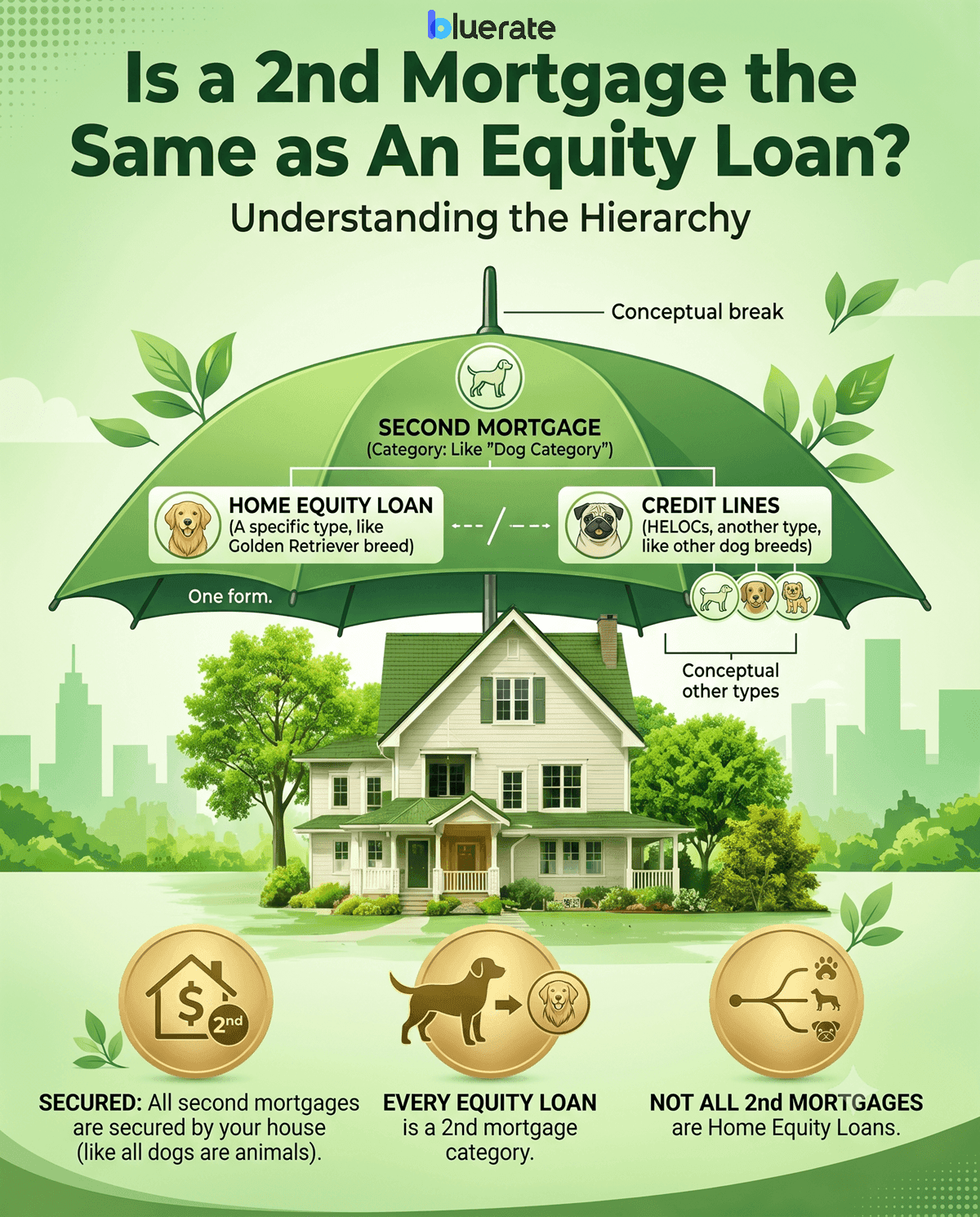
Here is the short answer: not exactly, but they are closely related. Think of 'second mortgage' as a broad umbrella term. A home equity loan is just one specific type of loan that sits under that umbrella. To make it simple, it's like comparing the word 'dog' to a 'Golden Retriever.'
Every home equity loan is technically a second mortgage because it's a second debt secured by your house. But not every second mortgage is a home equity loan—some are credit lines (HELOCs). Once you grasp that hierarchy, the whole confusing mortgage market starts making sense.
Also Read: How to Get a Second Mortgage: Ultimate Guide for Borrowers
What is a Second Mortgage?
When you take out a second mortgage, you are borrowing against your home's built-up value while keeping your original purchase mortgage intact. The word 'second' matters a lot here. It refers to your lender's place in line if things go south. In financial speak, this is a junior lien position. If you default and your home gets sold, the primary lender gets paid off first.
Because they take a back seat, second mortgage lenders take on more risk, which is why their interest rates run slightly higher than first mortgages. To qualify in the U.S., you will typically need to keep a 15% to 20% equity cushion in your property, show a solid credit score, and prove your monthly debts aren't overwhelming your income.
What is a Home Equity Loan?
If you decide to go with a home equity loan, you're signing up for a very predictable, one-time payout. The lender hands you a single lump sum of cash upfront, and you pay it back over a fixed timeline, typically between 5 and 20 years (30-year terms are rare and usually carry higher rates).
What I love about this setup is that the interest rate, currently ranging from 8.5% to over 9.5% APR in the U.S. as of mid-2026, is locked in for good. Your monthly bill won't change, no matter what happens to national rates. It's an ideal setup if you have a massive, one-off expense where you know the exact price tag beforehand, like paying off a specific pile of credit card debt or funding a major kitchen remodel.
Pros:
-
Peace of mind: Fixed rates protect you from market spikes, making monthly budgeting painless.
-
All cash at once: You get the full amount on day one to pay off contractors or creditors.
-
Cheaper than plastic: The interest rates beat credit cards and personal loans by a mile.
Cons:
-
Zero flexibility: You pay interest on the whole amount, even if you end up not needing part of it.
-
**Closing costs: **Expect to shell out roughly 2% to 5% of the loan amount, though many lenders now offer "no-closing-cost" options (in exchange for a slightly higher rate or upfront points). HELOCs often have lower or even waived closing fees compared to lump-sum home equity loans.
-
Rigid bills: If your finances take a hit, that fixed monthly payment isn't going to budge.
Also Learn About HELOC
Now, let's talk about the other main player: the Home Equity Line of Credit, or HELOC. Unlike a loan, a HELOC works more like a giant credit card backed by your roof. You get a credit limit you can borrow against, repay, and reuse as you see fit.
This happens during the 'draw period' (typically 10 years), where most, but not all, lenders allow interest-only minimum payments on the amount you've actually borrowed. Some products now require small principal payments even during the draw phase to reduce end-of-term payment shock.
When that ends, you enter the 'repayment period', often 10 to 20 years, making the total loan term commonly 20 or 30 years depending on the product. The catch? The catch? HELOCs almost always come with variable interest rates, with fully indexed rates typically between 8.0% and 9.0%+ in the U.S. as of 2026, though introductory teaser rates may start lower. This means your monthly bill will drift up or down based on market rate shifts.
Pros:
-
Only pay for what you take: You aren't charged interest on credit you leave untouched.
-
Cheap entry point: Low, interest-only minimums during the draw phase keep initial cash flow easy.
-
Perfect for step-by-step projects: Great for ongoing bills like university tuition or multi-stage renovations.
Cons:
-
Unpredictability: If national interest rates climb, your monthly payment goes right up with them.
-
Easy to overspend: Having an open credit line for ten years is a massive temptation.
-
Payment shock: Once the draw period ends, your monthly bill can skyrocket as you start repaying principal.
Comparing the Three Options:
-
First Mortgage: The main loan you used to buy the house in the first place.
-
Home Equity Loan: A fixed-rate, one-time cash lump sum built for structured, upfront costs.
-
HELOC: A variable-rate, revolving line of credit designed for ongoing, flexible spending needs.
Home Equity Loan vs. HELOC: Understanding the Choice
At the end of the day, picking between these two second mortgages depends on how clear your project's costs are and how you feel about financial surprises. Personally, if I'm dealing with an unpredictable remodel, I like knowing I can tap a credit line on the fly. But if you are someone who gets anxious over fluctuating bills, the predictability of a fixed rate is worth its weight in gold.
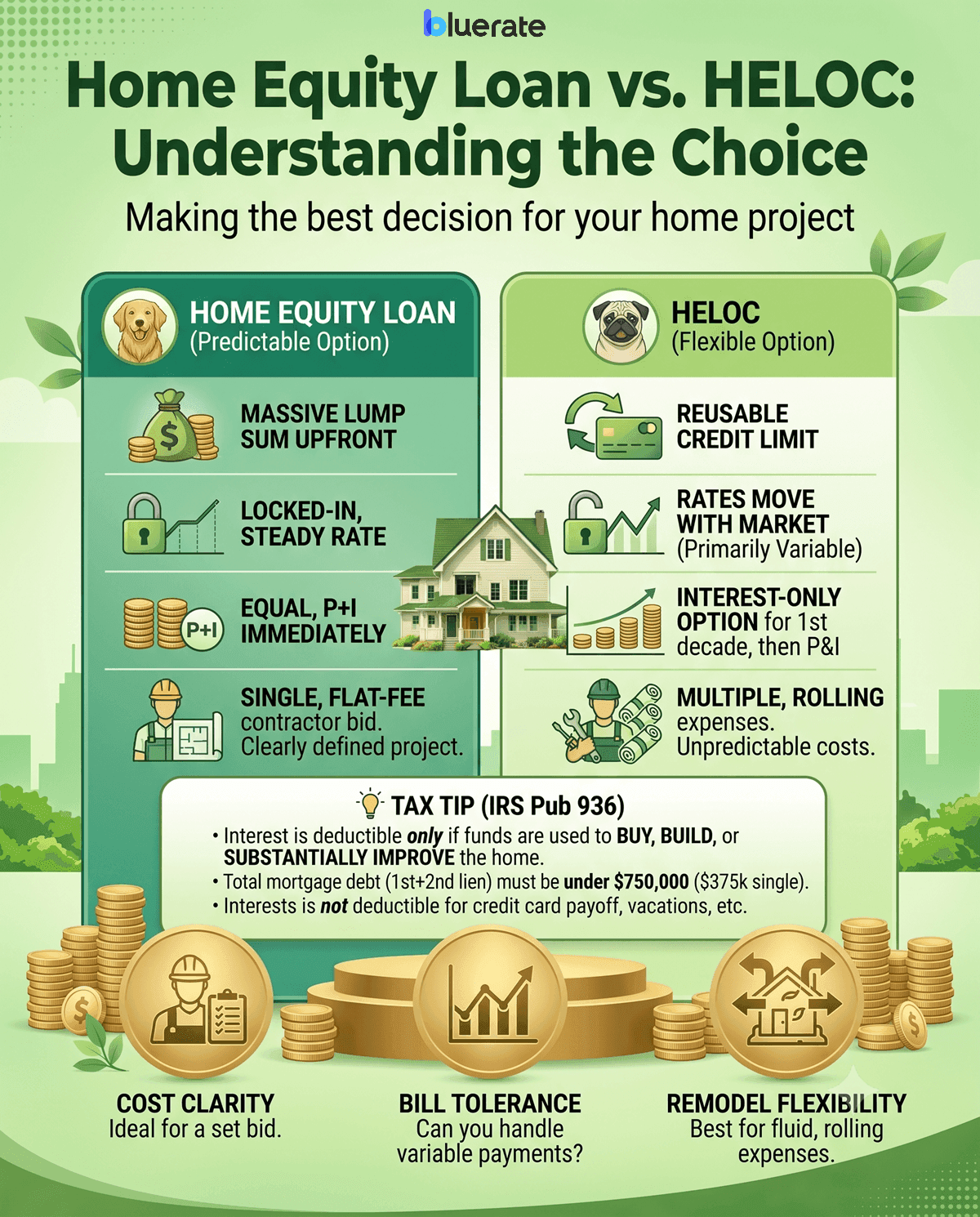
Let's look at how they differ across the board:
-
Payout: You get a massive lump sum upfront with a loan, compared to a reusable credit limit with a HELOC.
-
Rates: Loans give you a locked-in, steady interest rate, whereas HELOC rates move with the market.
-
Repayment: Loans demand equal, principal-plus-interest payments immediately. HELOCs allow interest-only payments for the first decade.
-
Best use: Go with a loan for a single, flat-fee contractor bid. Choose a HELOC if you're managing fluid, rolling expenses.
💡 Tax tip: Under current U.S. tax law (IRS Pub 936), interest on home equity loans and HELOCs is only deductible if the funds are used to buy, build, or substantially improve the home that secures the loan. Plus, your total mortgage debt (first + second lien) must stay under $750,000 ($375k if single) to qualify. Using the money to pay off credit cards or fund a vacation? That interest is not deductible.
FAQs About Second Mortgage vs Home Equity Loan
Q1. Is a home equity loan better than a cash-out refinance?
It honestly boils down to your current mortgage rate. If you locked in a rock-bottom rate a few years ago, say, anywhere from 2.5% to 4.5%, you should protect it at all costs. Refinancing would force you to trade that sweet low rate for today's much higher market rates (6.5%–7%+ for first mortgages, and even more for cash-out refis) on your entire home debt.
Getting a home equity loan lets you borrow extra cash without touching your first mortgage. Refinancing would force you to trade that sweet 3% rate for today's much higher market rates on your entire home debt, which is a massive financial mistake.
Q2. What are the disadvantages of a second mortgage?
The most obvious downside is that you're taking on a second monthly bill. On top of that, these loans carry higher interest rates than your primary mortgage, force you to pay hefty closing costs, and put your home on the line. If life throws a curveball and you can't pay, the lender can foreclose.
Q3. What is the major disadvantage of a home equity loan?
The biggest headache is the lack of flexibility. Because you get the cash in one big lump sum, you start paying interest on every single penny from day one. If you borrow $40,000 but only end up spending $25,000, you're still paying interest on that idle $15,000 sitting in your bank account.
Q4. Can I lose my home with a home equity loan?
Yes, absolutely. This isn't a signature personal loan or a credit card. Your house is the collateral. If you fall behind and default on your payments, the lender can legally seize and sell your home to recover their cash, even if you are perfectly up to date on your first mortgage.
Q5. When not to use a home equity loan?
Avoid using it to fund a lifestyle you can't afford, like buying a luxury boat, taking a dream vacation, or playing the stock market. I'd also say avoid it if you plan to pack up and sell your house in a year or two. You won't live there long enough to recoup the upfront closing fees.
Final Word: How to Choose?
When you are ready to make a move, take a hard look at your spending habits and your project's scope. Do you need all the cash right now, or will you need to pay bills in stages?
Here is a quick cheat sheet to help you choose:
-
Pick a Home Equity Loan if you have a set contractor quote, want a predictable monthly payment that won't ever budge, and prefer a steady, fixed payoff plan.
-
Pick a HELOC if you want an emergency safety net, have rolling college tuition bills, and have a flexible budget that can absorb variable rate changes.
Search for a Vetted LO Nearby and Consult for Free on Bluerate
Disclaimer: This guide is just for informational purposes and shouldn't replace professional financial advice. Always talk to a licensed financial advisor or mortgage broker before signing on the dotted line.
People Also Read
