
How to Get a Second Mortgage: Ultimate Guide for Borrowers
As a homeowner, watching your home value rise is incredibly satisfying. But if you need to fund a major renovation or consolidate high-interest debt, that equity shouldn't just sit there. I know how overwhelming navigating second mortgages can feel. That is why we built this guide. If you want direct, personalized advice, I highly recommend scheduling a free consultation with local Loan Officers near you on Bluerate.
Key Takeaways
-
A second mortgage lets you borrow against your home equity without touching your primary low-rate mortgage.
-
Lenders typically require at least** 15% to 20%** home equity, a credit score of 620+, and a debt-to-income (DTI) ratio below 43%, though some may allow higher ratios (often up to 45%–50%) depending on your credit profile and overall financial strength.
-
Choose a Home Equity Loan for a lump-sum cash payoff with fixed rates, or a HELOC for a revolving line of credit with variable rates.
-
Success requires comparing APRs across multiple lenders and preparing documents like W-2s and tax returns.
What is a Second Mortgage?
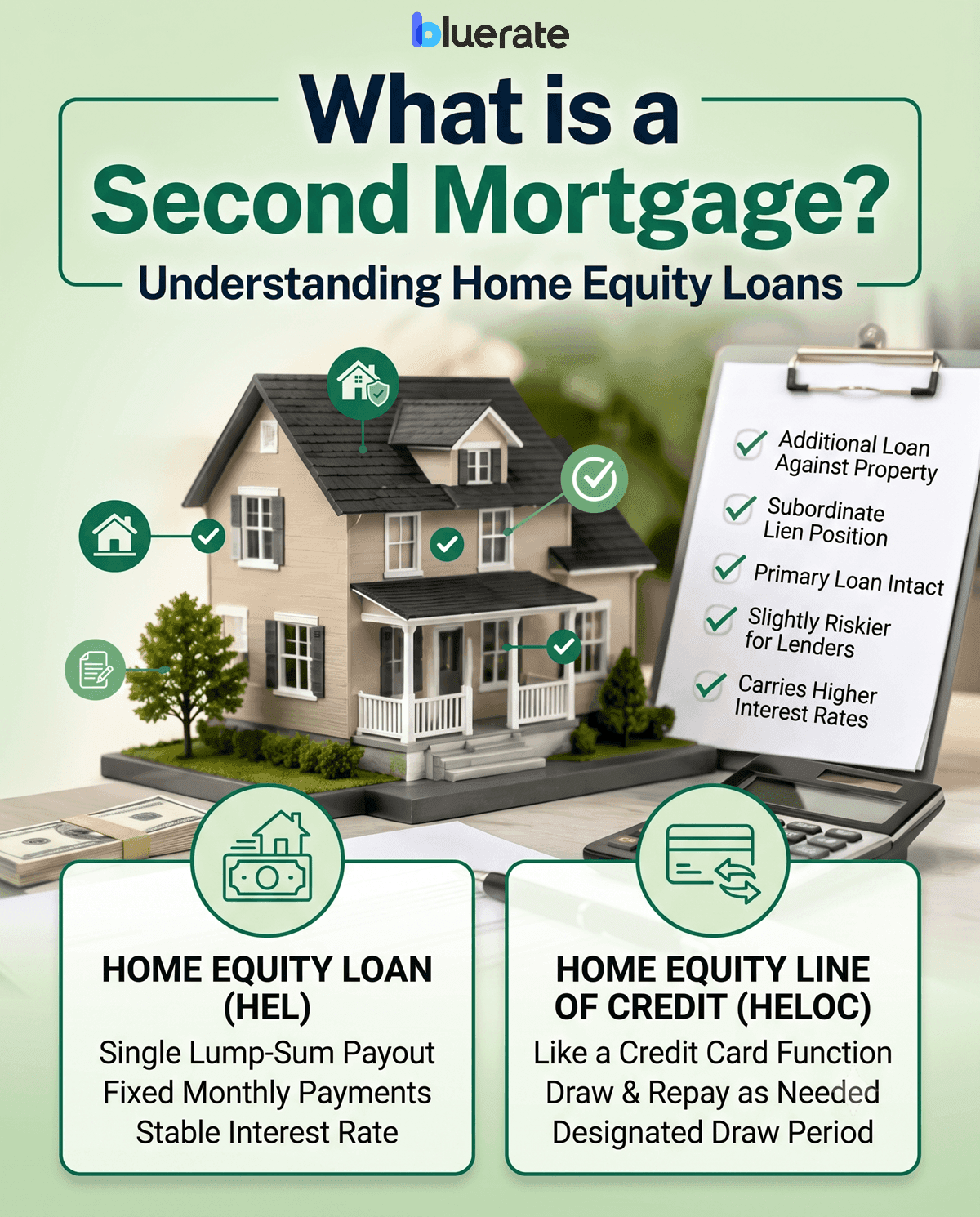
When I first looked into tapping my home's equity, the term "second mortgage" sounded intimidating. Simply put, it is an additional loan you take out against your property while keeping your original home loan completely intact. It is called "second" because it sits in a subordinate lien position. If you default, your primary mortgage lender gets paid first, which makes second mortgages slightly riskier for lenders and carries slightly higher interest rates.
You can typically access this equity in two ways:
-
Home Equity Loan (HEL): Distributes your money in a single lump-sum payout, featuring fixed monthly payments and a stable interest rate over 5 to 30 years.
-
Home Equity Line of Credit (HELOC): Functions like a credit card, allowing you to draw and repay funds as needed during a designated draw period.
Also Read:
Step-by-Step Guide: How to Get a Second Mortgage?
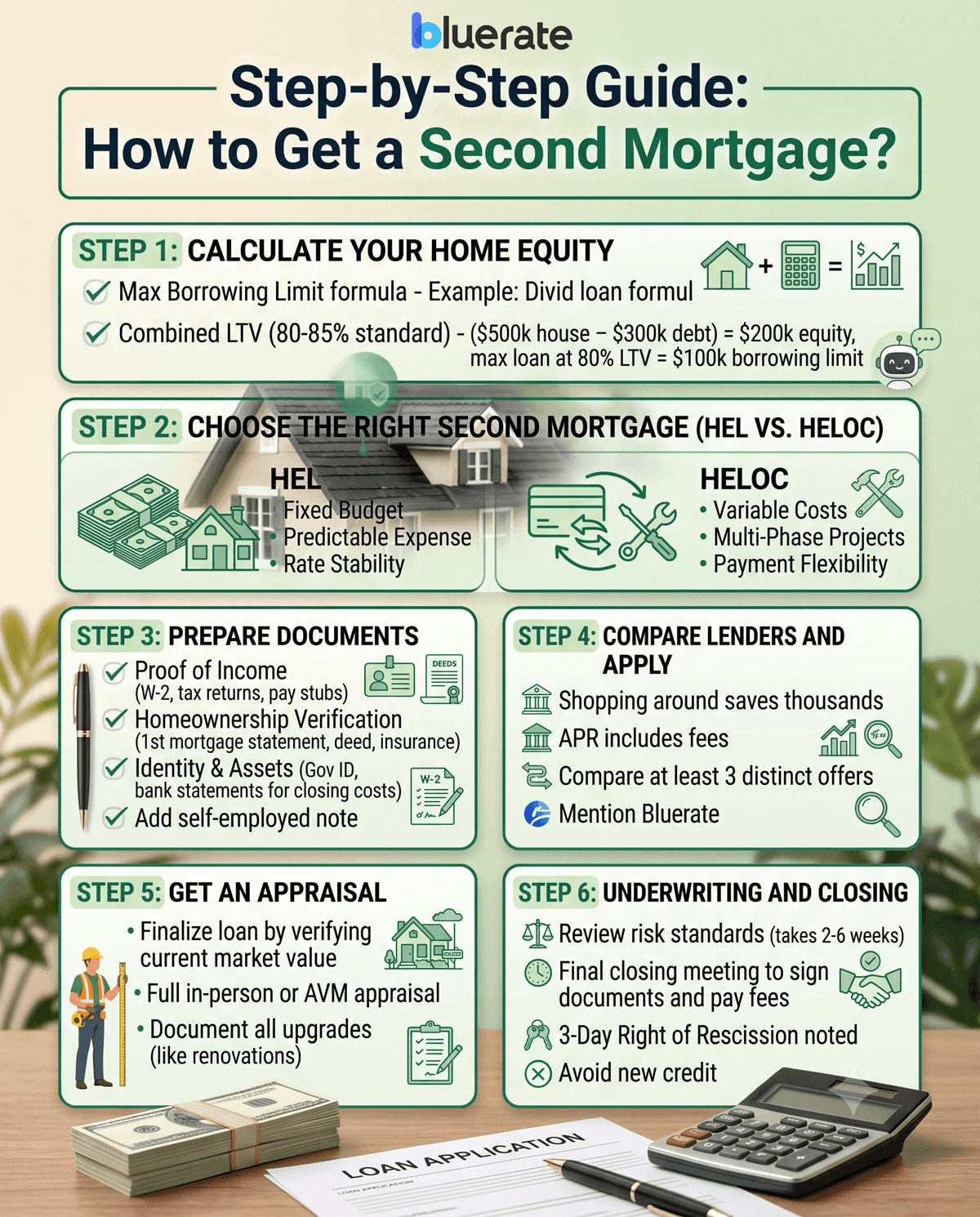
Navigating the application process requires a clear roadmap. We have broken down the journey into six manageable, actionable steps to help you secure the best terms possible:
-
Step 1: Calculate Your Home Equity
-
Step 2: Choose the Right Second Mortgage
-
Step 3: Prepare Documents for a Second Mortgage
-
Step 4: Compare Lenders and Apply
-
Step 5: Get an Appraisal
-
Step 6: Underwriting and Closing
STEP 1. Calculate Your Home Equity
Before you apply, you must figure out exactly how much cash you can actually pull out. I always advise against relying on basic online home value estimates. They are rarely accurate enough for financial planning. Instead, use this standard lender formula:
Maximum Borrowing Limit = (Your Estimated Home Value × LTV Limit) - Current Mortgage Balance
Most lenders cap your Combined Loan-to-Value (CLTV) ratio at 80% to 85%. For example, if your home is worth $500,000 and you owe $300,000, an 80% CLTV limit means your total combined loan balance cannot exceed $400,000 (80% of $500,000). Subtracting your current mortgage balance of $300,000, you could potentially borrow up to $100,000.
To skip the manual math, you can easily use the Bluerate AI Agent via an interactive AI Chat to estimate your equity instantly.
Keep these key factors in mind:
-
Market changes: Local real estate shifts can quickly reduce your home value, impacting your borrowing power.
-
Lender limits: Some credit unions allow up to 90% CLTV, but this usually comes with higher interest rates.
STEP 2. Choose the Right Second Mortgage
Deciding between a Home Equity Loan and a HELOC comes down to how you plan to use the money. In my experience, making the wrong choice can lead to unnecessary interest costs. You need to match the loan structure to your project's timeline and cash-flow needs.
Choose a Home Equity Loan if:
-
You have a fixed budget: Perfect for one-time, predictable expenses like a $40,000 roof replacement or consolidating credit cards.
-
You want rate stability: You prefer a fixed monthly payment that will never fluctuate.
Choose a HELOC if:
-
Your costs are variable: Ideal for ongoing, multi-phase projects like a kitchen remodel where bills come in stages.
-
You want payment flexibility: You only want to pay interest on what you actually withdraw, though you must be comfortable with variable rate fluctuations.
STEP 3. Prepare Documents for a Second Mortgage
To avoid unnecessary delays, you should gather all required financial files before reaching out to lenders. Having a neat, complete package ready to go shows underwriting that you are a highly prepared and low-risk borrower.
Here is what you will need to retrieve:
-
Proof of Income: Your two most recent W-2 forms, tax returns, and 30 days of consecutive pay stubs.
-
Homeownership Verification: Your current first mortgage statement, deed, and up-to-date homeowners insurance policy.
-
Identity and Assets: A government-issued ID alongside recent bank statements verifying you have sufficient funds to cover prospective closing costs.
If you are self-employed, I suggest preparing a year-to-date profit-and-loss (P&L) statement is often required. Some lenders may request it to be prepared or reviewed by an accountant, but this is not always mandatory. Lenders scrutinize self-employed income much more strictly during second mortgage applications.
STEP 4. Compare Lenders and Apply
Never sign with the first second mortgage lender you find. Rates, fees, and closing costs can vary dramatically, and shopping around can save you thousands of dollars over the life of your loan. I always recommend comparing at least three distinct offers, checking traditional banks, local credit unions, and online specialists. To make this search easy and stress-free, we invite you to use Bluerate to find licensed loan officers in your zip code who can provide competing, customized quotes.
As you compare options, keep these factors in mind:
-
The APR: Always compare the Annual Percentage Rate (APR) rather than just the interest rate, as the APR includes lender fees.
-
Closing fees: Ask about application fees, origination charges, and document fees that can inflate upfront costs.
-
Prepayment penalties: Ensure your lender does not charge a penalty if you decide to pay off your second mortgage early.
Also Read:
STEP 5. Get an Appraisal
To finalize your loan, your lender must verify the current market value of your property. They do this by ordering an official home appraisal, which confirms you actually have enough equity to secure the debt. Depending on your lender and loan amount, they might order a full in-person appraisal or a simpler automated valuation model (AVM).
To ensure you get the highest possible valuation, I recommend following these tips:
-
Document all upgrades: Provide the appraiser with a detailed list of recent renovations, or system upgrades, along with receipts.
-
Boost curb appeal: Clean up the yard, touch up paint, and ensure all basic fixtures are fully functional.
-
Declutter the interior: While clutter technically doesn't lower property value, a clean, tidy home allows the appraiser to inspect structural features easily and leaves a strong professional impression.
STEP 6. Underwriting and Closing
Once the appraisal is in, your application heads to underwriting. The underwriter's job is to double-check your financial profile and ensure you meet their risk standards. This phase typically takes anywhere from two to six weeks. If approved, you will attend a closing meeting to sign the final documents and pay your closing fees.
To ensure your loan closes smoothly, avoid these critical mistakes:
-
Don't touch your credit: Do not open new credit cards, close old accounts, or take on new auto loans during underwriting.
-
Keep your job stable: Avoid changing jobs or switching to contract work mid-process, as this triggers immediate re-verification.
-
Use your three-day window: Remember,Federal law generally provides a** three-day **right of rescission for most non-purchase loans secured by a primary residence, such as HELOCs, home equity loans, and refinances.. That allows you to cancel the loan penalty-free if you change your mind immediately after signing.
Tips Before Applying for a Second Mortgage
Before you dive headfirst into the application process, I want to share a few pro tips to protect your financial health and secure the absolute best interest rate. Tapping your home equity is a serious move, and a little preparation goes a long way.
-
Improve your DTI ratio: Try paying off small credit card balances or minor personal loans to lower your debt-to-income ratio.
-
Preserve your first mortgage: If your first mortgage has a low interest rate, do not do a cash-out refinance. A second mortgage can be more cost-effective if your existing mortgage has a significantly lower rate, but in some cases, a cash-out refinance may be cheaper depending on current market rates and fees.
-
Prepare for default risk: Always remember that your home serves as collateral. Ensure your emergency fund can cover both payments in case of unexpected income loss.

FAQs About Getting a Second Mortgage
Q1. Is it hard to get a second mortgage?
It can be slightly harder to qualify for a second mortgage than a first one. Because the second lender takes on subordinate risk—meaning they only get paid after your first mortgage is fully satisfied. They may apply more conservative underwriting standards or charge higher rates due to the subordinate lien position, though requirements vary by lender and product. However, if you have strong equity (20%+), a solid credit score (660+), and a steady income, the process is very straightforward.
Q2. What are the requirements for a 2nd mortgage?
While specific standards vary by lender, most require a minimum credit score of 620 to 660, a debt-to-income (DTI) ratio below 43% (though some credit unions allow up to 50%), and proof of stable income. Crucially, you must also maintain at least 15% to 20% equity in your home after the new loan is factored in.
Q3. Can I get a second mortgage to buy another house?
Yes, absolutely. Many homeowners use a second mortgage, particularly a HELOC, to fund the down payment on a second home, vacation property, or real estate investment. It is a highly effective way to leverage your existing home's value to expand your real estate portfolio without selling your primary residence.
Q4. What is the difference between a cash-out refinance and a second mortgage?
A cash-out refinance replaces your existing first mortgage with an entirely new, larger loan, paying off the old balance and giving you the difference in cash. A second mortgage, however, leaves your original first mortgage completely untouched. You simply add a second, separate loan on top of it, which is ideal if your first mortgage has an incredibly low interest rate you want to preserve.
Also Read: Cash-out Refinance vs HELOC: All Differences to Learn
Q5. Is the interest on a second mortgage tax-deductible?
Yes, but with strict conditions. According to the IRS, interest may be tax-deductible only if the funds are used to buy, build, or substantially improve the home securing the loan, and only if you itemize deductions. Additionally, total mortgage debt limits (generally up to $750,000) may apply. If you use the cash to pay off credit cards or fund a vacation, the interest is not tax-deductible. Always consult a tax professional to confirm your eligibility.
Wrap Up
Taking out a second mortgage is a major financial decision, but it is also one of the most powerful ways to build wealth and fund your goals. By taking the time to calculate your equity, compare terms, and work with the right experts, you can borrow with confidence.
If you are ready to take the next step, I highly encourage you to explore Bluerate to find and consult with trusted, local loan officers who can guide you to the most suitable option.
People Also Read
