

Best Second Mortgage Lenders: 6 Top Picks in 2026
When I bought my vacation home, comparing lenders felt completely overwhelming. Between shifting interest rates, strict underwriting, and hidden fees, finding the right second mortgage lender is tough. To save you the headache, I reviewed the top picks for 2026. If you want to bypass the endless comparison, I recommend using the Bluerate AI Agent to instantly match with the best loan officer near you.
This guide covers both second mortgages (such as HELOCs and home equity loans) and second home purchase loans, which are distinct financial products.
Key Takeaways
Here is a quick summary of my market research:
-
Leading lenders range from national banks like Chase to specialized regional credit unions.
-
Qualifying requires stronger credit (620–680+), lower DTI ratios, and extra cash reserves.
-
Options include leveraging primary equity (HELOCs) or securing traditional second home purchase loans.
-
Using Bluerate speeds up finding local, vetted loan specialists tailored to your financial profile.
General Second Mortgage Requirements
In my years analyzing mortgage markets, I have noticed that lenders treat second mortgages and second home loans with extra caution because secondary residences have historically shown higher default risk during economic downturns, which leads lenders to apply stricter standards.
Whether you are tapping existing equity via a HELOC or buying a getaway cabin, here are the baseline criteria you must meet:
-
Down Payment: Expect to put down 15% to 20% in most cases, although some lenders may allow as low as 10% under strong borrower profiles.
-
Credit Score: Most lenders require at least 680 for second home loans, with 700–720+ typically needed to qualify for the best rates.
-
Debt-to-Income (DTI) Ratio: DTI generally needs to be below 43%, although some borrowers may qualify with higher ratios (up to around 45%) depending on automated underwriting approval and compensating factors.
-
Cash Reserves: You will need proof of 2 to 6 months of liquid cash reserves to cover both mortgages.
Quick Comparison of Best Second Mortgage Lenders
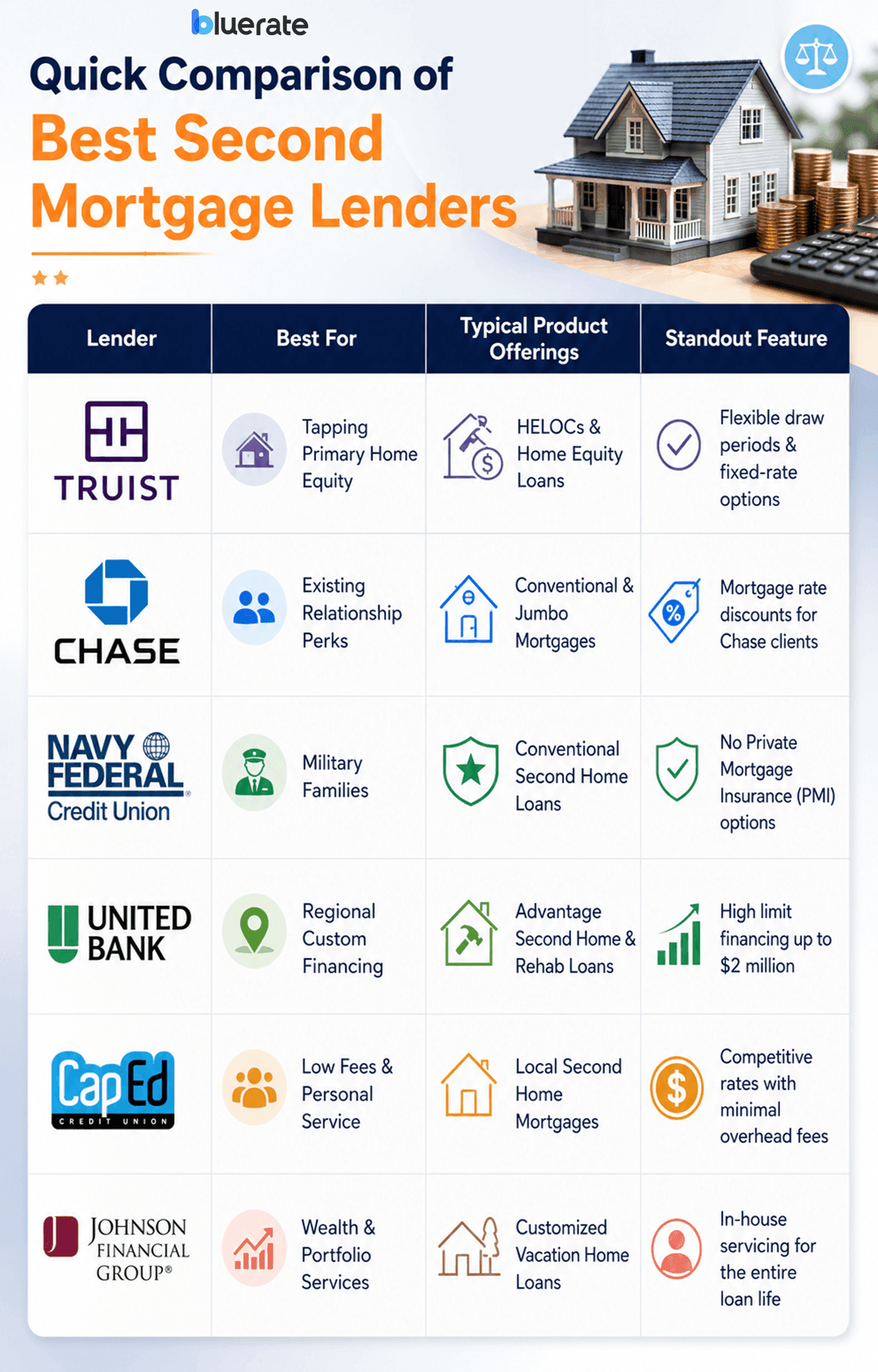
To help you narrow down your choices, I created a side-by-side snapshot of my top six picks for 2026. Each institution excels in different areas depending on whether you prefer big-bank rate discounts, credit union savings, or local portfolio lending.
Top Second Home Mortgage Lenders in 2026
I evaluated dozens of financial institutions to find the best options for 2026. My selection criteria focused on interest rate competitiveness, down payment flexibility, unique customer perks, and transparency during the underwriting process.
#1. Truist
Best Fit: Best for homeowners wanting to tap existing home equity via a HELOC or home equity loan to finance a second residence.
Truist stands out as my top recommendation if you plan to fund your second property using equity built up in your primary home. They offer structured Home Equity Loans and lines of credit (HELOCs) with fixed-rate conversion features. During my review, I appreciated their transparent fee structures and online management portal, which makes moving funds quick and seamless for ongoing projects or earnest money deposits.

Pros:
-
Flexible fixed-rate payment options on HELOC balances
-
No closing cost promotions on eligible home equity products
-
User-friendly digital portal for easy account management
-
Competitive interest rates for existing bank customers
Cons:
-
Branch access is mostly limited to the Southeast and Mid-Atlantic
-
Strict equity requirements on primary properties
#2. Chase
Best Fit: Best for high-net-worth borrowers and existing Chase clients looking for relationship rate discounts on jumbo second home loans.
Chase remains a powerhouse for traditional mortgage financing on vacation properties. I frequently suggest Chase to clients who already hold deposits or investments with the bank because their Relationship Pricing program can slice a meaningful percentage off your mortgage interest rate. They handle both standard conventional loans and complex jumbo mortgages for high-value resort properties, backed by an efficient digital pre-approval process that sellers respect.
Pros:
-
Attractive mortgage rate discounts for existing Chase account holders
-
Extensive availability of fixed and adjustable-rate jumbo loans
-
Seamless mobile app tracking from application to closing
-
Wide geographic coverage across the United States
Cons:
-
Higher credit score standards for jumbo secondary property loans
-
Customer service can feel impersonal compared to local lenders
#3. Navy Federal Credit Union
Best Fit: Best for military members, veterans, and their eligible family members seeking low-cost second home financing.
If you qualify for membership, Navy Federal is tough to beat. While government-backed VA loans cannot be used for secondary residences, Navy Federal bridges the gap by offering conventional loans with low down payment requirements and competitive interest rates for vacation homes. In my analysis, their standout benefit is offering alternatives to traditional borrower-paid PMI, such as lender-paid mortgage insurance (LPMI) or structured pricing that reduces visible monthly PMI costs.
Pros:
-
No Private Mortgage Insurance (PMI) required on conventional loans
-
Consistently lower interest rates than traditional retail banks
-
Dedicated mortgage representatives familiar with military lifestyle needs
-
Flexible terms ranging from 10 to 30 years
Cons:
-
Membership is strictly restricted to military personnel, veterans, and families
-
Underwriting processing times can be longer during peak seasons
#4. United Bank
Best Fit: Best for borrowers looking for higher loan limits, personalized regional underwriting, or renovation loan bundles.
United Bank is a premier regional bank offering tailored products like their "United Bank Advantage" second home program. I like United Bank for buyers purchasing properties that might need upgrades or those needing loan amounts up to $2 million without navigating national bank bureaucracy. Their local mortgage originators walk you through unique options, including combined purchase-and-rehabilitation loans that let you finance remodeling expenses right into your main mortgage.

Pros:
-
Generous financing limits up to $2 million for second homes
-
Renovation loan options that bundle purchase and repair costs
-
High level of one-on-one support from local loan officers
-
Customized in-house underwriting for unique properties
Cons:
-
Regional footprint primarily serves Mid-Atlantic states
-
Fewer fully automated digital application tools
#5. CapEd Credit Union
Best Fit: Best for Idaho and Mountain West borrowers seeking community-focused service, low fee structures, and competitive credit union rates.
CapEd Credit Union delivers the personalized care that large national banks often lack. Based in Idaho, CapEd offers specialized second home and vacation home mortgages with extremely low overhead fees and transparent guidelines. From my experience reviewing regional lenders, credit unions like CapEd are fantastic for buyers looking at mountain cabins or local getaway condos, as their underwriters understand local property values better than distant corporate algorithms.
Pros:
-
Lower closing costs and fewer administrative fees
-
Deep local market knowledge for rural or resort properties
-
Highly responsive customer support throughout the loan lifespan
-
Competitive interest rates for credit union members
Cons:
-
Geographic focus is limited primarily to regional residents
-
Less advanced tech infrastructure than big national brands
#6. Johnson Financial Group
Best Fit: Best for Midwest borrowers wanting comprehensive wealth management integrated with long-term portfolio mortgage servicing.
Johnson Financial Group excels at taking a holistic view of your finances when funding a secondary residence. Unlike mortgage brokers who sell off your debt immediately after closing, Johnson Financial Group services many of their loans in-house. I appreciate their portfolio lending capabilities, which allow them to accommodate complex financial profiles, self-employed borrowers, or non-standard property types that traditional cookie-cutter lenders reject.

Pros:
-
In-house loan servicing keeps your mortgage with the same team
-
Customized wealth management integration for long-term goals
-
Flexible portfolio loan options for unique financial situations
-
Dedicated loan officers who stay with you post-closing
Cons:
-
Physical branches are concentrated mostly in the Midwest
-
Requires a more detailed financial review during underwriting
How to Choose a Fit Second Home Mortgage Lender?
Choosing the right lender for your second home comes down to matching your personal financial strengths with the lender's specialty. Here is my personal checklist when helping clients choose:
-
Compare Full Loan Costs: Look beyond interest rates. Calculate origination fees, appraisal costs, and closing expenses.
-
Check Property Restrictions: Confirm whether the lender allows short-term rentals if you plan to offset costs via Airbnb.
-
Evaluate Local Expertise: Choose a lender familiar with the regional real estate market where your second home is located.
-
Assess Processing Speed: In competitive vacation markets, fast pre-approvals can win bidding wars.
Pro Tip: Finding a local officer who understands second home nuances can be tedious. I suggest using the Bluerate AI Agent to instantly connect with top-rated loan experts in your target area for free, tailored advice.
FAQs About Top Second Mortgage Lenders
Q1. Do banks offer second mortgages anymore?
Yes, financial institutions actively offer second mortgages. They primarily come in two forms: Home Equity Lines of Credit (HELOCs) or Home Equity Loans on your primary residence, and standalone second home purchase mortgages for acquiring new vacation properties.
Q2. How does a 2nd home mortgage work?
A second home mortgage works similarly to a primary home loan, but lenders enforce stricter qualification criteria. You must occupy the property for personal use part of the year, put down a higher down payment, and maintain strong credit to offset the lender's risk.
Q3. How much can I borrow for a 2nd home?
Borrowing limits depend on your income, existing debt, and property equity. Typically, lenders restrict your combined debt-to-income (DTI) ratio to 43%–45% and cap loan-to-value (LTV) limits between 80% and 90% of the second home's appraised value.
Q4. What is the main difference between a second mortgage and a second home loan?
A second mortgage is an additional loan taken against your existing home's equity (a junior lien like a HELOC). A second home loan is a primary mortgage used specifically to purchase a secondary residence or vacation property.
Q5. Can I use a HELOC on my primary home to buy a second home?
Absolutely. Many buyers pull equity from their primary residence via a HELOC to fund the down payment, or even pay cash, for a second home, which may help reduce or avoid PMI on the new mortgage, though it increases overall leverage and must be carefully evaluated by lenders.
Conclusion
Securing a second home mortgage is a major milestone, but picking the right financial partner keeps costs low. Here is my 2026 recap:
-
Truist: Best for HELOC equity financing
-
Chase: Best for relationship rate discounts
-
Navy Federal: Best for military families (no PMI)
-
United Bank: Best for higher limits & rehab loans
-
CapEd Credit Union: Best for low regional fees
-
Johnson Financial Group: Best for portfolio servicing
Ready to find your ideal fit? Visit Bluerate to let the Bluerate AI Agent match you with top local loan experts today.
