

2026 Updated: Mortgage Application Checklist for You
Over the years, I've seen countless buyers face frustrating underwriting delays simply because they missed a single financial document. Whether you earn a standard W-2 salary, run a business, invest in real estate, or buy your very first home as a renter, your prep work matters. I built this straightforward checklist to help you organize your loan file before talking to a lender and get pre-approved faster.
Also Read:
- Mortgage Application Explained: Definition, Requirements, and FAQs
- Documents Needed for Mortgage Application: Get 100% Ready
Key Takeaways
-
Universal Basics: Most borrowers should be prepared to provide a government-issued photo ID, the taxpayer identification information accepted by the applicable loan program, and a complete residential history, commonly covering the previous two years. Additional immigration or residency documentation may be required depending on the borrower's status and loan program.
-
Core Financials: Expect to gather income proof, asset statements, and a complete debt breakdown.
-
Borrower Specifics: Tailor your loan file to your situation—W-2 wage earners, self-employed business owners, real estate investors, and current renters each have distinct document requirements.
-
Proactive Prep: Organize your paperwork early to prevent underwriting delays and secure smoother approvals.
Mortgage Application Checklist For W-2 Employees
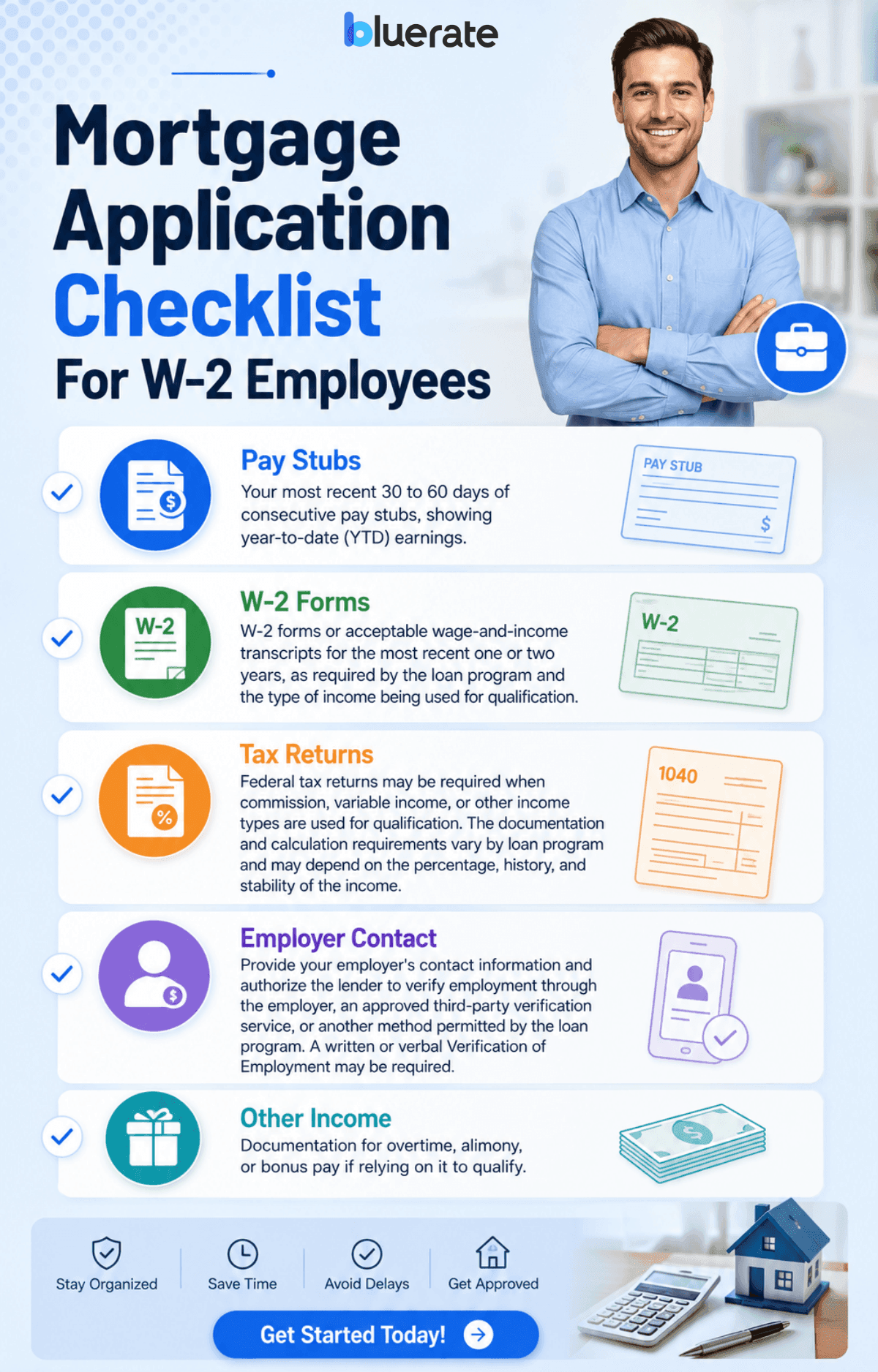
When I work with salaried or hourly workers, their process is usually the most straightforward, yet small errors like missing pay stub pages can still stall underwriting. Lenders want to confirm steady earnings and job stability over a two-year window, often using digital automated verification alongside paper backup.
-
Pay Stubs: Your most recent 30 to 60 days of consecutive pay stubs, showing year-to-date (YTD) earnings.
-
W-2 Forms: W-2 forms or acceptable wage-and-income transcripts for the most recent one or two years, as required by the loan program and the type of income being used for qualification.
-
Tax Returns: Federal tax returns may be required when commission, variable income, or other income types are used for qualification. The documentation and calculation requirements vary by loan program and may depend on the percentage, history, and stability of the income.
-
Employer Contact: Provide your employer's contact information and authorize the lender to verify employment through the employer, an approved third-party verification service, or another method permitted by the loan program. A written or verbal Verification of Employment may be required.
-
Other Income: Documentation for overtime, alimony, or bonus pay if relying on it to qualify.
Mortgage Application Checklist For Self-Employed Borrowers
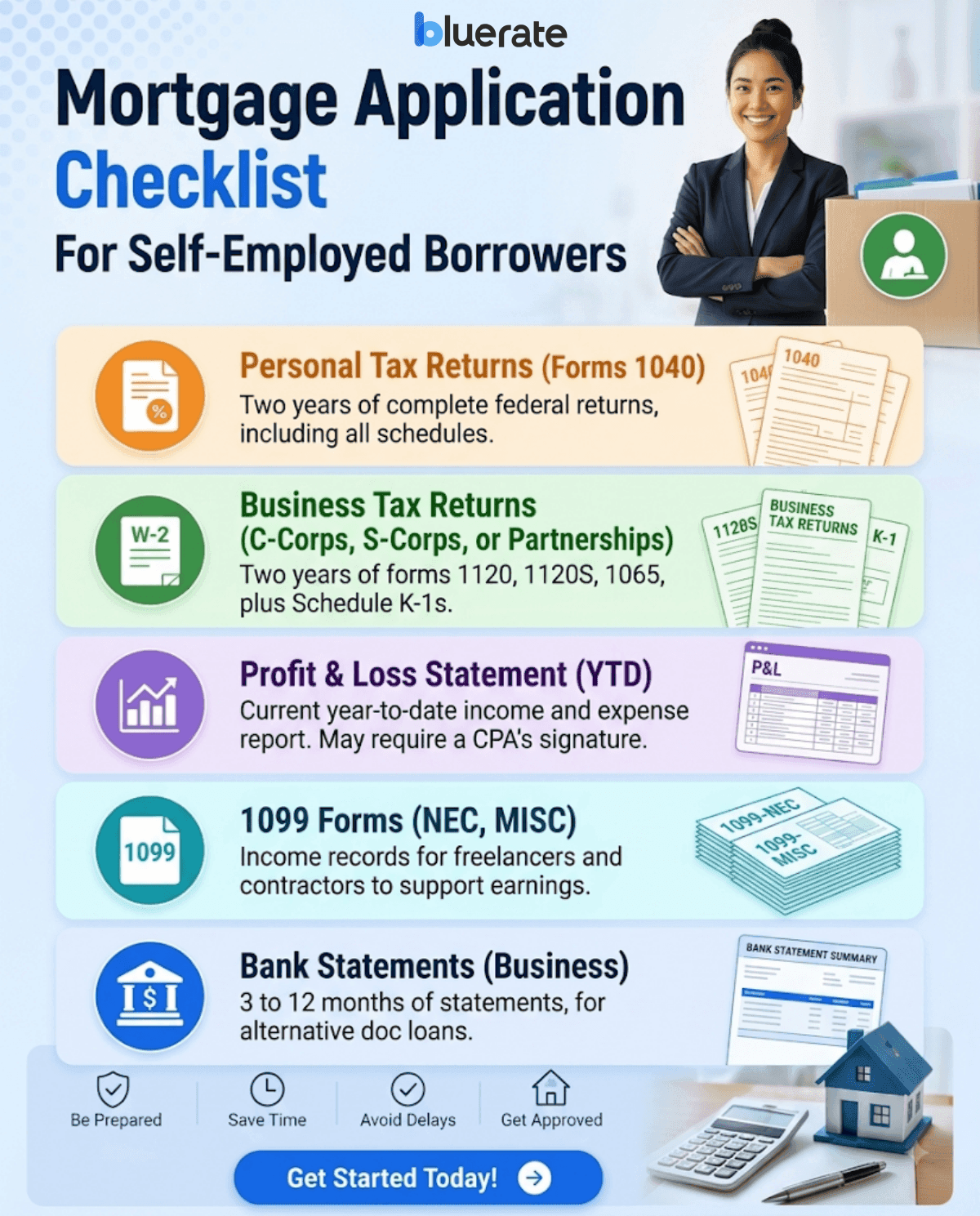
If you are a freelancer, contractor, or business owner, lenders scrutinize your income closely because tax write-offs can lower your qualifying income. I always advise my self-employed clients to demonstrate cash flow stability through net adjusted income rather than gross revenues.
-
Personal Tax Returns: Two years of complete federal returns (Form 1040) with all schedules.
-
Business Tax Returns: Two years of corporate returns (Forms 1120, 1120S, 1065, or Schedule C) plus Schedule K-1s.
-
Profit & Loss Statement: A current year-to-date profit-and-loss statement may be required, and the lender may also request a balance sheet or other business financial information. The lender will specify whether the statement must be signed by the borrower, a CPA, or another qualified preparer.
-
1099 Forms: If applicable, provide Forms 1099-NEC, 1099-MISC, or other income records that support the self-employment income reported on the tax returns and used for qualification.
-
Business Ownership Proof: Depending on the business structure and lender, provide documents that support the existence and ownership of the business, such as business registration records, licenses, formation documents, or other acceptable third-party documentation.
-
Bank Statements: 3 to 12 months of business bank statements if applying for alternative documentation loans.
Mortgage Application Checklist For Investors
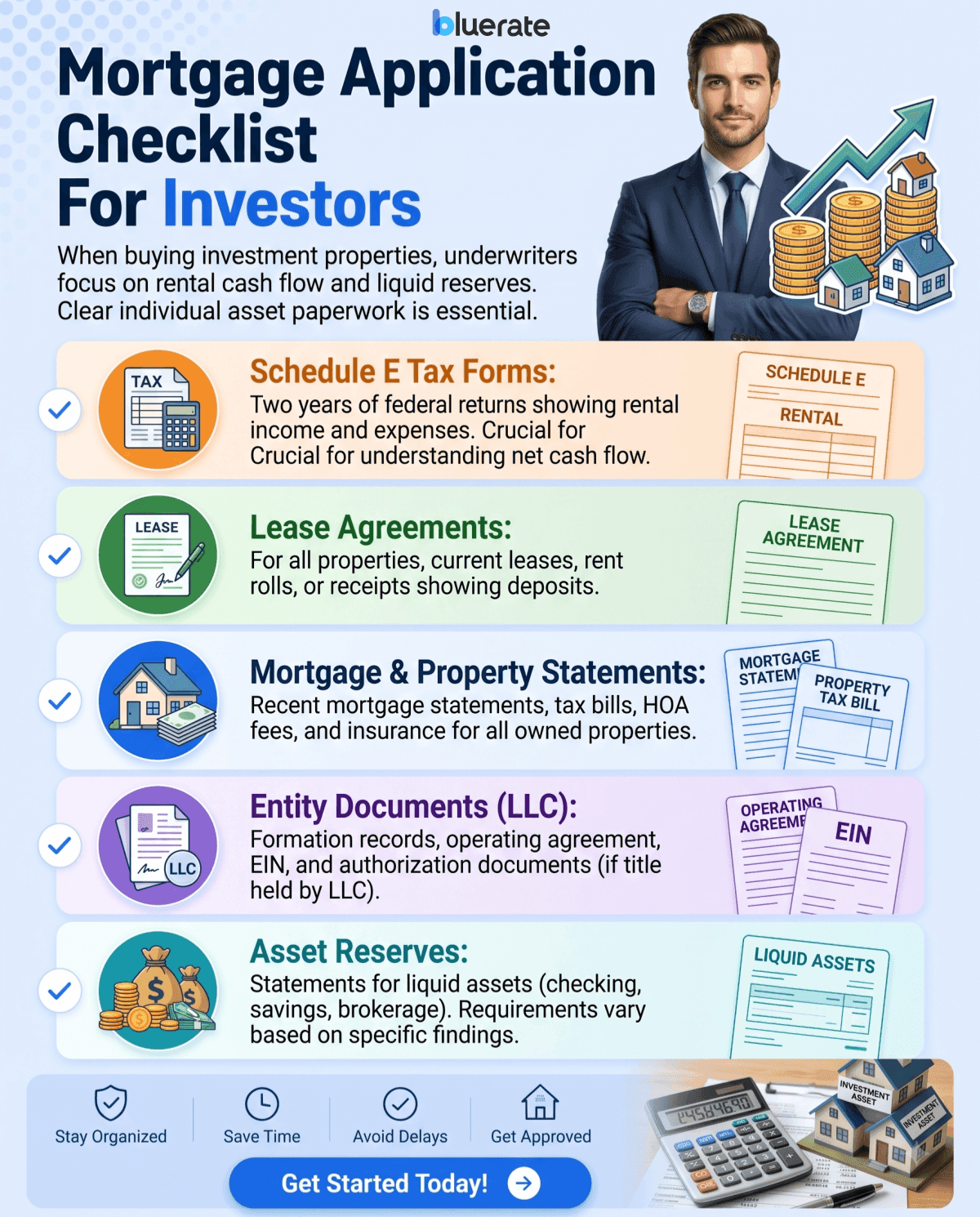
When evaluating real estate investors buying non-owner-occupied properties, underwriters look beyond personal income to focus on rental cash flow and cash reserves. I often remind investors that having multiple properties requires clear paperwork for each asset to satisfy debt-to-income and liquid reserve calculations.
-
Schedule E Tax Forms: Two years of federal tax returns showing rental income and expenses.
-
Lease Agreements: For applicable rental properties, provide current leases, rent rolls, rent receipts, or bank statements showing rental deposits. The lender may request additional documentation for vacant, short-term, or recently acquired properties.
-
Mortgage & Property Statements: Recent mortgage statements, property tax bills, HOA fees, and insurance declaration pages for all owned real estate.
-
Entity Documents: If the transaction involves an LLC, the lender may request formation documents, an operating agreement, ownership information, an EIN confirmation, and authorization documents. Whether an LLC may take title or be used in the loan depends on the lender and loan program.
-
Asset Reserves: Provide statements for eligible liquid assets, such as checking, savings, brokerage, or retirement accounts, if reserves are required. Reserve requirements vary by loan program, property type, number of financed properties, DTI, and underwriting findings. They are not universally calculated as 3 to 12 months of PITIA for every property.
Mortgage Application Checklist For First-Time Homebuyers (Current Renters)
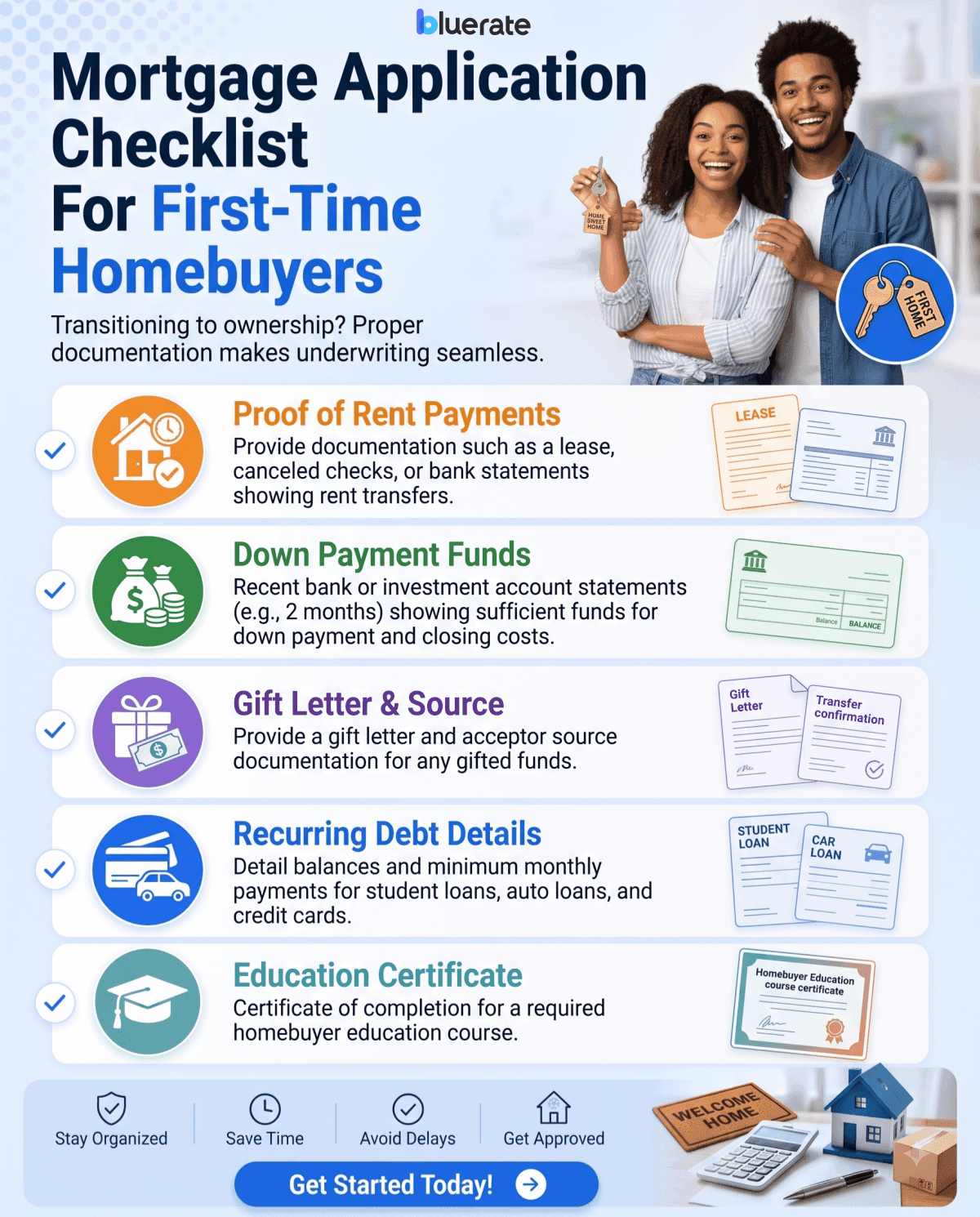
Transitioning from renting to owning is exciting, but because you lack a property ownership track record, lenders double-check your rental payment history and down payment sources. In my experience, showing clean rent transfers and properly documented gift funds makes the underwriting process seamless.
-
Proof of Rental Payments: 1If requested, provide rental documentation such as a lease, landlord Verification of Rent, canceled checks, bank statements, payment-service statements, or a property-management payment history. Certain FHA first-time-buyer transactions may use a documented 12-month positive rental payment history to support the underwriting assessment.
-
Bank Statements: Provide the most recent bank or investment account statements required by the lender, often two months for a purchase transaction, showing sufficient funds for the down payment, closing costs, and any required reserves. The lender may also require documentation explaining large or recently received deposits.
-
Gift Letter: If gift funds are being used, provide a gift letter and documentation acceptable to the lender showing the donor's source of funds and the transfer of the gift to the borrower, settlement agent, or closing account. The required transfer evidence may include bank statements, a wire confirmation, a canceled check, or other acceptable documentation.
-
Recurring Debt Records: Statements for student loans, auto loans, and credit cards detailing balances and minimum monthly payments.
-
Education Certificates: Complete a homebuyer education course only when required by the applicable down-payment assistance program, lender, or loan product, and retain the certificate of completion.
What Else You Should Pay Attention To?
Gathering your paperwork is only half the battle. Keeping your financial profile stable until closing is equally vital. In my practice, I constantly urge buyers to avoid common pitfalls that trigger last-minute underwriting rejections.
-
Document Expiration: Keep in mind that pay stubs and bank statements usually expire after 60 to 90 days.
-
Large Deposits: Be prepared to explain and document large or unusual deposits, especially when the funds are being used for the down payment, closing costs, or reserves. Unverified funds may be excluded from the assets used to qualify, and cash-on-hand may not be acceptable under many loan programs.
-
Credit Change: Avoid opening new credit accounts, financing purchases, changing jobs without discussing the change with your lender, or taking on additional debt before closing. These changes may require a new credit review or recalculation of your debt-to-income ratio. Do not place or remove a credit freeze without coordinating with your lender if a credit report must be accessed.
-
File Integrity: Submit complete PDF documents, including blank pages, and avoid low-resolution phone screenshots.
-
Data Security: Always upload sensitive financial files through encrypted portal connections rather than unencrypted email.
Conclusion
Preparing your mortgage application package ahead of time puts you in total control of your homebuying journey. When you organize your documents by borrower type, you eliminate unnecessary stress and speed up your loan pre-approval. I encourage you to gather your financial file today, verify your paperwork, and consult with a licensed mortgage loan originator to review your best loan options before shopping for properties.
Important note: This checklist describes documents commonly requested for U.S. residential mortgage applications. It is not a universal or exhaustive list. Requirements vary by loan program, lender, automated underwriting findings, borrower profile, property type, occupancy, income source, and state law. Your lender or licensed mortgage loan originator may request additional or different documentation.
People Also Read
