
Documents Needed for Mortgage Application: Get 100% Ready
I've sat with countless homebuyers who freeze the minute we talk about paperwork. You just want a clear list of what to pull together so underwriting doesn't stall your file. Because loan rules shift between Conventional, FHA, or VA programs—and banks love adding their own overlays—getting organized early saves serious headaches. Here is the documents required when I hand my clients before we submit anything.
Key Takeaways
-
The Big Four: Lenders only care about verifying four things: who you are, what you make, what you own, and what you owe.
-
Core Records: Pull your last 30 days of pay stubs, 2 years of W-2s/tax returns, and the most recent 2 months of complete bank statements for all accounts used to qualify (refinance files may require only 1 month. Some programs or complex files may ask for more).
-
Expiration Dates: Pay stubs typically must be dated within 30 days of application/closing. Most credit documents (income, assets, credit report) must be no more than four months (120 days) old on the note date under Fannie Mae guidelines.
-
Unbroken Pages: Underwriters will reject a 6-page bank statement if page 6 is missing, even if that page is completely blank.
Mortgage Application Documents Required
When I submit an application to my underwriting desk, the goal is simple: prove your Debt-to-Income (DTI) and Loan-to-Value (LTV) ratios on paper. To keep your file moving without endless conditions, here is what you need to collect and where to grab it.
Personal Identification & Application Records
Lenders run tight identity checks upfront to pull your credit report and satisfy federal anti-money-laundering rules.
-
Valid Photo ID: A current driver's license, state ID card, or passport. Snap a clean, uncropped color scan of the front and back.
-
Social Security Verification: Your physical Social Security card, or a recent W-2/1099 clearly showing all nine digits.
-
Uniform Residential Loan Application (Form 1003): Your loan officer generates this, but you'll review and sign off on two full years of addresses and job history.
-
Legal Residency Status (if non-US citizen): A copy of your permanent resident card (Green Card) or active work visa (like H-1B, L-1, or EAD card with approval notices).
Proof of Income & Employment
Underwriters want proof that your earnings are steady, recurring, and likely to continue for at least three more years.
-
Last 30 Days of Pay Stubs: Showing current and year-to-date (YTD) earnings. Pull these straight as PDFs from your workplace payroll portal (such as Workday, ADP, or Gusto).
-
Past 2 Years of W-2s or 1099s: Lenders need both years to calculate your baseline income. Grab them from your tax folder or past employer portals.
-
Past 2 Years of Federal Tax Returns (Form 1040): Required for self-employed borrowers, 1099 contractors, or anyone counting rental income. Include all schedules (Schedule C, E, etc.).
-
Self-Employed Business Packages: If you own 25%+ of a business, bring 2 years of business returns (1120-S or 1065) plus a current, signed year-to-date Profit & Loss (P&L) and balance sheet.
-
IRS Form 4506-C: You'll sign this so the lender can pull official tax transcripts directly from the IRS to cross-check your numbers.
-
Award Letters & Court Orders: Formal paperwork for Social Security, disability, pensions, or court-ordered child support backed by 12 months of cleared deposits.
Assets and Down Payment Funds
Where your cash comes from matters just as much as how much you have in the bank.
-
Checking & Savings Statements (2–3 Months): Export full PDF statements from your online bank portal. Do not use mobile phone screenshots.
-
Investment & Retirement Statements: Recent monthly or quarterly statements for your 401(k), IRA, or brokerage accounts to show financial reserves.
-
Gift Letters & Audit Trail: If family is helping with funds, you'll need a signed gift letter stating the money isn't a loan, plus bank receipts showing the money leaving their account and landing in yours.
-
Letter of Explanation (LOE) for Large Deposits: Any deposit outside regular payroll that exceeds 50% of your monthly qualifying income needs a written note and a paper trail (like a vehicle bill of sale).
Debts and Liabilities
While your credit pull catches most recurring debts, we still have to document items that sit off the standard bureaus.
-
Monthly Debt Statements: Recent bills for auto loans, student loans, or personal loans showing your remaining balance and minimum monthly payment.
-
Other Property Records: If you own other real estate, provide your current mortgage statement, tax assessment, and hazard insurance bill for each property.
-
Divorce Decree & Separation Agreements: Legal paperwork detailing child support or alimony payments you are required to make.
-
Bankruptcy & Foreclosure Discharge Papers: Court records showing exact discharge dates so we can verify you've passed the required waiting period.
Property Information
Once you're under contract or setting up a refinance, the paperwork shifts toward the real estate itself.
-
Signed Purchase Contract: The complete purchase agreement signed by both parties, along with counter-offers and addenda.
-
Proof of Earnest Money: A copy of the cancelled check or wire transfer receipt showing your initial deposit cleared your account.
-
Homeowners Insurance Policy/Quote: Contact info for your insurance agent so escrow can bind coverage before closing.
-
Refinance Paperwork: Your latest mortgage statement, property tax bill, and a copy of your current title policy.
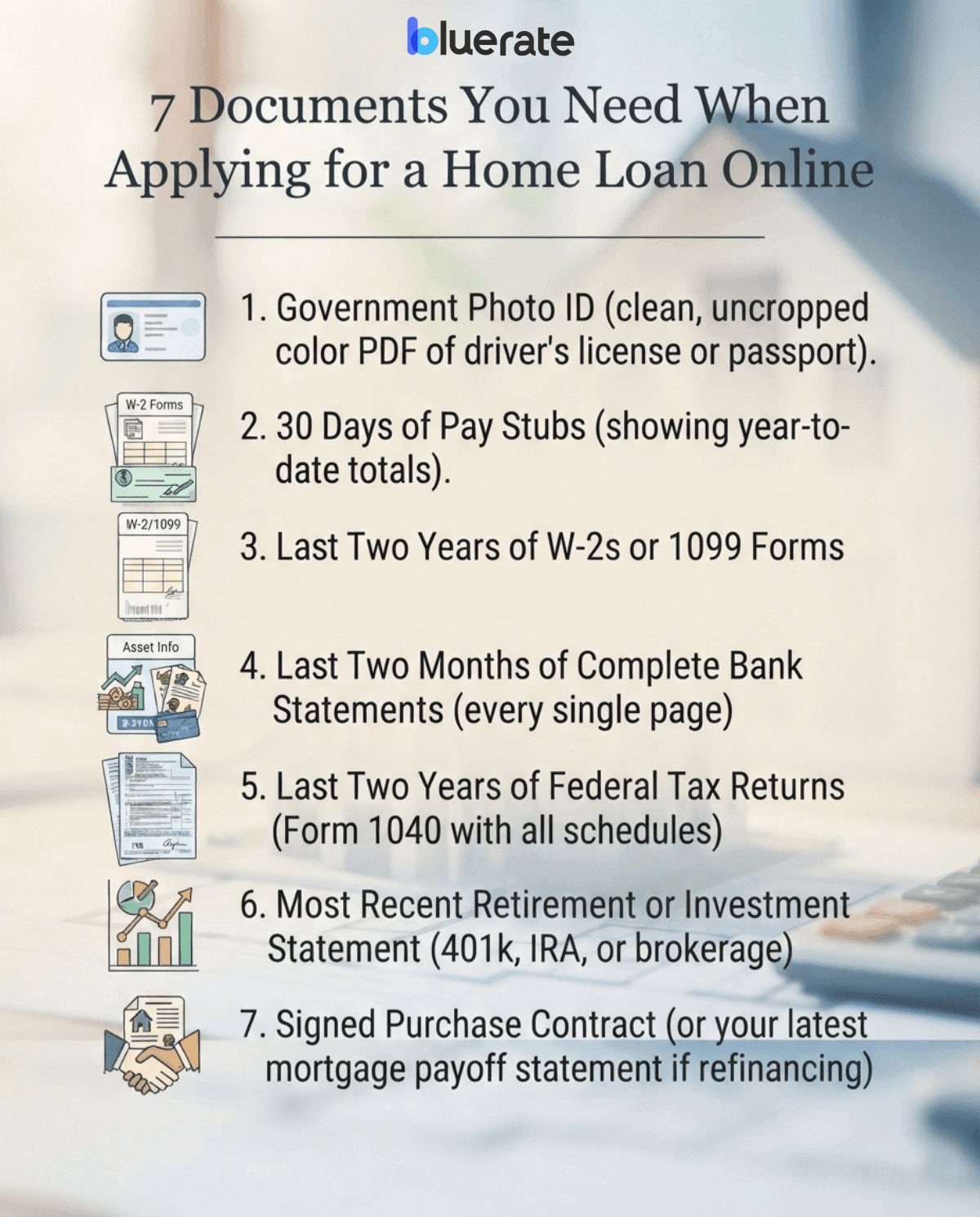
7 Documents You Need When Applying for a Home Loan Online
Applying through an online mortgage portal saves a ton of back-and-forth, but uploading piecemeal paperwork will only slow you down. If you want a fast pre-approval in your inbox within a day or two, bundle these seven digital files into a single desktop folder before you start clicking:
-
Government Photo ID (clean, uncropped color PDF of driver's license or passport)
-
30 Days of Pay Stubs (showing year-to-date totals)
-
Last Two Years of W-2s or 1099 Forms
-
Last Two Months of Complete Bank Statements (every single page)
-
Last Two Years of Federal Tax Returns (Form 1040 with all schedules)
-
Most Recent Retirement or Investment Statement (401k, IRA, or brokerage)
-
Signed Purchase Contract (or your latest mortgage payoff statement if refinancing)
FAQs About Mortgage Application Documents
Q1. How far back do mortgage lenders look at bank statements and tax returns?
Underwriters typically examine 60 days (two full statement cycles) of bank records and two calendar years of tax filings. If you're a straightforward W-2 wage earner with steady tenure, automated systems might only ask for one year of W-2s. However, self-employed borrowers or anyone with commission-heavy income should plan on supplying two full years of personal and business returns.
Q2. Why do mortgage lenders require every page of my bank statements, including blank ones?
Mortgage guidelines treat missing pages as potential hidden liabilities. If a statement footer reads "Page 1 of 6," the underwriter has to see all six sheets. Even if page six is completely empty or just boilerplate legal disclosures, omitting it makes underwriters worry you're hiding undisclosed loans or major withdrawals, which immediately puts your file on hold.
Q3. Can I use unverified cash or "mattress money" for my down payment?
Not as-is. Lenders generally cannot accept cash that has no paper trail. Funds typically must be deposited into a verifiable, insured account and either be "seasoned" (visible on at least two consecutive monthly statements, ~60 days) or fully sourced with documentation (e.g., proceeds from a sale, gift letter with donor's withdrawal, withdrawal records). Large or recent cash deposits often trigger additional sourcing and anti–money laundering review.
Q4. Why do I need to sign IRS Form 4506-C if I already gave my tax returns?
Form 4506-C gives your mortgage company permission to pull official tax transcripts straight from the IRS system. It serves as a fraud check. Lenders use it to verify that the tax paperwork you uploaded matches the exact numbers you filed with the government, ensuring nothing was altered or omitted before approving the loan.
Q5. How recent must my financial documents be when I close on the house?
Most conventional and government loan programs require credit documents (income, assets, credit report) to be no more than four months (120 days) old on the note date. Some lenders may refresh them sooner depending on closing delays or internal overlays. Pay stubs typically cannot be older than 30 to 45 days. If your closing gets pushed back or escrow runs long, expect your loan officer to ask for your latest pay stub and fresh bank statements right before closing.
Final Word
Getting your paperwork together early takes the stress out of buying a home. Once your files are uploaded, keep your finances quiet: don't open new credit cards, don't finance furniture, and don't move money between accounts. When you're ready to put an offer on a house, have a licensed loan officer review your documents so you can make moves with total confidence.
People Also Read
