
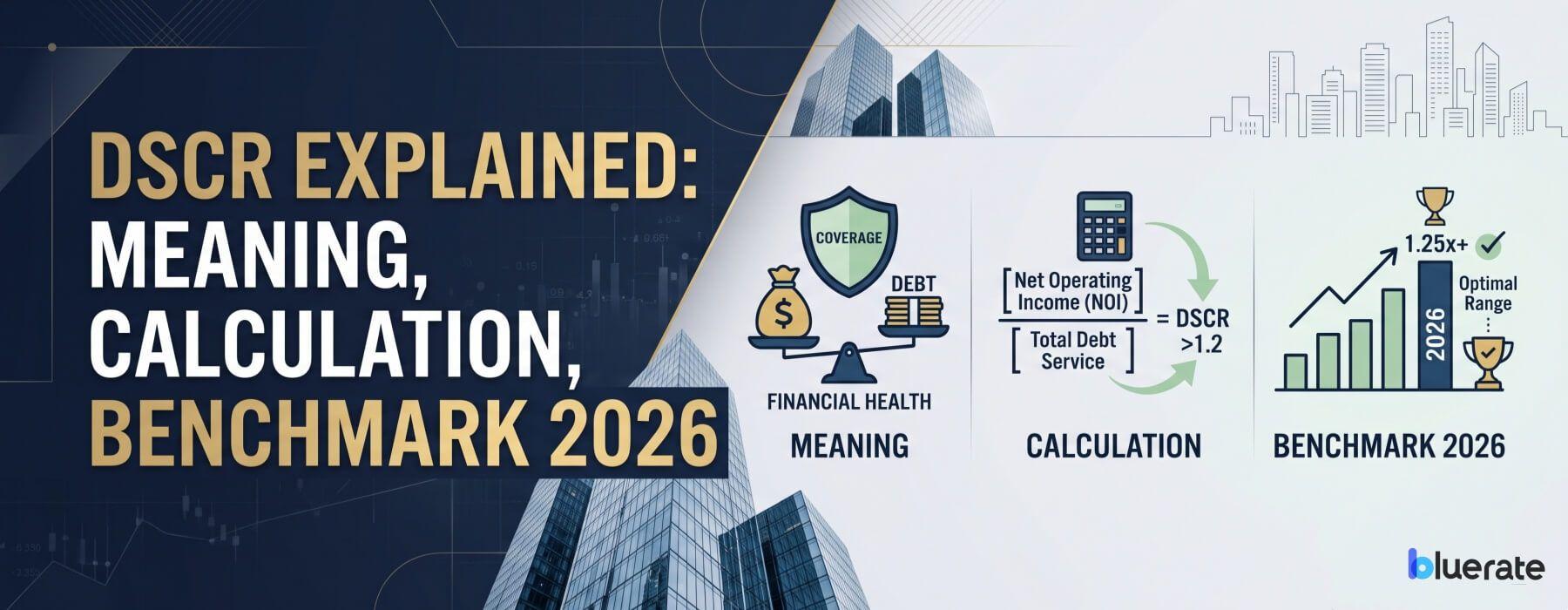
DSCR Explained: Meaning, Calculation, Benchmark 2026
In a common scenario, an investor's fifth rental purchase gets declined by a credit union because tax returns show large depreciation write‑offs that hurt the personal debt‑to‑income ratio. That's where DSCR loans come in.
Instead of using your W‑2s or tax returns to qualify income, DSCR lenders primarily underwrite based on whether the property's rent covers the monthly housing payment (PITIA), while still reviewing credit, reserves, and property documentation.
Key Takeaways
-
Approval is driven by the property's rental cash flow (rent vs. PITIA). Personal tax returns and paystubs are typically not used to qualify income, though lenders still review credit, reserves, and property documentation.
-
A 1.0 DSCR means the rent exactly covers the monthly debt service (PITIA) — a break‑even on debt, not necessarily zero profit after other operating expenses. Below 1.0, the borrower must cover the monthly shortfall out of pocket.
-
In many programs, hitting 1.20–1.25 (and especially 1.25+) positions you for better pricing and more flexible down‑payment/LTV options, though exact tiers vary by lender and product.
-
Common ways to improve a weak DSCR include putting more cash down (lowering the loan balance), selecting an interest‑only option where available, or otherwise reducing the monthly PITIA used in underwriting.
What is DSCR (Debt Service Coverage Ratio) in a Mortgage?
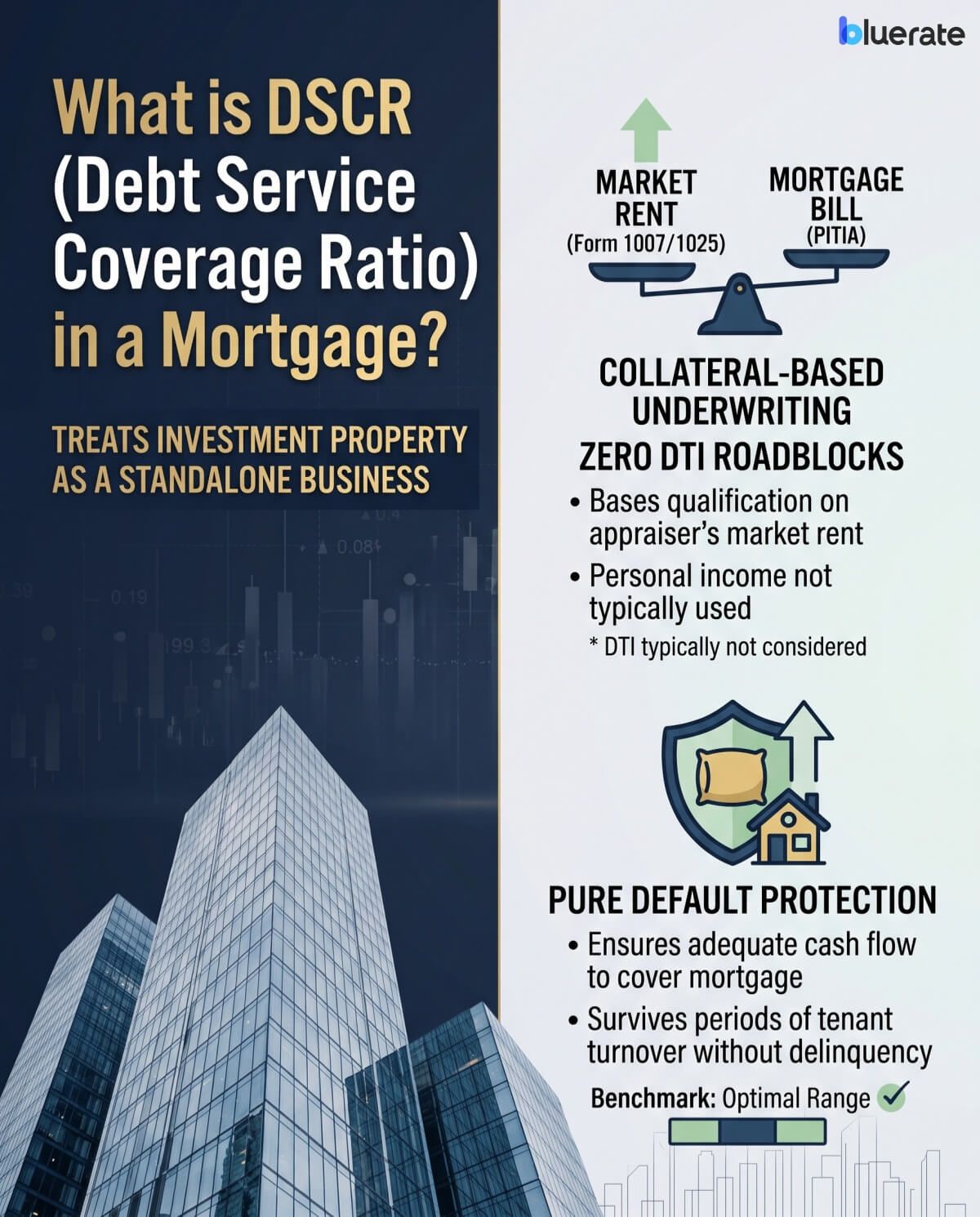
Traditional home loans treat you like an employee first and an investor second. DSCR flips that perspective around. When I apply for one of these loans, the underwriter looks at the property as a standalone business. As long as market rent covers the recurring mortgage bill, you can close deals without sending piles of paystubs or explaining your business write-offs.
-
Collateral‑based underwriting: Lenders base qualification on the appraiser's market rent (often via Form 1007/1025) rather than using your personal income to qualify the loan, while still reviewing credit and reserves.
-
Zero DTI roadblocks: DTI typically not used for qualification. Because DSCR loans underwrite rent vs. PITIA, your personal car loans or primary mortgage usually don't enter the DSCR math. However, overall credit profile, reserves, and lender‑specific limits on number of properties can still apply.
-
Pure default protection: Lenders use this number to confirm the house carries enough cushion to survive tenant turnover without falling into delinquency.
Formula for DSCR Ratio
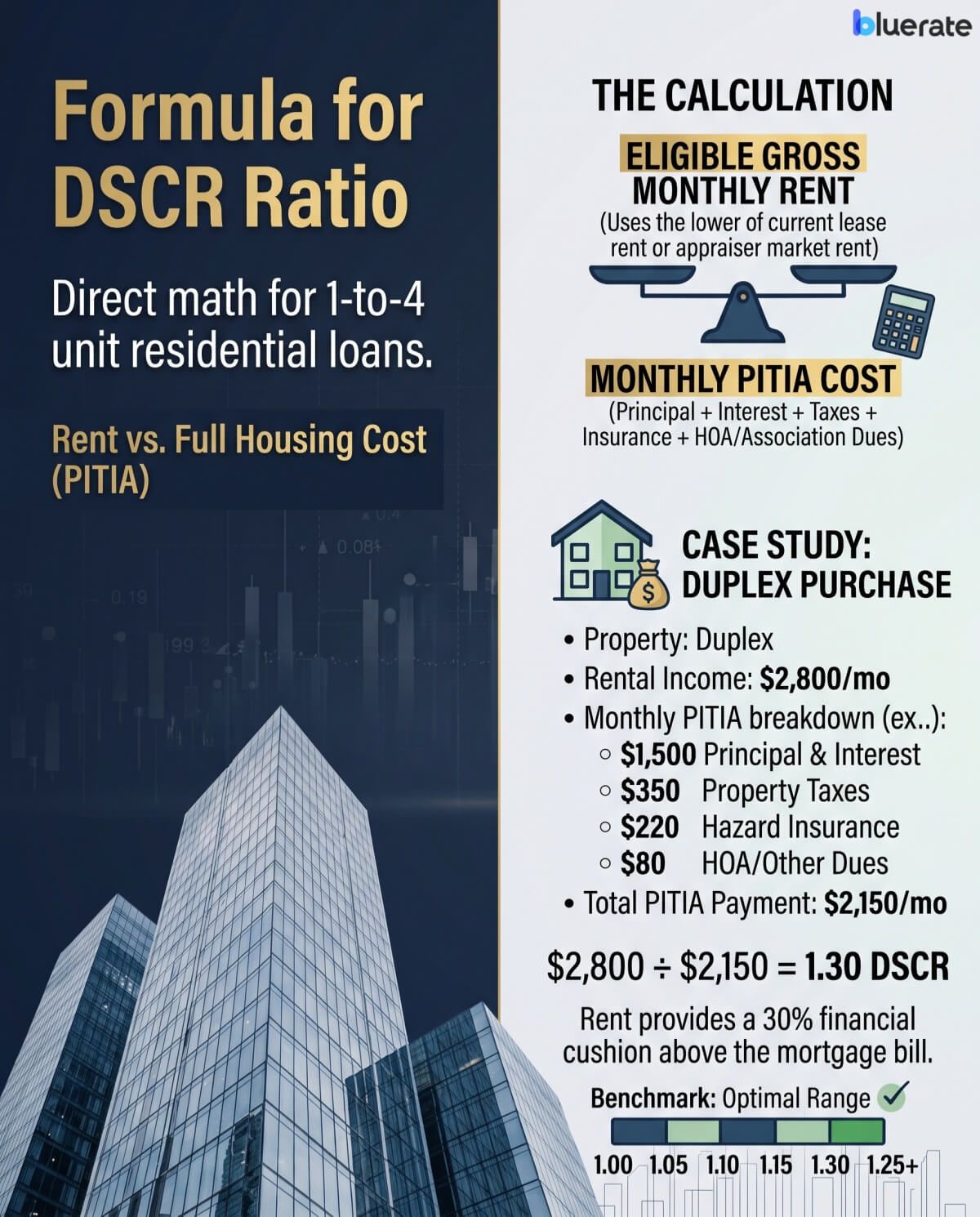
Commercial loans use complex net operating income figures, but 1-to-4 unit residential loans keep the math direct. Lenders take your gross monthly rent and divide it by the full monthly housing cost, known in the industry as PITIA.
DSCR = Eligible Gross Monthly Rent ÷ Monthly PITIA (principal + interest + taxes + insurance + HOA/association dues, all on a monthly basis). Lenders typically use the lower of current lease rent or the appraiser's market rent estimate.
To see this in practice, say you buy a duplex bringing in $2,800 in rent each month. Your total monthly payment comes to $2,150, which breaks down into:
-
$1,500 principal and interest
-
$350 county property taxes
-
$220 hazard insurance
-
$80 for flood insurance and/or HOA dues (as applicable), with annual amounts divided by 12 to get the monthly figure.
Divide $2,800 by $2,150, and your DSCR comes out to 1.30. The rent produces a 30% financial cushion above the mortgage bill, making this an easy approval for most underwriters.
Also Read: DSCR Formula: How to Calculate DSCR in Real Estate?
What is the Average DSCR Ratio?
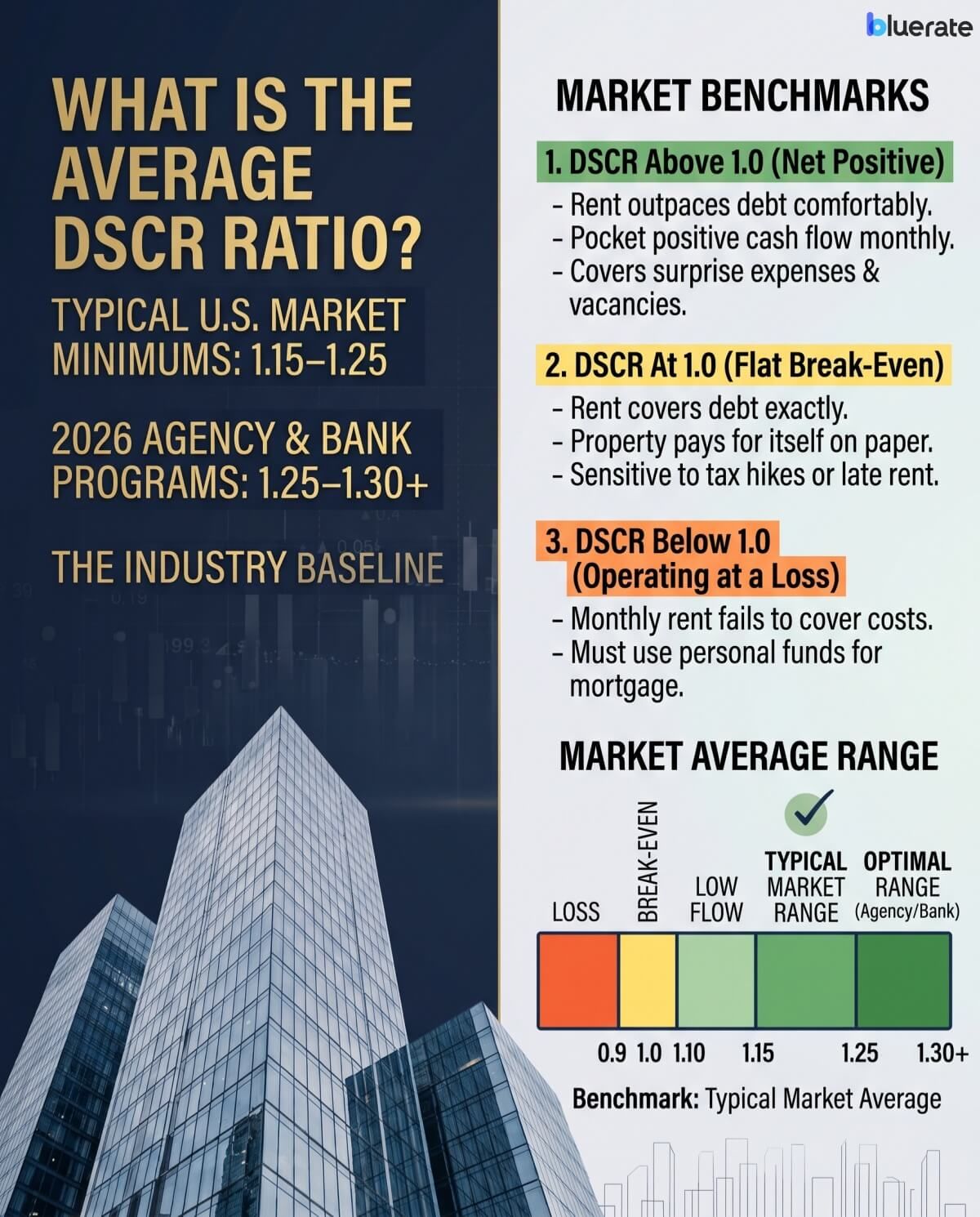
Across the U.S. Non‑QM/DSCR market, minimums vary by lender and product. Many programs sit around 1.15–1.25, while some agency and bank programs in 2026 require 1.25–1.30 or higher for stabilized assets.
That is the baseline most private lenders want before offering standard terms. To understand where your deal lands against that industry average, you have to look at how DSCR lenders interpret the 1.0 threshold:
-
DSCR Above 1.0 (Net Positive): The rent comfortably outpaces your debt bills. You pocket positive cash flow every month, which helps pay for surprise plumbing issues or brief vacancies.
-
DSCR At 1.0 (Flat Break-Even): Every cent of rental income goes straight to your lender. The property pays for itself on paper, but a single property tax hike or late tenant pushes you into the red.
-
DSCR Below 1.0 (Operating at a Loss): Monthly rent cannot keep up with basic carrying costs. You have to feed the mortgage out of your own pocket each billing cycle.
What is a Good DSCR?
In practical lending, a "good" ratio is whatever gets you the lowest rate and the smallest down payment requirement. Over years of working with different portfolio lenders, I found that guidelines generally fall into these distinct buckets:
-
1.25 and Above: Prime tier at many lenders — best pricing and the potential for higher leverage (often up to 75–80% LTV, depending on the program).
-
1.10 to 1.24: Solid everyday territory. Most non-bank lenders will fund this deal all day, though you might pay an extra quarter-point on the rate.
-
1.00 to 1.09: Acceptable, but tight. Underwriters will scrutinize your personal credit score (often demanding 700+) and ask for six months of liquid bank reserves.
-
Under 1.00: Often called sub‑1.0 DSCR programs. Only certain lenders offer these, and they typically require stronger credit, more reserves, and larger down payments (commonly 25–30% or more, depending on the product).
What are the Factors Affecting Debt Service Coverage Ratio?
DSCR is a moving target because both sides of the fraction can change quickly before you reach the closing table. These are the main variables that usually push the ratio up or down during underwriting:
-
Appraised Market Rents: Lenders often use the lower of the signed lease rent or the appraiser's market rent estimate (Form 1007/1025). Weak neighborhood comps can reduce the eligible rent and thus the DSCR.
-
Prevailing Interest Rates: Even a half-percent bump in mortgage rates inflates your monthly principal and interest, directly worsening your coverage.
-
Insurance Rates and Property Taxes: Premium spikes and aggressive county reassessments have crushed many deals lately by adding hundreds of dollars to the monthly PITIA payment.
-
Association Dues: High condo fees or monthly HOA assessments count against you dollar for dollar, shrinking your coverage ratio on managed properties.
How to Improve Debt Service Coverage Ratio?
If your target property comes back with a weak ratio that threatens loan approval, you do not have to walk away. You can actively adjust the numbers using a few reliable techniques:
-
Put More Cash Down: Bumping your equity from 20% to 25% lowers your loan balance, immediately cutting your monthly debt service and lifting the ratio.
-
Request an Interest-Only Option: Where available, an interest‑only period removes principal from the underwriting payment and can materially improve DSCR (the exact improvement depends on rate, loan size, and term).
-
Fight the Property Assessment: If the local county overvalues the property, an appeal can trim annual taxes and permanently lower your monthly escrows.
-
Shop Around for Insurance: Getting quotes through an independent broker often uncovers policies with identical coverage for $50 to $100 less per month, boosting your bottom line.
FAQs About DSCR Ratio
Q1. What does 1.25 DSCR mean?
A 1.25 DSCR means the property produces $1.25 of eligible rent for every $1.00 of total monthly debt service (PITIA: principal, interest, taxes, insurance, and HOA/association dues), i.e., a 25% cushion above the full housing payment used in underwriting.
Q2. What are the limitations of debt service coverage ratio?
The biggest flaw is that DSCR provides a static snapshot based on regular monthly bills. It completely ignores big-ticket capital repairs, such as buying a new roof or replacing an air conditioner, which can wipe out annual profits. It also fails to measure your personal liquidity. If a major repair hits and you have no cash reserves, a high ratio will not save you.
Q3. What is a DSCR loan?
A DSCR loan is an asset‑backed mortgage for rental properties. Instead of using personal tax returns, W‑2s, or employment income to qualify, the lender primarily underwrites based on the property's rental income relative to PITIA, while still reviewing credit, reserves, and property documentation.
Final Thoughts
Learning how to calculate and position DSCR changed how I approach real estate deals. You stop asking banks for permission based on your personal tax return and start letting your properties stand on their own merits.
Always verify market rents, monitor property taxes and insurance, and aim for a healthy buffe, typically 1.20–1.25 or higher depending on the lender and product. When your numbers are solid, finding the capital to expand your portfolio becomes much simpler.
People Also Read
