

Second Home Mortgage Requirements: Learn All the Rules Here
Buying a vacation getaway or a second home is an exciting milestone, but financing it comes with a unique set of hurdles. In my years helping buyers navigate mortgages, I've seen many get caught off guard by stricter standards than primary residences. Understanding the rules upfront saves you time and money. If you want tailored advice for your situation, consulting a local loan officer is always your best first move.
Key Takeaways
- A conventional second-home mortgage may allow a down payment as low as 10% for an eligible one-unit property, although some lenders and loan programs may require more.
- There is no universal 680 minimum credit-score rule. Some programs may accept scores around 620, while lenders often require higher scores for stronger pricing and approval terms.
- Many lenders prefer a total DTI of 43% to 45% or lower, but automated underwriting may allow a higher ratio depending on the borrower's overall profile.
- Agency guidelines commonly require at least two months of reserves for a second-home transaction, while lender overlays, jumbo financing, or multiple financed properties may require more.
- The property must be a genuine second home generally a one-unit residence suitable for year-round occupancy, occupied by the borrower for part of the year, and primarily reserved for personal use.
- FHA, VA, and USDA loans are generally designed for primary residences, so a conventional, jumbo, or portfolio loan is typically used for a second home.
- Short-term rentals may be permitted in some cases, but the borrower must retain control of occupancy and comply with the loan documents, insurance policy, HOA rules, and local law.
Second Home Mortgage Rules
When underwriters review a second home loan, their biggest priority is verifying that the property is truly for personal use, not a hidden investment property. Over the years, I've watched Fannie Mae and Freddie Mac tighten these standards to manage risk. To qualify under standard agency rules, your property must satisfy several key criteria:
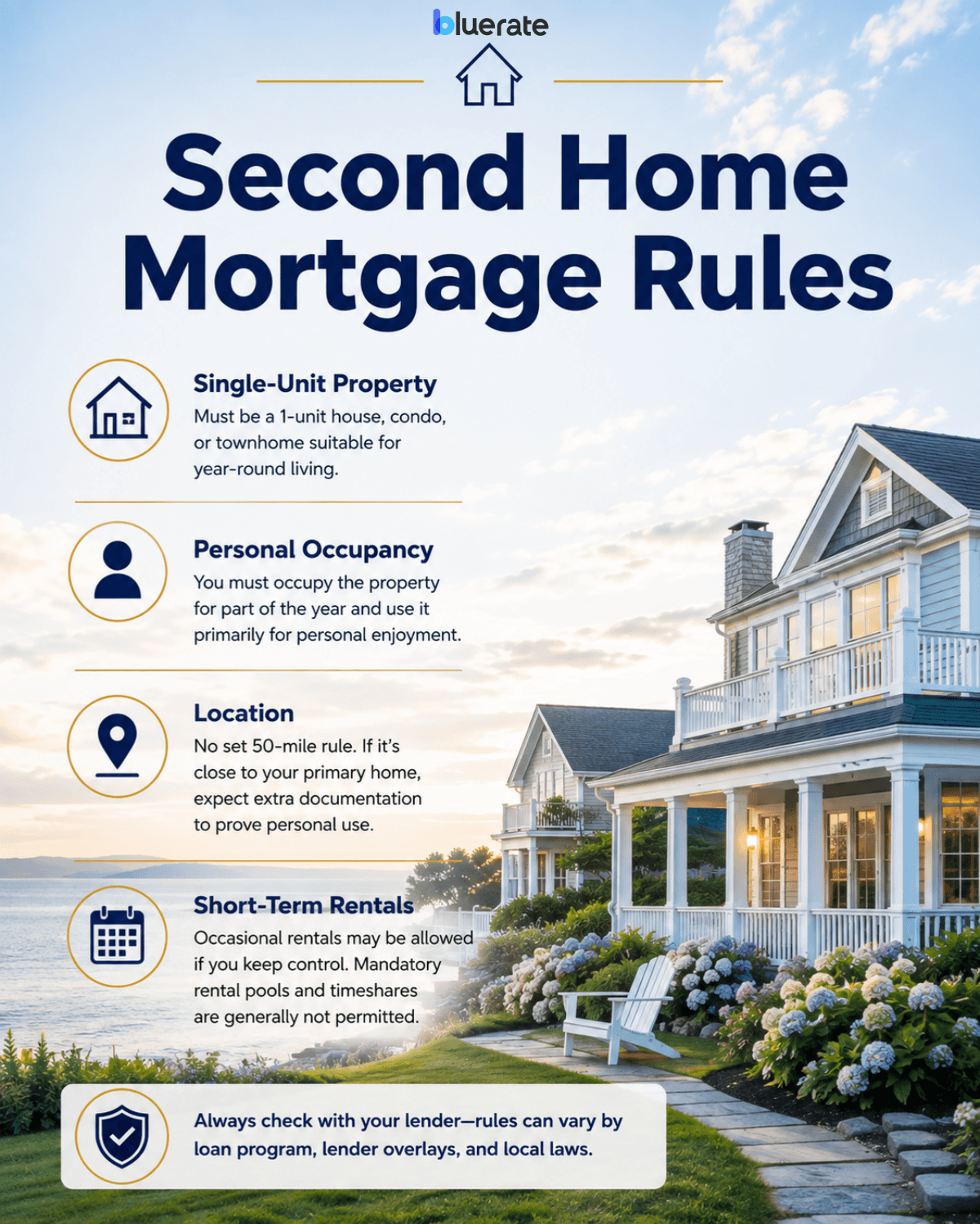
- Single-unit property: Must be a 1-unit house, condo, or townhome suitable for year-round living. Under standard Fannie Mae and Freddie Mac second-home guidelines, the property generally must be a one-unit residence. Duplexes and other two- to four-unit properties are generally not eligible as agency-financed second homes, although portfolio or other non-agency programs may have different rules.
- Personal occupancy: The borrower must occupy the property for part of the year, and the property must be suitable for year-round occupancy and primarily intended for the borrower's personal use and enjoyment.
- Location: Agency guidelines do not impose a universal 50-mile distance requirement. If the second home is close to the borrower's primary residence, the lender may request additional documentation to confirm that the property is genuinely intended for the borrower's personal use rather than as an investment property.
- Short-term rentals: Occasional short-term rentals may be permitted if the borrower retains exclusive control over the property's occupancy and use and the loan documents, insurer, HOA, and local laws allow them. Mandatory rental pools, timeshares, and arrangements that give a management company control over occupancy are generally not permitted. Expected rental income from the second home generally cannot be used as qualifying income unless the applicable program specifically allows it.
Second Home Mortgage Qualification
Qualifying for a second home mortgage means proving to lenders that you can easily carry two housing expenses at once. In my experience, borrowers with solid credit and manageable debt have a smooth approval process, while others may face stricter lender overlays. Here is what you need financially:
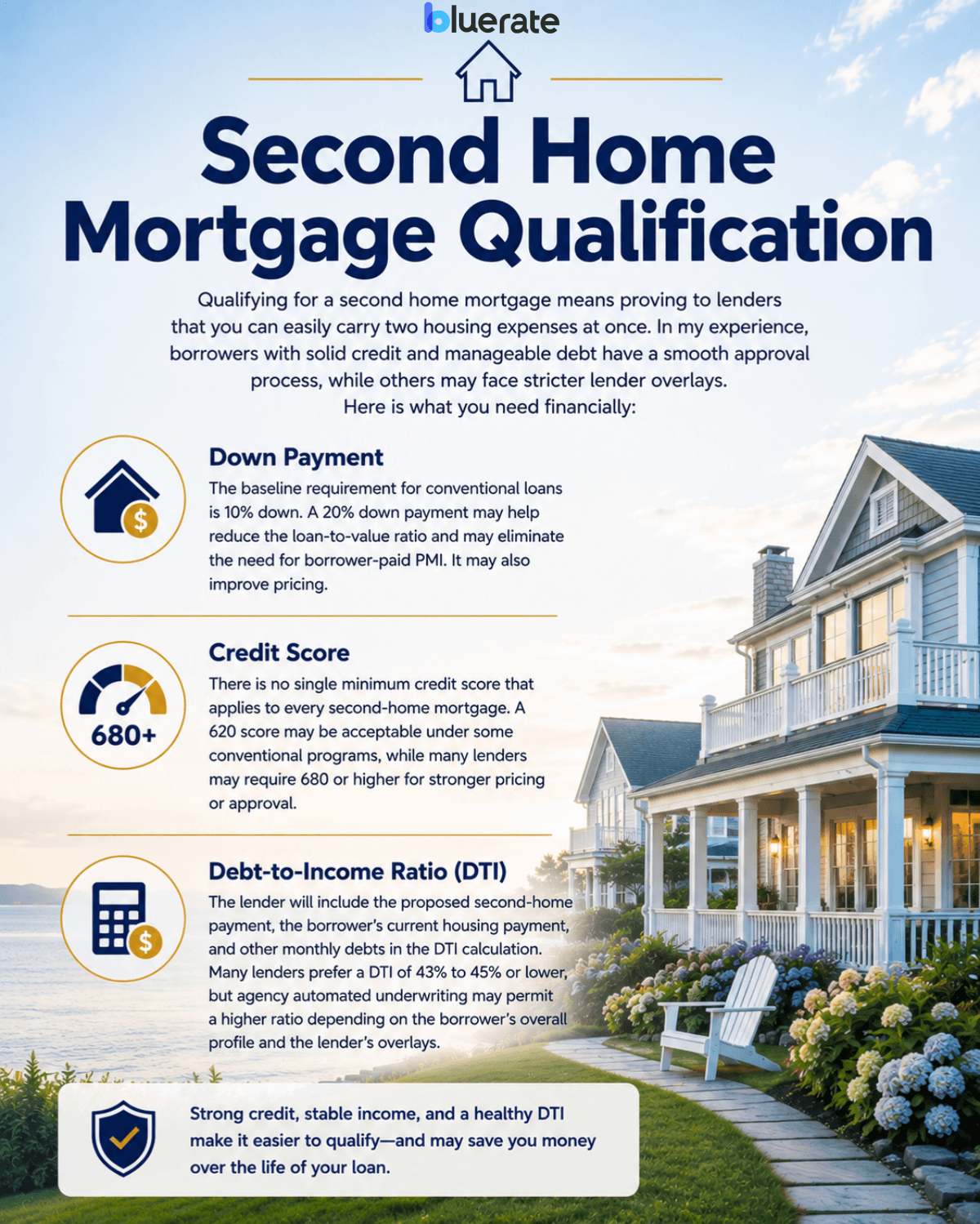
- Down payment: The baseline requirement for conventional loans is 10% down. A 20% down payment may help reduce the loan-to-value ratio and may eliminate the need for borrower-paid PMI on an eligible conventional loan. It may also improve pricing, but the interest rate will depend on the borrower's credit profile, loan amount, property type, market conditions, and lender pricing.
- Credit score: There is no single minimum credit score that applies to every second-home mortgage. A 620 score may be acceptable under some conventional programs, while many lenders may require 680 or higher for stronger pricing or approval. Lower scores may result in higher rates, stricter underwriting, or a larger down payment.
- Debt-to-income ratio (DTI): The lender will include the proposed second-home payment, the borrower's current housing payment, and other monthly debts in the DTI calculation. Many lenders prefer a DTI of 43% to 45% or lower, but agency automated underwriting may permit a higher ratio depending on the borrower's overall profile and the lender's overlays.
Second Home Mortgage Requirements
Beyond standard credit and income checks, second home loans carry unique reserve and asset requirements that catch many buyers off guard. When I structure these loans, I always make sure borrowers understand where their funds can—and cannot—come from:
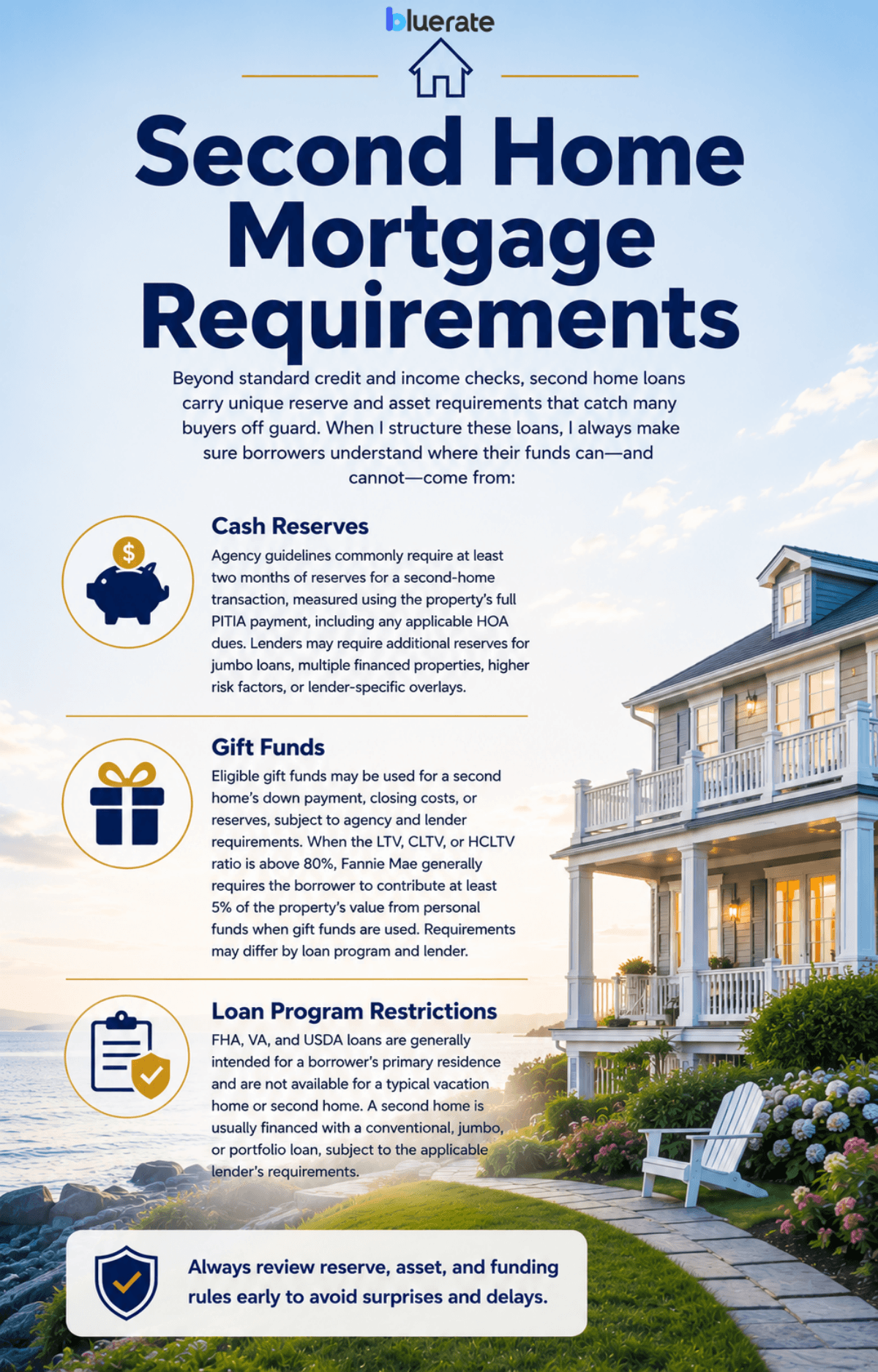
- Cash reserves: Agency guidelines commonly require at least two months of reserves for a second-home transaction, measured using the property's full PITIA payment, including any applicable homeowners' association dues. The lender or automated underwriting system may require additional reserves for jumbo loans, multiple financed properties, higher risk factors, or lender-specific overlays.
- Gift funds: Eligible gift funds may be used for a second home's down payment, closing costs, or reserves, subject to agency and lender requirements. When the LTV, CLTV, or HCLTV ratio is above 80%, Fannie Mae generally requires the borrower to contribute at least 5% of the property's value from personal funds when gift funds are used. Requirements may differ by loan program and lender.
- Loan program restrictions: FHA, VA, and USDA loans are generally intended for a borrower's primary residence and are not available for a typical vacation home or second home. A second home is usually financed with a conventional, jumbo, or portfolio loan, subject to the applicable lender's requirements.
How to Buy a Second Home Mortgage?
Buying a second home is a smooth process when you tackle the paperwork in the right order. I recommend following these five steps to secure your mortgage without unexpected delays:
- Review your finances: Check your credit score, calculate your combined DTI, and make sure you have sufficient funds for the required down payment, closing costs, and post-closing reserves. A 10% down payment may be available under some agency programs, but the lender may require more based on the borrower's credit profile, property type, loan amount, and underwriting results.
- Confirm occupancy compliance: Ensure the property meets agency distance and property-use rules so it isn't misclassified as an investment home.
- Consult a loan officer: Get pre-approved with an expert who can compare agency guidelines and lender overlays for the best rate.
- Find the property: Search for single-unit homes suitable for year-round living, keeping rental pool restrictions in mind.
- Close the loan: Submit your asset and income verification, complete the appraisal, and finalize your mortgage closing.
FAQs About Second Home Mortgage Rules
Q1: Can I rent out my second home on Airbnb?
Yes, short-term or occasional renting is permitted, but the home must remain primarily for your personal use. You cannot enter mandatory rental pools, give full control to a management company, or use potential rental income to help you qualify for the mortgage.
Q2: Can I use an FHA or VA loan to buy a second home?
No. FHA, VA, and USDA loan programs are strictly reserved for primary residences. You must finance a second home using conventional loans, jumbo products, or private portfolio options.
Q3: How far away does my second home need to be from my primary residence?
Most lenders prefer a distance of at least 50 miles to establish a bona fide secondary use. However, exceptions are often made for properties in recognized resort, beach, or mountain areas closer to home.
Q4: Can I use gift funds for my second home down payment?
Gift funds are allowed, but many lenders require you to contribute at least 5% to 10% of your own personal funds toward the purchase if your loan-to-value ratio is above 80%.
Q5: What is the minimum credit score for a second home mortgage?
Most conventional programs require a recommended credit score of 680. While some non-conforming or portfolio lenders accept scores down to 620, doing so usually requires a larger down payment and higher cash reserves.
Final Word
Navigating second home mortgage requirements comes down to meeting strict credit thresholds and staying compliant with occupancy rules. Because individual lenders apply their own overlays on top of agency guidelines, shopping around is crucial.
I always suggest visiting Bluerate to connect with top-rated local loan officers near you. They will help you compare loan options, find competitive interest rates, and guide you smoothly through every step of the approval process.
People Also Read
