
When are 1099 Forms Due? Check Here
As someone who writes mortgages for self-employed folks, I see tax season trigger panic every year. If you're trying to buy a house, you're probably asking yourself when those 1099s will finally show up.
Waiting on missing forms doesn't just frustrate your CPA—it can completely stall your loan pre-approval. Here is what you need to know about the deadlines.
Key Takeaways
-
Form 1099-NEC: Due January 31 in most years, but for tax year 2025 the deadline is Monday, February 2, 2026, because January 31 falls on a Saturday. This date applies to both recipient copies and IRS submissions.
-
Form 1099-MISC: Recipient copies are due by January 31 generally, but for tax year 2025 the deadline is Monday, February 2, 2026. IRS paper filing is due by February 28 (or March 2 if the 28th falls on a weekend), and electronic filing is due by March 31.
-
Weekend Rule: If a cutoff falls on a weekend or federal holiday, the deadline pushes to the following Monday.
-
Mortgage Impact: Underwriters usually want your last two years of 1099s to prove steady self-employment income.
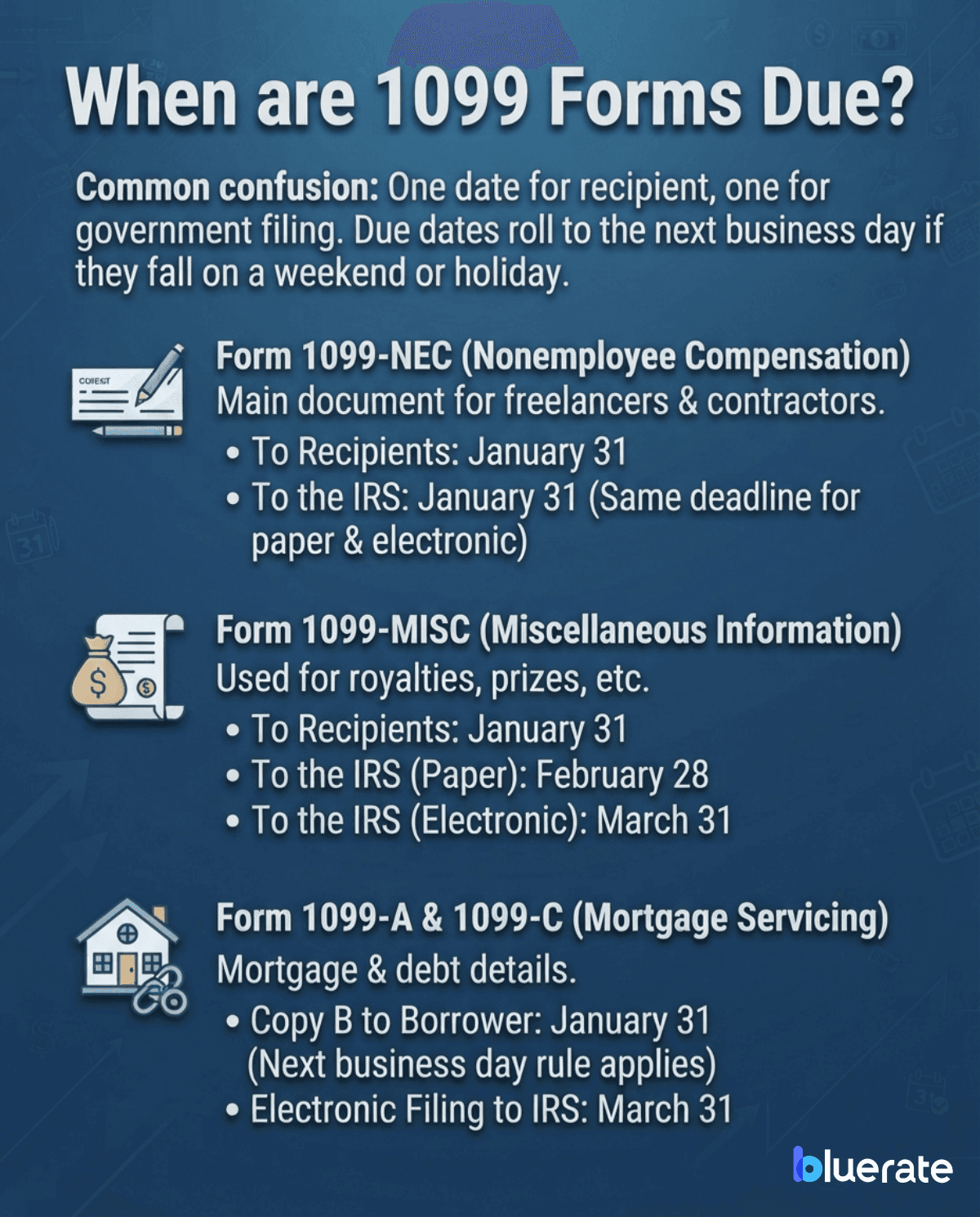
When are 1099 Forms Due?
There is a common point of confusion here: one date dictates when an employer or client must get the form into your hands, while another sets the deadline for filing with the government. The IRS also gives everyone a break if the 31st lands on a Saturday, Sunday, or legal holiday. In those cases, the due date automatically rolls over to the next open business day.
Form 1099-NEC (Nonemployee Compensation)
If you freelance, work contract gigs, or run your own business, this is the main income document lenders will ask for.
-
To Recipients: January 31
-
To the IRS: January 31 (paper and electronic filers share the exact same due date)
Form 1099-MISC (Miscellaneous Information)
You will receive this slip if you earned rental proceeds, royalties, legal settlements, or specific prizes over the past year.
-
To Recipients: January 31
-
To the IRS (Paper Filing): February 28
-
To the IRS (Electronic Filing): March 31
Form 1099-A and Form 1099-C (Mortgage Servicing Records)
Under IRS rules, mortgage servicers must follow this schedule for Forms 1099-A and 1099-C:
-
Copy B to the Borrower: January 31 of the year following the event (or the next business day if the 31st falls on a weekend or holiday).
-
Electronic Filing to the IRS: March 31.
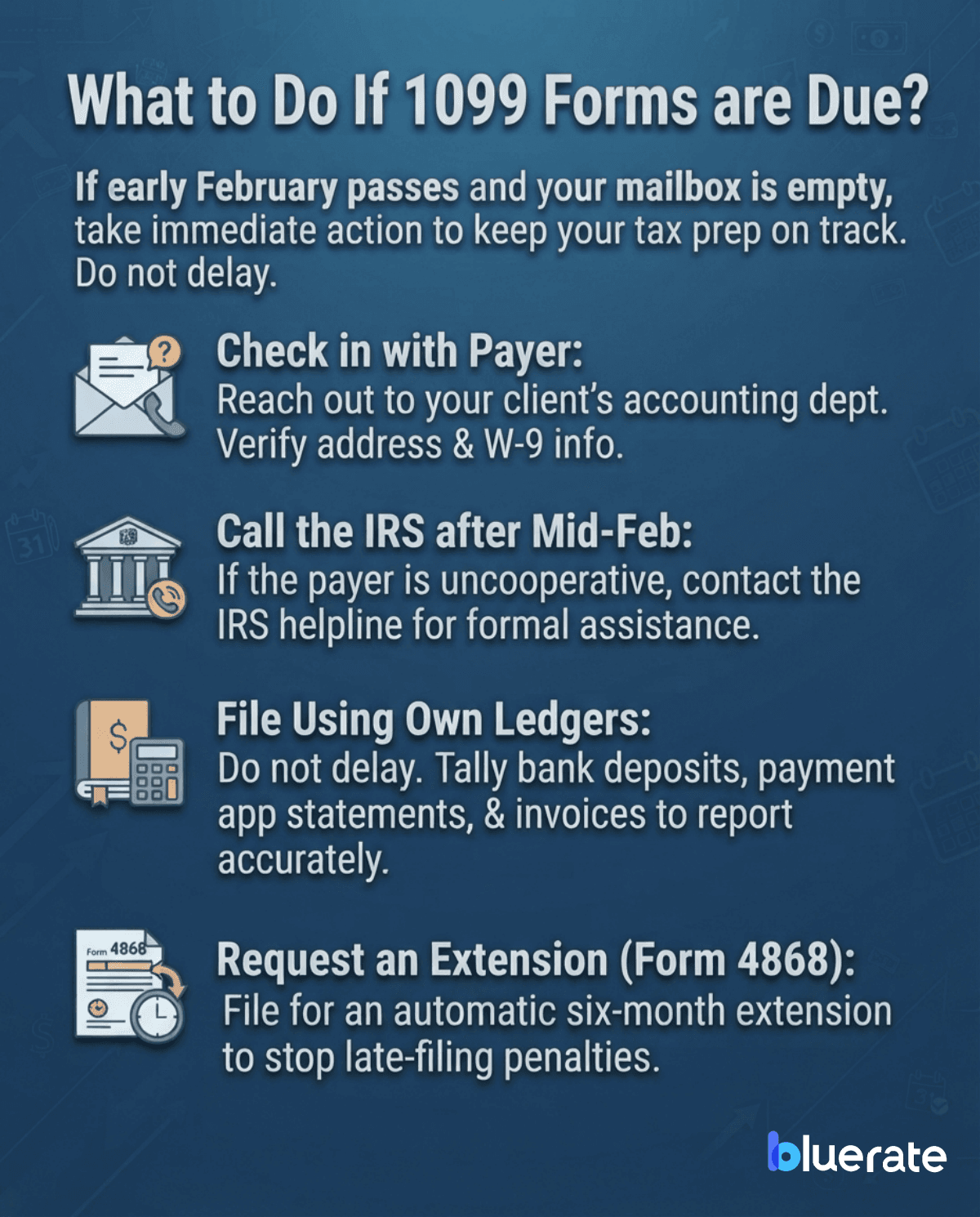
What to Do If 1099 Forms are Due?
If early February rolls around and your mailbox is still empty, do not just sit and hope they turn up. Take these steps right away so your tax prep and loan timeline stay on track:
-
Check in with the payer: Reach out to your client's accounting department. Half the time, they simply have an old address or need an updated W-9.
-
Call the IRS after mid-February: If a payer refuses to cooperate or goes silent, contact the IRS helpline. An agent will send them a formal reminder.
-
File using your own ledgers: You do not have to delay filing. Tally up your bank deposits, 1099 statements from payment apps, and invoices to report your earnings accurately.
-
Request an extension (Form 4868): If you still lack critical paperwork, filing for an automatic six-month extension gives you breathing room and stops late-filing penalties.
Tips If You Need 1099 Forms for a Mortgage
Qualifying for a home purchase as an independent earner takes a bit more strategy than handing over two standard W-2 paystubs. Here is how I tell my 1099 clients to prepare:
-
Gather two full years: Most conventional loan programs look for a consecutive two-year paper trail to verify that your self-employment earnings are dependable.
-
Line up your deposits: Underwriters cross-check your 1099 gross numbers against your business bank statements, so make sure those client payments actually cleared your accounts.
-
Ask about Non-QM 1099 loans: Some non-traditional loan programs can qualify you primarily based on gross 1099 income, especially if deductions have lowered your taxable income. However, most lenders still require 1–2 years of self-employment history, which may be verified through IRS income transcripts, bank statements, or prior tax returns
-
Prove ongoing cash flow: Previous tax forms only show old earnings, so bring recent invoices and year-to-date bank statements to demonstrate your business is still thriving today.
-
Get contact to pros: Try to find a vetted Loan Officers on Bluerate to help you streamline your trip.
Conclusion
Treat January 31 as your personal starting line each tax season. Getting your 1099 forms sorted out early keeps your tax filing smooth and stops underwriting delays before they ever start. If a form goes missing, rely on your bank statements and reach out to clients right away. Talk with your loan officer and CPA early so your mortgage application stays on solid ground.
People Also Read
