
Best Mortgage Application Software: Which to Pick in 2026?
I spent years tracking down missing pay stubs and fixing messy 1003 entries. Gathering mortgage applications by hand burns out originators and frustrates borrowers. In 2026, slow intake destroys pipeline velocity. Modern mortgage application software replaces clunky PDFs and endless email threads with smooth digital intake.
By automating initial data capture, you collect verified borrower details in minutes, spare your team from manual rework, and immediately boost conversion rates.
Key Takeaways
-
Modern intake platforms serve as your digital front door, bridging borrower-facing speed with back-office underwriting accuracy.
-
**Instant **DTI calculations and automated credit checks eliminate days of back-and-forth document chasing.
-
Native FNM 3.4 export capability is essential to prevent data transcription errors across different loan origination systems.
-
Next-generation tools like Zeitro combine digital 1003 forms with AI-driven guideline verification across both agency and Non-QM loan files.
What is Mortgage Application Software?
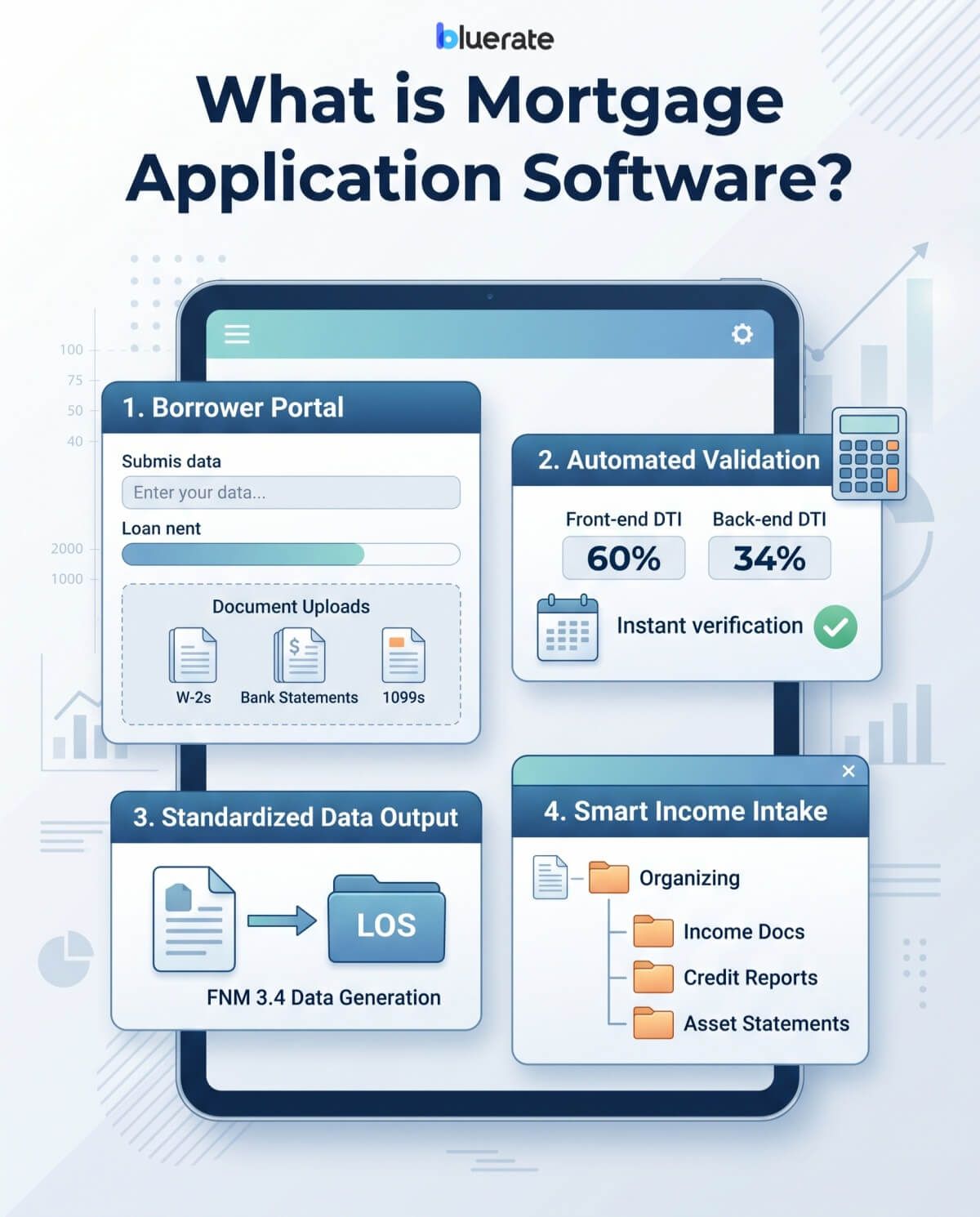
Mortgage application software acts as the secure digital gateway between borrowers and your origination pipeline. Instead of handing applicants a confusing, static form, these platforms transform the Uniform Residential Loan Application (Form 1003) into an intuitive, step-by-step digital journey.
In my experience running production desks, an effective application platform brings several mission-critical functions under one roof:
-
Borrower-Facing POS: Mobile-friendly portals where applicants submit financial data, run credit checks, and upload docs securely.
-
Automated Validation: Engines that compute front-end and back-end debt-to-income (DTI) ratios on the fly without waiting for manual processor reviews.
-
Standardized Data Exports: Clean generation of industry-standard FNM 3.4 files, ensuring zero-friction handoffs into your core LOS.
-
Smart Income Intake: Purpose-built workflows that organize W-2s, 1099s, and bank statements before underwriting ever touches the file.
Top Mortgage Application Software in 2026
Evaluating mortgage technology today means looking beyond pretty intake forms. You need an engine that cuts operational drag across diverse loan products. Here is how the leading platforms compare on my desk this year:
Zeitro
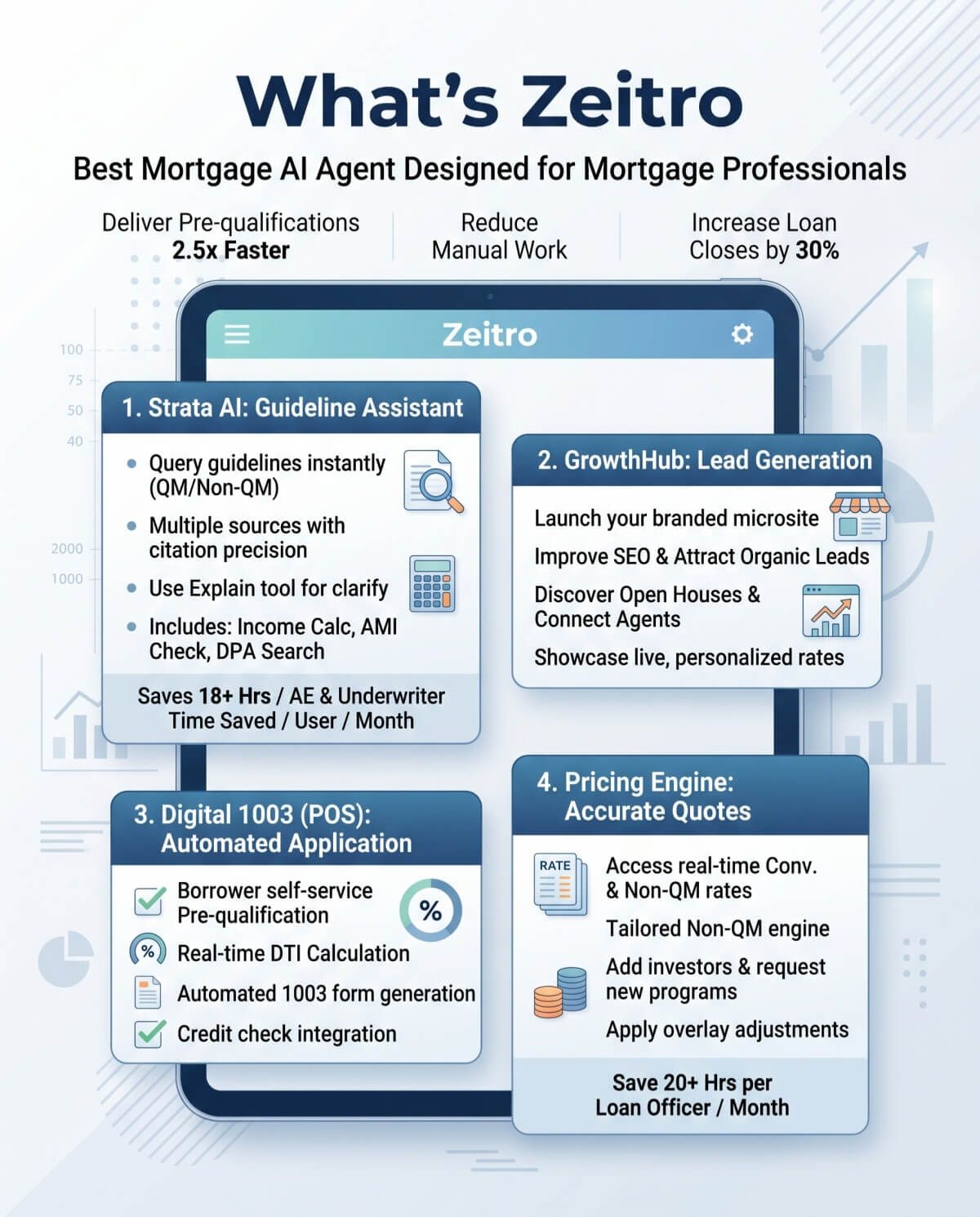
Zeitro stands out as an AI-native solution built specifically for wholesale lenders, brokers, and originators handling both conventional agency and complex Non-QM scenarios. Its Digital 1003 application system reimagines borrower intake: applicants complete an intuitive pre-qualification in roughly five minutes, pushing completion rates past 90%. Behind the scenes, the system pulls borrower financials, calculates precise DTI ratios in real time, and exports data cleanly in standard FNM 3.4 format for frictionless lender handoffs.
What makes Zeitro exceptionally compelling is its deep synergy with Zeitro Strata AI (formerly Scenario AI/GuidelineGPT, rebranded in March 2026), an AI guideline assistant that cross-checks over 100 wholesale investors and 1,000+ program guidelines in seconds with citation-backed answers.
The platform is also rolling out intelligent document recognition that reads uploaded borrower files to auto-populate the 1003 application directly. Originators using Zeitro routinely save over 20 hours per month while closing files up to 20% faster, making it uniquely capable across FHA, VA, DSCR, Jumbo, and asset-utilization loans.
Blend
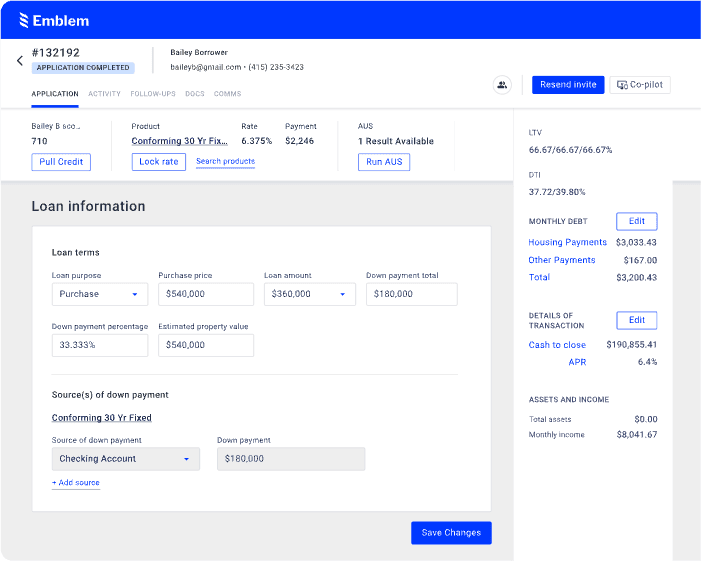
Blend remains a familiar enterprise standard across regional banks and national retail lenders, offering a polished consumer interface and deep connectivity with major financial institutions. However, its implementation cycles and enterprise pricing tiers may present challenges for smaller brokers originating non-traditional or Non-QM loans.
Floify
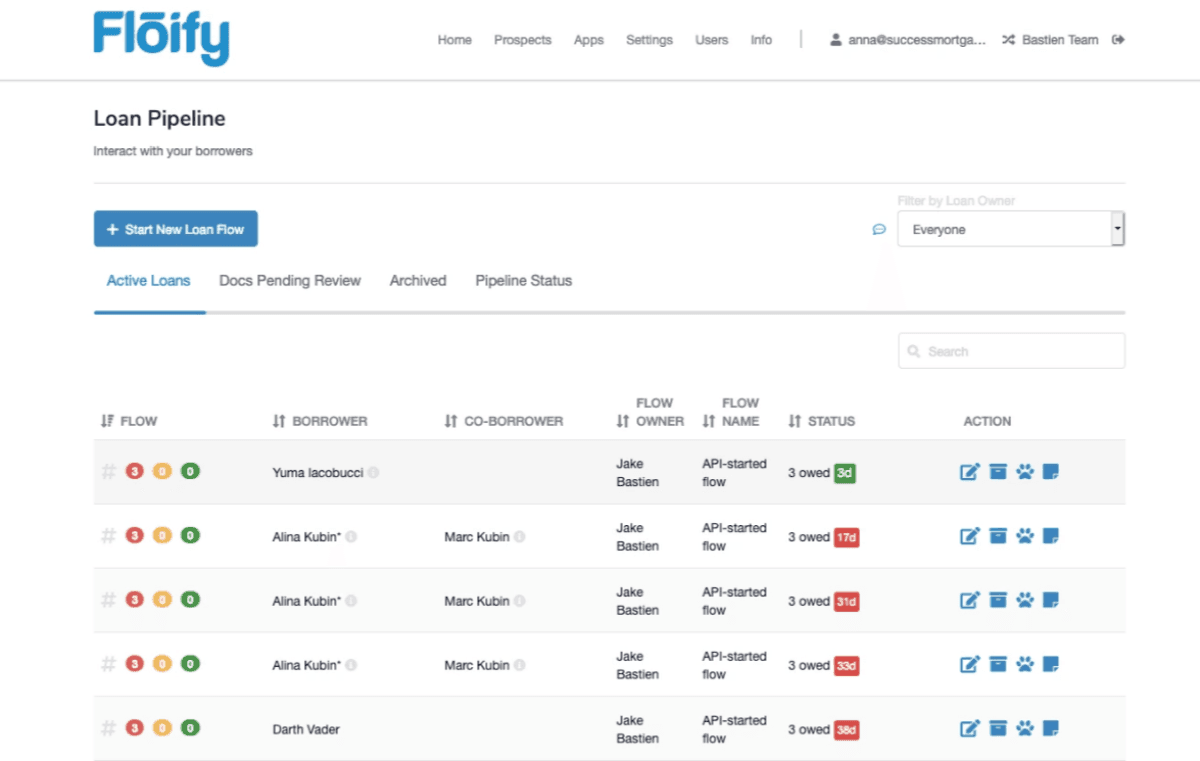
Floify offers an established, straightforward point-of-sale environment focused on automated milestone updates, secure document collection, and borrower communication. While it organizes paperwork reliably for traditional agency loans, some originators note it lacks native AI guideline intelligence and real-time income verification engines for non-conforming scenarios.
What to Consider When Choosing Mortgage Application Software?
Selecting the wrong intake tool creates bottlenecks that bleed deals out of your pipeline. When I test application platforms for modern lending teams, I evaluate five core operational criteria:
-
Borrower Drop-Off Friction: Look for guided question logic that borrowers can easily finish on their phones without stumbling over dense lending jargon.
-
Strict FNM 3.4 Compliance: Your software must generate clean, valid FNM 3.4 files to sync smoothly with your primary LOS and investor portals.
-
Non-QM and DSCR Adaptability: Avoid systems hardcoded purely for conventional Fannie or Freddie loans. Ensure the platform supports bank statements, 1099s, and investor debt-service flows.
-
Built-in Calculation Engines: Prioritize software that computes live DTIs and initial qualification metrics during intake rather than hours later.
-
Document Extraction Potential: Choose systems that can read uploaded tax and bank documents to eliminate repetitive manual data entry for your staff.
FAQs About Best Mortgage Application Software
Q1. What is the difference between a mortgage POS and an LOS?
A point-of-sale (POS) is traditionally the borrower-facing front end where applicants submit information, authorize credit checks, and upload financial documents. A loan origination system (LOS) is the internal back-office system where processors, underwriters, and closers manage compliance, pricing, and packaging. However, modern platforms increasingly blur these boundaries with integrated POS-LOS solutions.
Q2. Can modern mortgage application software handle Non-QM and DSCR loans?
Yes, though older legacy systems still struggle with non-traditional scenarios. Modern platforms like Zeitro are built natively for Non-QM, DSCR, and self-employed files, capturing necessary rent schedules, bank statements, or asset depletion data without breaking standard 1003 formatting.
Q3. Why is FNM 3.4 export capability so important?
FNM 3.4 is Fannie Mae's implementation of the MISMO XML data standard, widely used across the mortgage industry for loan file transfers. When your intake tool exports valid FNM 3.4 files, you can instantly transfer complete loan files to wholesale lenders or secondary market systems without manual re-keying or document re-indexing errors.
Q4. How does AI improve borrower application completion rates?
AI simplifies dynamic question logic so applicants only see fields relevant to their specific employment and asset profiles. Combined with automated DTI checks and clear visual prompts, it eliminates confusing loan terminology, helping borrowers finish applications in minutes rather than abandoning them halfway through.
Q5. How does document auto-population help loan officers?
Smart document recognition parses uploaded W-2s, pay stubs, and tax forms, auto-filling borrower income and employment details directly into the 1003. This strips out repetitive data entry, cuts human transcription errors, and frees loan officers to focus on client advisory work.
Final Word
Originating loans in 2026 requires speed, precision, and an effortless borrower experience. Relying on static forms or disjointed document intake costs you deals before underwriting even starts.
Upgrading to an AI-accelerated system like Zeitro strips out hours of manual paperwork, clears friction across both conventional and Non-QM programs, and frees you to focus on what actually grows your pipeline: advising clients and closing loans on time.
People Also Read
