

Best No-Doc Mortgage Lenders in 2026: Pick the Right One
If you are a freelancer, business owner, or real estate investor, you've probably felt the sting of a traditional bank rejecting your application just because your tax returns don't tell the whole story. I have been there, and it is incredibly frustrating.
Thankfully, modern "no-doc" loans, now widely known as Non-QM (Non-Qualified Mortgage) or alternative documentation loans, offer a realistic path forward. You don't need endless W-2s anymore. Let's explore the top lenders leading this space right now. Ready to skip the guesswork? Speak to nearby expert loan officers for a free consultation to explore your options today.
Key Takeaway
- Modern "No-Doc" Reality: True blind lending is gone. Today's options look at bank deposits, liquid assets, or property cash flow to ensure you can repay.
- Top Players: Griffin Funding, Truss Financial Group, and Stratton Equities lead the 2026 market for flexible approvals.
- Trade-offs: Expect slightly higher interest rates (1-3% above conventional) and larger down payments (typically 10% to 30%).
Types of No-Doc Mortgage Loans to Consider
Today, saying "I need a no-doc loan" usually means you are looking for an alternative way to prove you can handle the monthly payments. Here are the most common paths we see working in 2026:
- Bank Statement Loans: Lenders review 12 to 24 months of personal or business bank deposits instead of asking for tax returns. Ideal for self-employed individuals and business owners.
- DSCR (Debt Service Coverage Ratio) Loans: Approval hinges entirely on whether a property's rental income covers the mortgage payment, ignoring your personal income entirely. Perfect for real estate investors.
- Asset-Based Loans: You qualify by showing significant liquid assets, like stocks or savings accounts, that could theoretically cover the debt. Great for high-net-worth retirees.
- 1099 Loans: Uses your 1099 earning statements rather than a traditional W-2 to verify cash flow. Tailored for independent contractors and freelancers.
5 Top No-Doc Mortgage Lenders
I've evaluated dozens of institutions based on their market reputation, alternative loan variety, and sheer underwriting speed. Here are five standout lenders currently dominating the 2026 landscape.
Griffin Funding
Best for: Self-employed buyers seeking competitive bank statement loans.
Supported No-Doc Loans: Bank Statement, DSCR, Asset-Based, VA Non-QM.
Requirements: 620 minimum credit score, typically 10-20% down depending on profile.
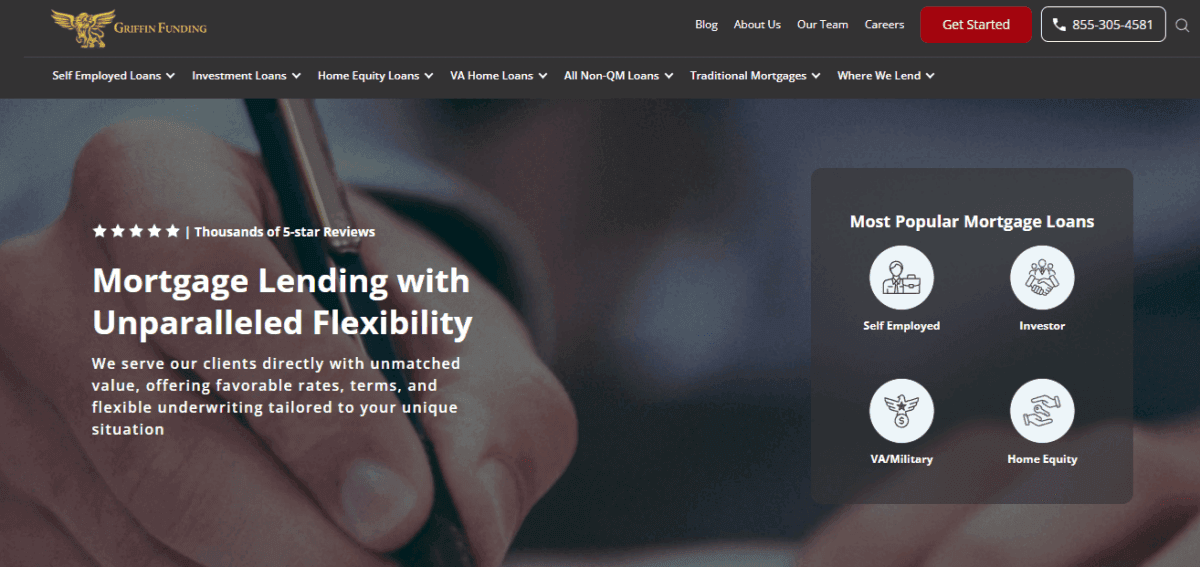
I regularly point self-employed folks toward Griffin Funding because they have practically perfected the bank statement mortgage. Instead of nitpicking your business write-offs, their automated underwriting platform securely syncs up to 24 months of your banking history to verify your true cash flow. What makes them a top choice this year is their willingness to drop down to a 620 FICO score while still funding loan amounts up to $20 million.
They even feature "near-miss" jumbo loans that don't fit into the standard government-backed boxes. If you happen to be a veteran, they offer unique non-traditional VA options too. You get a streamlined digital experience coupled with aggressive rates that often rival conventional pricing if your credit profile is solid. The major benefit here is avoiding the punishing scrutiny of tax returns, allowing entrepreneurs to preserve their legal deductions without sacrificing their homeownership dreams.
Truss Financial Group
Best for: Complex borrowers and business owners who got denied elsewhere.
Supported No-Doc Loans: Bank Statement, DSCR, No Doc, Fix & Flip.
Requirements: Varies widely by product. Generally expects a 20%+ down payment for heavy alternative doc loans.
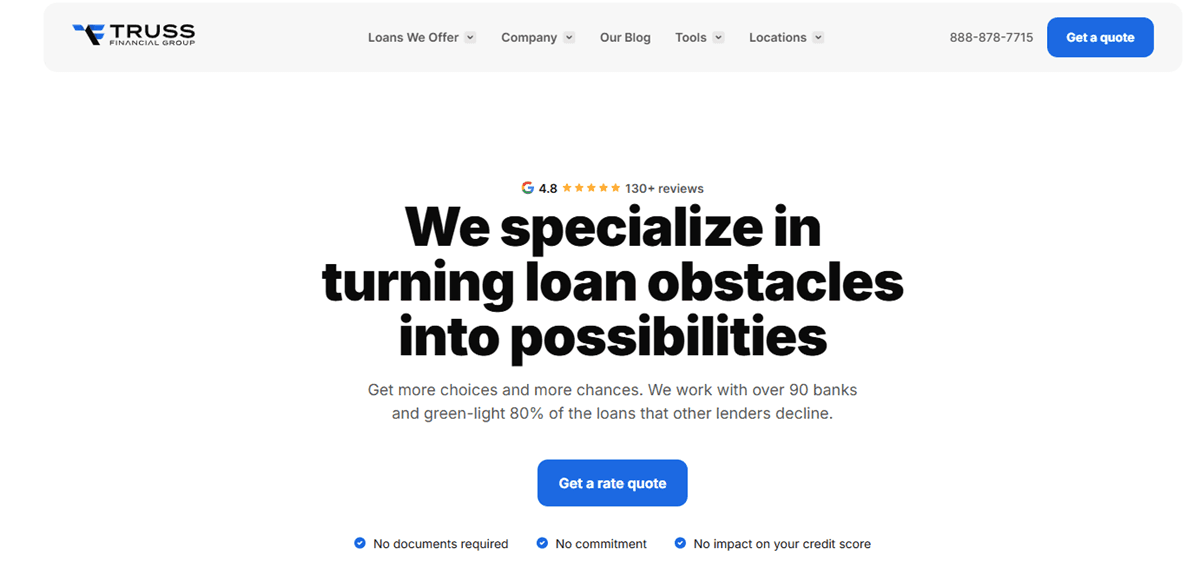
Truss Financial Group essentially built its brand on saying "yes" when big retail banks slam the door. I like Truss because they operate as a highly connected broker with access to over 90 different wholesale lenders. If your financial situation is a tangled web, their loan officers know exactly which underwriter will accept your file. They excel with self-employed folks and serial investors who lack standard W-2s.
One massive advantage to using them in 2026 is their processing speed. They frequently close complex alternative loans in roughly 36 days, which is remarkably fast for the Non-QM space. Plus, they offer a very intuitive online portal. You should seriously consider Truss if you have an unconventional income stream, need a fast DSCR approval, or want someone else to do the heavy lifting of shopping the fragmented private market for the fairest terms.
Stratton Equities
Best for: Real estate investors needing fast, direct asset-based lending.
Supported No-Doc Loans: Hard Money, Fix & Flip, Bridge Loans, No-Doc Rental.
Requirements: No minimum FICO for hard money, maximum 75% LTV (requires 25%+ equity or down payment).
When you need capital immediately for an investment property and absolutely cannot wait for a 45-day traditional closing process, Stratton Equities is an absolute powerhouse. As a direct nationwide private money lender, they focus almost entirely on the value of the asset itself rather than your personal credit history. For their core hard money products, they do not even enforce a minimum credit score requirement.
I've seen deals funded by Stratton in as little as one to two weeks. Keep in mind, these programs are strictly for non-owner-occupied investment properties. Why consider them? They control their own funds, meaning no lengthy committee approvals or hidden junk fees. If you are scaling a real estate portfolio and care more about seizing a time-sensitive opportunity than snagging the lowest possible 30-year fixed rate, Stratton provides the rapid liquidity you need without the exhausting paperwork demands.

Guild Mortgage
Best for: Self-employed borrowers and real estate investors using alternative income docs.
Supported No-Doc Loans: Alternative credit conventional loans, Non-QM.
Requirements: 620 minimum credit score generally, proof of consistent alternative payments, like rent/utilities.
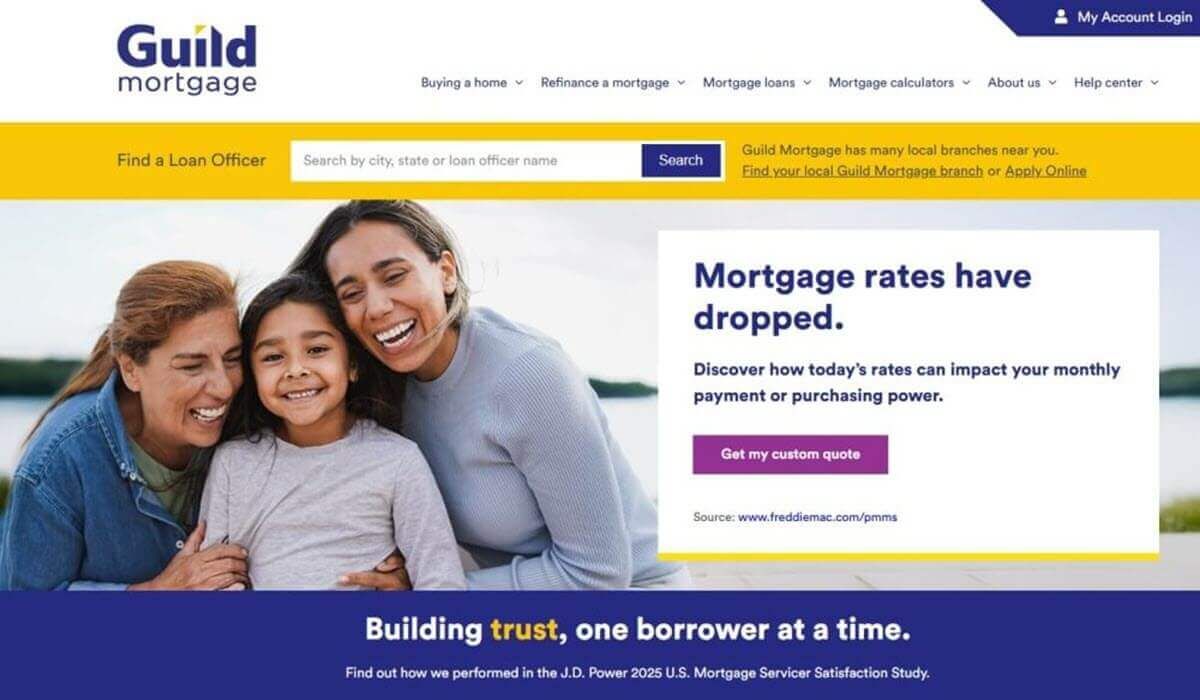
Guild Mortgage isn't your typical private hard money lender. They are a massive, established retail organization that happens to have a remarkably progressive approach to non-traditional underwriting. I included them because they leverage incredible tech, like FormFree's RIKI (Residual Income Knowledge Index), to help self-employed gig workers or folks without a standard credit score get approved.
Instead of demanding conventional proof, Guild looks at your consistent rent, utility payments, and residual bank account income to build a profile of reliability. This is a massive win if you are a first-time buyer with complex freelance income but a flawless history of paying your monthly bills. Furthermore, they offer fantastic local, face-to-face service through hundreds of branches and provide generous down payment assistance programs. If you want the stability of a giant traditional lender but desperately need alternative documentation flexibility, Guild bridges that gap beautifully.
Gelt Financial
Best for: Non-standard commercial real estate and credit-challenged investors.
Supported No-Doc Loans: No-Doc Commercial, Bridge Loans, Foreclosure Bailouts.
Requirements: Up to 75% LTV, property value minimum of $250,000, no minimum credit score required.
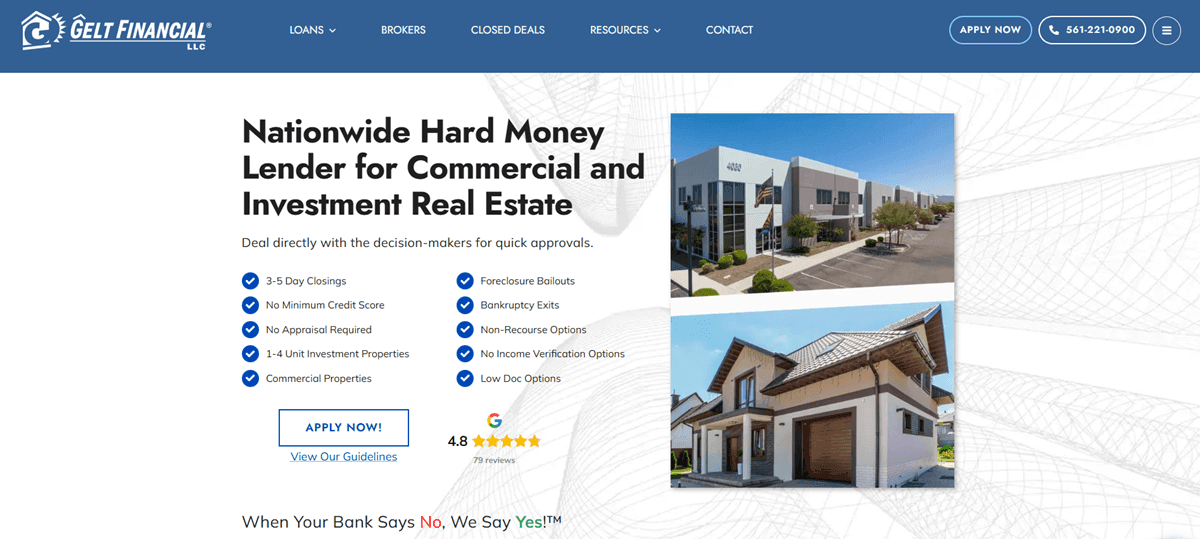
Finding a true no-doc loan for a quirky commercial property or a foreclosure bailout scenario is incredibly tough, but Gelt Financial actively looks for these exact deals. Operating since 1989, this family-owned portfolio lender writes the checks that strict traditional banks simply refuse to touch.
I highly respect their "common sense underwriting" model. If the collateral makes sense, they do not care if your credit is bruised or if you lack personal income verification. They finance loans starting at just $50,000 up to $2 million, with incredibly flexible terms stretching from six months to five years. What sets Gelt apart is their speed and lack of red tape. You speak directly with the decision-makers, allowing for closings in a staggering 3 to 7 days. For an investor dealing with a distressed property or facing a tight deadline, Gelt's bespoke, collateral-based approach is a lifesaver.
Considerations Before Application
Alternative mortgages offer incredible freedom, but that convenience absolutely comes with a price tag. Before signing anything, please consider these realities:
- Higher Interest Rates: Because the lender takes on significantly more risk without standard W-2s, expect rates to be roughly 1% to 3% higher than standard conventional loans.
- Larger Down Payments: You will rarely see a 3% down option here. Most institutions require at least 20% to 30% down to mitigate their exposure.
- Prepayment Penalties: Always read the fine print. Many non-QM loans penalize you financially if you try to refinance or pay off the balance within the first few years.
- Shop Around: Never settle for the first mortgage quote you get. I strongly suggest using an intelligent comparison platform like Bluerate to instantly shop multiple options, ensuring you secure the most competitive terms for your specific scenario.
FAQs About No-Doc Loan Lenders
Q1. What credit score is needed for a no-doc mortgage?
While some asset-based hard money lenders ignore FICO entirely, most standard Non-QM bank statement loans require a minimum credit score between 620 and 680. Naturally, maintaining a score above 700 will unlock noticeably lower interest rates and more favorable down payment requirements.
Q2. What is the interest rate for a no doc loan?
Because they aren't federally standardized, alternative documentation loans typically carry interest rates 1% to 3% higher than conventional mortgages. Lenders charge this premium to offset the inherent risk of skipping tax returns. Your exact rate heavily depends on current market conditions and your creditworthiness.
Also Read: Full Comparison: Difference Between QM and Non-QM Mortgage
Q3. What banks offer no-doc loans?
You generally won't find these at massive retail institutions like Chase or Wells Fargo. Instead, they are exclusively provided by specialized Non-QM originators, dedicated mortgage brokerage firms, and direct private money lenders. These niche institutions have the regulatory freedom to hold the debt on their own balance sheets.
Q4. Do I need a larger down payment for a no-doc mortgage?
Yes, absolutely. Because the lender cannot verify your historical income through standard tax documents, they demand more "skin in the game." Expect to put down a minimum of 20% to 30% upfront to comfortably secure approval. This equity cushion protects the institution if you eventually default.
Q5. Are modern no-doc mortgages safe?
Yes. Today's non-QM products are heavily regulated under the ["Ability-to-Repay" (ATR) rules](https://www.consumerfinance.gov/rules-policy/final-rules/ability-to-pay-qualified-mortgage-rule/). Unlike the dangerous NINJA loans prior to the 2008 crash, modern lenders still rigorously verify your financial stability using alternative methods like bank deposits or property cash flow. This ensures borrowers aren't taking on debt they truly cannot handle.
Conclusion
Securing a mortgage as a self-employed professional or real estate investor in 2026 doesn't have to be a frustrating battle against traditional banking rules. As we've seen, the market is filled with excellent alternative options, whether you rely on the bank statement mastery of Griffin Funding, the tech-forward flexibility of Guild Mortgage, or the raw speed of a private lender. The secret is simply matching your unique financial profile to the right institution's specific criteria.
Don't let missing W-2s keep you from buying your dream property. Whether you choose Griffin Funding or check options on Bluerate, take the first step today by connecting with an expert loan officer to get pre-approved!
People Also Read
- Best Mortgage Lenders for Self-Employed: Top-Rated Picks
- Best Non-QM Mortgage Lenders: Get Your Best Pick Here
- Best DSCR Lenders Near Me: Highlights, Pros & Cons
- Best No-Income Verification Mortgage Lenders: Make a Smart Choice
- Best Mortgage Lenders for Low-Income: Top-rated Picks
- Best First-Time Home Buyer Lenders: Find Your Perfect Match
