
Best 1099 Mortgage Lenders: Which One to Pick? 【2026】
Can I use a 1099 for a loan? Yes, you absolutely can. If tax write-offs wipe out your reported net earnings, qualifying through conventional underwriting feels impossible. Specialized 1099 mortgage programs solve this by evaluating your gross cash flow without demanding tax returns. To navigate tricky state guidelines without stress, you can use Bluerate to find licensed, knowledgeable local loan officers completely free of charge.
Key Takeaways
-
Tax Returns Not Used for Income Calculation: 1099 mortgages assess gross 1099 earnings, ignoring Schedule C deductions for qualifying purposes, though tax returns may still be requested for identity and debt verification.
-
High Gross Calculations: Most lenders count 80% to 90% of your gross earnings, applying only a modest 10% to 20% standard operational expense haircut.
-
Flexible Credit Limits: While high-leverage programs favor a 680+ FICO score, options exist for scores as low as 620 with slightly larger down payments.
-
Channel Matters: Certain leading wholesale programs require an independent mortgage broker to unlock, making comparison shopping across local loan officers essential.
Requirements to Qualify for a 1099 Loan
Qualifying for a 1099 home loan does not mean skipping financial scrutiny. While underwriters bypass heavy Schedule C write-offs, they still inspect several core non-QM factors:
-
Consistent Earnings: One to two continuous years of 1099 statements with the same employer or within the exact line of work.
-
Credit Standing: A minimum 620 to 680 FICO score, with higher ratings unlocking lower interest rates and smaller down payment hurdles.
-
Down Payment: Typically 10% to 20% down, based on your overall financial profile and final purchase price.
-
Liquid Reserves: Three to six months of full housing payments (principal, interest, taxes, and insurance) kept liquid.
*Note: Every mortgage lender enforces distinct internal underwriting overlays. You can rely on **Zeitro Strata AI *to instantly verify intricate underwriting guidelines before applying, protecting yourself from unexpected lender turn-downs.
6 Top 1099 Mortgage Lenders
Every financing partner treats non-traditional income differently. To help you locate the best match for your credit profile and budget, I evaluated six standout lenders that excel in accommodating self-employed borrowers.
#1 Newfi
Best for: High Loan Balances and Flexible Documentation
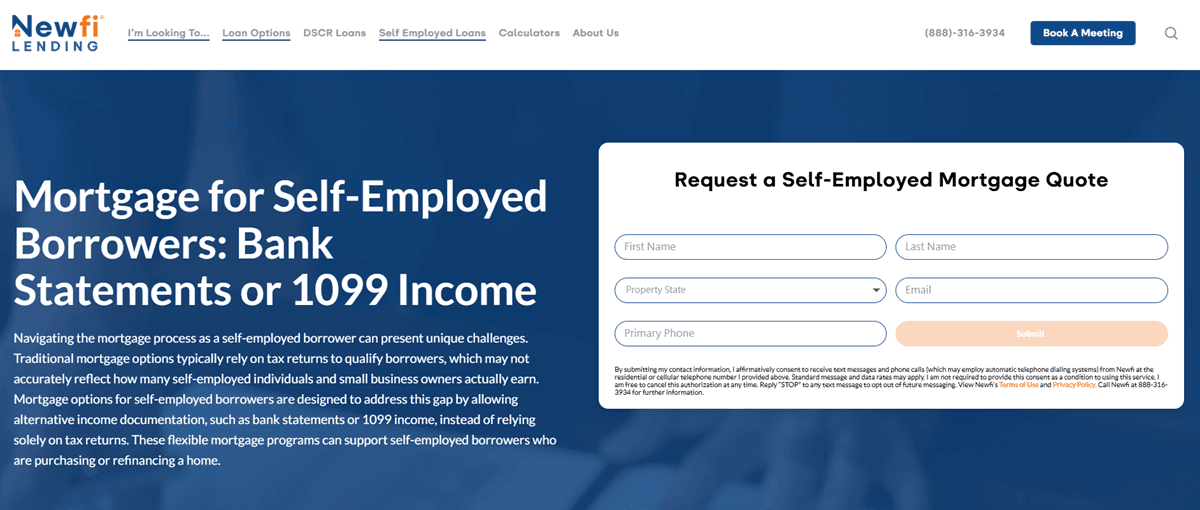
Newfi is an established nationwide direct lender celebrated for its proprietary non-QM portfolio products. If you are an independent consultant or high-billing gig professional, Newfi offers customizable 1099 financing that stretches up to $3.5 million. While they primarily look for a 2-year self-employment history, they may consider 1 year of 1099 income when combined with year-to-date bank statements or prior industry experience.
Pros:
-
Substantial loan amounts reaching up to $3.5 million for jumbo purchases.
-
Permits a 1-year 1099 option instead of mandatory 2-year histories.
-
Available for primary residences, second vacation homes, and investment properties.
-
Favorable pricing adjustments for clients with healthy cash assets.
Cons:
-
Requires substantial liquid reserve funds for jumbo loan tiers.
-
Down payment requirements rise sharply for credit scores near 640.
#2 Mbanc
Best for: Maximizing Gross Income and Fast Digital Approvals
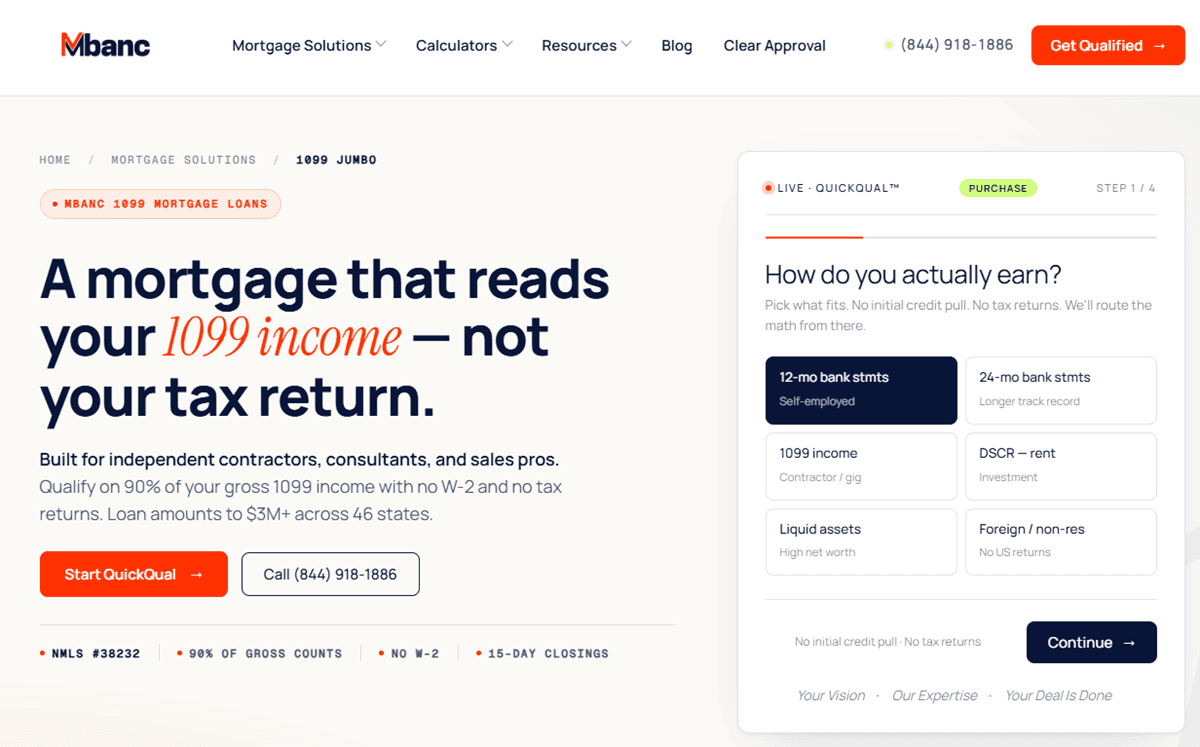
Mbanc is a tech-driven non-QM direct lender focused on serving modern entrepreneurs, freelancers, and small business operators. Where Mbanc truly shines is in its aggressive approach to calculating qualifying income. Instead of slashing your purchasing power with broad expense assumptions, they routinely apply up to a 90% gross income calculation. This lets you access maximum borrowing power through an intuitive, paperless application portal.
Pros:
-
Applies up to 90% of gross 1099 earnings directly toward your qualification.
-
Modern online application system that delivers quick underwriting turnarounds.
-
No IRS tax transcripts (4506-C) or exhaustive corporate audits required.
-
Straightforward documentation rules tailored for single-member LLCs and sole proprietors.
Cons:
-
Tighter credit tier preferences, generally requiring at least a 640 FICO.
-
Initial origination expenses can sit slightly higher than conforming loans.
#3 Foundation Mortgage
Best for: Credit Score Flexibility and Lower Down Payments
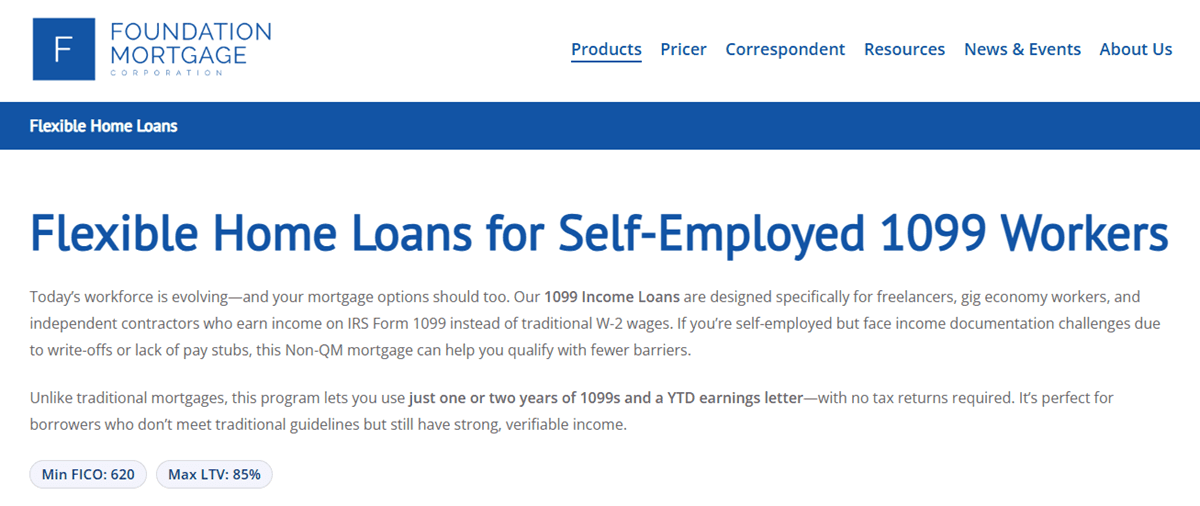
Operating since 1998, Foundation Mortgage serves as a seasoned direct mortgage banker offering diverse alternative lending pathways. If past credit hiccups or brief financial disruptions have dragged down your FICO score, Foundation Mortgage offers welcome relief. They accept credit ratings starting down at 620 for their 1099 loan products, offering workable leverage ratios so you are not forced to clean out your savings for an upfront down payment.
Pros:
-
Accessible credit requirements starting at a 620 FICO.
-
Loan-to-value allowances typically up to 80% to 85% for qualified scenarios, depending on credit profile.
-
Hands-on loan originators experienced in manual non-QM scenario underwriting.
-
Accommodates down payment gift funds on select residential transactions.
Cons:
-
Borrowers near the 620 credit minimum receive higher interest margins.
-
Portal self-service features feel less modern compared to newer fintech platforms.
#4 First National Bank of America
Best for: High Debt-to-Income (DTI) Ratios and Portfolio Lending
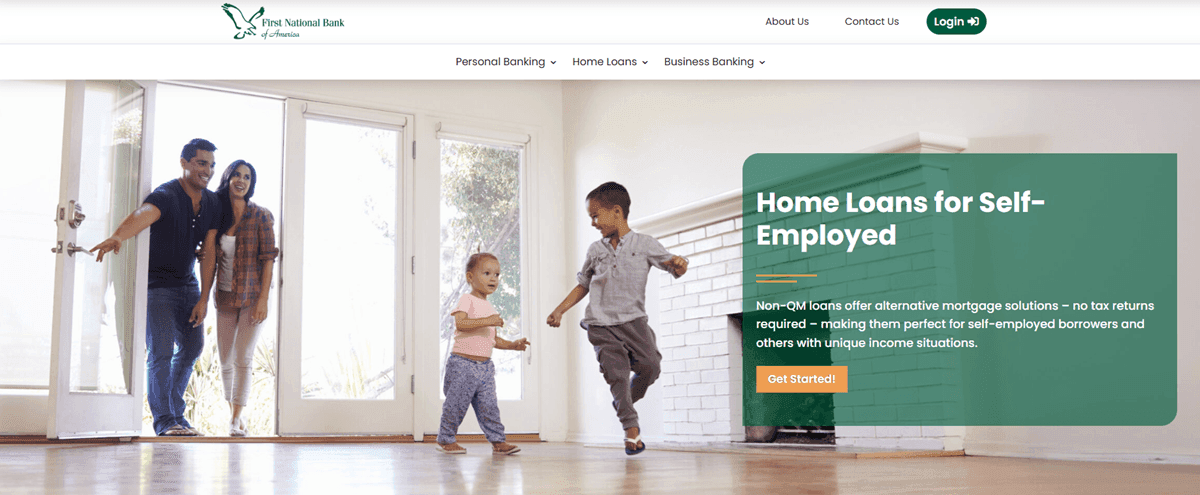
First National Bank of America (FNBA) operates as a portfolio commercial bank that retains loans on its own balance sheet. Because they do not answer to secondary market mortgage agencies, FNBA writes its own underwriting playbook. They stand out in the industry for accommodating 1099 contractors who carry substantial monthly liabilities, occasionally approving debt-to-income (DTI) ratios exceeding standard limits, potentially up to 50%–55% depending on the specific portfolio program and compensating factors.
Pros:
-
Exceptional debt-to-income flexibility reaching up to 55%–60%.
-
Direct portfolio decision-making without third-party investor restrictions.
-
Willingness to review complex financial profiles and unique residential properties.
-
Clear line of communication with internal credit underwriters.
Cons:
-
Traditional banking workflows can result in longer closing timelines.
-
Geographic program availability varies depending on the specific state.
#5 Angel Oak Loan Solutions
Best for: Established Non-QM Experience via Broker Networks
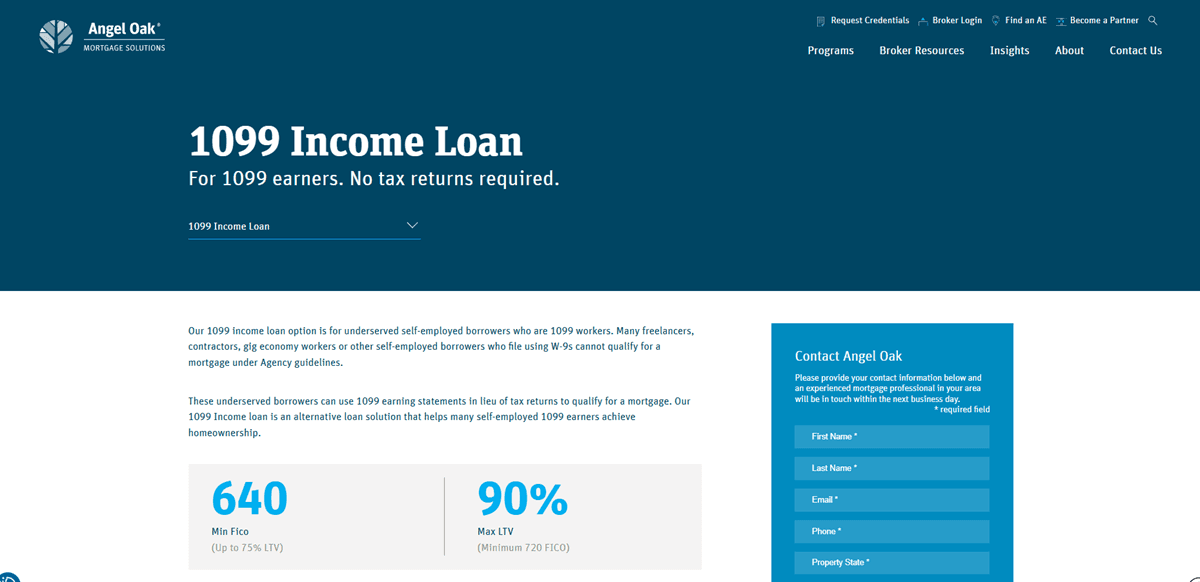
Angel Oak Loan Solutions is an industry pioneer in non-QM lending, maintaining deep capital backing and diverse product structures. Their 1099 program supports loan sizes up to $3 million and accommodates either a 12-month or 24-month revenue history. Because Angel Oak distributes its financing predominantly through wholesale channels, individual buyers access their rates and programs by working directly alongside licensed independent mortgage brokers.
Pros:
-
Exceptional institutional stability and deep alternative underwriting experience.
-
Generous borrowing limits often reaching $3 million or more for jumbo scenarios.
-
Straightforward documentation using 1 or 2 years of 1099 filings.
-
Broad availability through certified mortgage brokers across the country.
Cons:
-
No direct consumer retail portal. You must go through an approved broker.
-
Strict seasoning rules after major credit events like foreclosure.
#6 AD Mortgage
Best for: High Loan-to-Value (LTV) and No Private Mortgage Insurance (PMI)
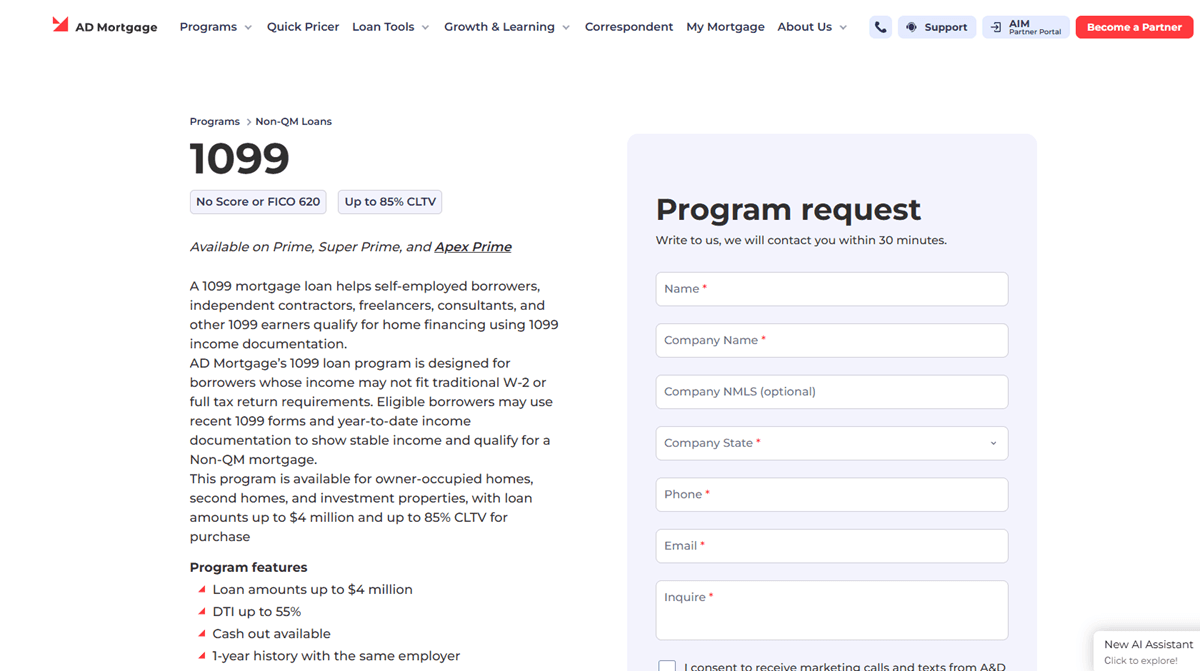
A&D Mortgage is a premier wholesale and retail lending powerhouse recognized for cutting-edge software and rapid file turnaround. For independent contractors seeking to conserve cash, A&D Mortgage offers 1099 financing with loan-to-value ratios up to 85% (or 90% with specific pricing adjustments), with options to minimize or structure mortgage insurance payments. They also permit single-year 1099 verification, simplifying your file preparation significantly.
Pros:
-
Requires no credit score or FICO 620 at least.
-
High LTV allowances up to 85%–90% that minimize upfront cash outlays.
-
Elimination of monthly private mortgage insurance (PMI) payments.
-
Fast pre-approvals via automated proprietary underwriting systems.
-
Accepts a streamlined 1-year 1099 track record.
Cons:
-
Peak LTV brackets require stellar credit and sizable post-closing reserves.
-
Primarily relies on mortgage broker distribution rather than localized branch offices.
How to Choose the Best 1099 Loan Lender?
Selecting the right 1099 lender is not about chasing the biggest brand. It is about aligning your specific cash flow with underwriting guidelines. Here is what you should evaluate:
-
Expense Ratio Formulas: Confirm whether the lender subtracts a fixed 10%, 20%, or demands a custom CPA letter.
-
Access Channel: Leading non-QM sources frequently work exclusively via wholesale brokers rather than direct consumer portals.
-
Credit and LTV Ratios: Ensure your FICO score unlocks low down payments without steep interest penalties.
-
Asset Reserves: Check whether you need three, six, or twelve months of liquid reserves post-closing.
-
Cost Transparency: Compare closing fees and origination charges across multiple loan estimates.
FAQs About 1099 Loan Lender
Q1. How is monthly income calculated on a 1099 mortgage?
Underwriters review your gross earnings across 12 or 24 months and deduct a standard expense ratio, usually 10%. The remaining 90% is divided across the evaluation period to determine qualifying monthly income without inspecting line-item deductions on your federal tax filings.
Q2. Are interest rates higher for 1099 loans compared to traditional mortgages?
Yes. Because non-QM loans carry higher portfolio risk and cannot be sold to government agencies, rates generally run 0.75% to 2.0% above conventional conforming benchmarks, varying with your down payment and credit history.
Q3. Can I qualify using only 1 year of 1099 forms?
Yes. Multiple progressive institutions, such as Newfi and A&D Mortgage, offer 1-year 1099 options, provided you can demonstrate previous employment stability or related experience within the same professional industry.
Q4. What is the difference between a 1099 loan and a bank statement loan?
A 1099 loan primarily uses 1099-NEC or MISC forms to calculate gross income, often supplemented by year-to-date bank statements. Bank statement loans, by contrast, rely exclusively on 12 to 24 months of deposit history without analyzing 1099 forms.
Q5. Can I get approved for a 1099 loan with a 620 credit score?
Yes. Certain lenders like Foundation Mortgage accept FICO scores starting at 620. However, expect to furnish a larger down payment (often 15% to 20%) and maintain around 3 to 6 months of liquid cash reserves.
Conclusion
Securing a home loan as an independent contractor does not require sacrificing legitimate tax deductions. A specialized 1099 mortgage bridges the gap between high gross revenue and strict underwriting criteria. Since non-QM guidelines vary widely, shopping around is vital. I encourage you to visit Bluerate to connect with experienced local loan officers for free and secure the best terms for your business.
People Also Read
